

Have you ever encountered lights in bars, theaters, or inspection settings that emit a faint purple glow-the kind that makes white shirts or fluorescent paints suddenly "light up"? These are known as LED UV "blacklight" floodlights. When encountering them for the first time, many buyers mistakenly assume they are simply "standard floodlights in a different color." This often leads to poor purchasing decisions: the lights may fail to trigger a fluorescent effect, or they might lack the specific technical specifications required for professional inspection tasks.
This article explores the differences between LED UV blacklight floodlights and standard floodlights-covering their operating principles, spectral characteristics, applications, and key purchasing considerations-to help you avoid common pitfalls.
What exactly is an LED UV blacklight floodlight?
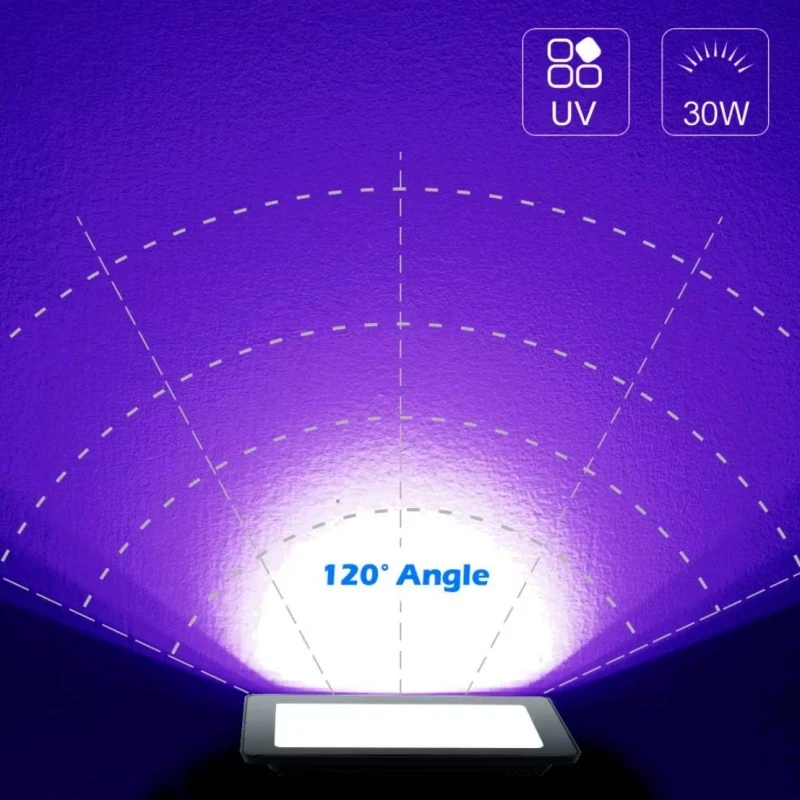
An LED UV blacklight floodlight is a wide-angle lighting fixture that uses ultraviolet LEDs as its light source. It primarily emits invisible light in the UVA spectrum (approximately 365–405 nm), accompanied by a faint, visible deep-purple glow. Its purpose is not to "illuminate a space" in the traditional sense, but rather to excite fluorescent substances, causing them to emit light.
The term "blacklight" refers to this type of light-largely invisible to the human eye, yet capable of making fluorescent materials glow. "Floodlight" indicates a wide beam angle, making it ideal for covering large areas evenly, such as stage backdrops, exhibition walls, or entire inspection workstations.
The core difference: Spectrum and wavelength
This is the most fundamental distinction between the two.
Standard floodlights: Emit visible light (approximately 400–700 nm) designed to help the human eye perceive the environment; they typically feature color temperatures ranging from 3000K to 6500K.
LED UV blacklight floodlights: Concentrate their output within the ultraviolet spectrum-most commonly at wavelengths of 365 nm, 385 nm, 395 nm, or 405 nm.
In short, standard floodlights provide "light for the human eye," while blacklights provide "light for fluorescent materials." If you shine a standard white light onto fluorescent pigment, you will only see the object's natural color; the characteristic glowing effect will not appear.
Differences in Light Sources and Optical Components
Light Source Chips: Standard floodlights use white LEDs (blue LED chips combined with phosphor), whereas UV floodlights utilize specialized ultraviolet LED chips. These are more costly and have more stringent requirements for heat dissipation.
Filtering and Lenses: High-quality UV lights employ optical materials that transmit ultraviolet light, such as quartz glass or specialized polycarbonate (PC). Standard glass or certain types of plastic absorb a portion of UV radiation, significantly reducing efficiency. Some products also incorporate optical filters to suppress visible light, resulting in a purer UV output.
Thermal Management: UV LEDs have a lower photoelectric conversion efficiency compared to white LEDs, generating more heat. Inadequate heat dissipation leads to accelerated light degradation (loss of brightness over time); therefore, the aluminum heat-dissipation structures in UV lights are typically engineered with greater precision.
Comparison of Application Scenarios
Standard floodlights are primarily used for:
Illuminating building facades, public squares, and parking lots.
Providing lighting for sports fields, warehouses, and nighttime operations at construction sites.
LED UV "blacklight" floodlights, by contrast, are used for:
Stage and Entertainment: Creating fluorescent effects in bars, nightclubs, themed parties, and theaters.
Fluorescent Inspection: Industrial flaw detection, penetrant testing, and anti-counterfeiting (e.g., verifying currency).
Art and Decoration: Fluorescent art exhibitions, theme parks, and immersive settings like escape rooms.
Other Specialized Uses: Artifact authentication, forensic investigation, and the examination of gemstones and minerals.
As can be seen, the value of blacklights lies in their ability to "create visual effects" and "facilitate detection," rather than in providing general illumination.
Key Parameters to Consider When Purchasing
Wavelength: For stage effects, 395nm or 405nm are common choices; they produce more visible purple light and offer a stronger visual impact. For inspection or detection purposes, 365nm is typically preferred due to its higher purity, which yields a cleaner, more distinct fluorescent response.
Power: Available in ranges from 10W to over 200W. Choose based on the required illumination distance and area-higher wattage is not necessarily better.
Beam Angle: Opt for a wide beam angle for large spaces, or a narrow beam angle to highlight specific areas.
Ingress Protection (IP) Rating: For outdoor use, an IP65 rating or higher is recommended.
Control Method: Stage applications may require DMX512 control, whereas inspection tasks generally only need a simple on/off switch.
Lumen Depreciation and Lifespan: Inquire about the supplier's L70 lifespan data and the design of the heat dissipation system.
Summary
While LED UV "blacklight" floodlights may resemble standard floodlights, they are fundamentally different products. The former emits ultraviolet light-used to trigger fluorescence, conduct inspections, or create atmospheric effects-while the latter emits visible light intended for general illumination. They differ significantly in terms of their light spectrum, LED chips, optical materials, thermal management, intended applications, and safety requirements.
When selecting a product, do not focus solely on wattage. First, clarify your specific purpose, then determine the appropriate wavelength, beam angle, and IP rating. This ensures you avoid purchasing a light that "turns on" but fails to deliver the desired effect.
Need help selecting the right UV blacklight floodlight for your project?
If you are looking for LED UV blacklight floodlights for stage productions, inspection tasks, or engineering projects, please get in touch with us. Let us know your intended application, illumination distance, and required wavelength; our team will recommend the ideal model and provide samples, price quotes, and OEM/ODM customization options.
Our address
No. 5-3 Niujiao Road, Yanchuan Community, Yanluo Subdistrict, Bao'an District, Shenzhen
benwei10@benweilighting.com






