

Basic Overview of Recessed Downlight Dimming Technology
Definition and Industry Demand of Downlight Dimming Function
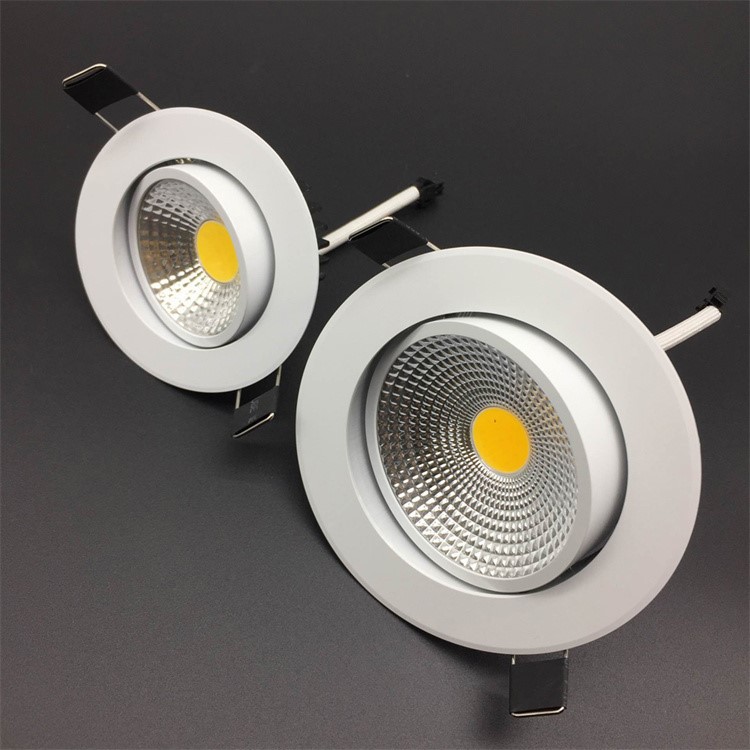
Recessed downlights, alternately defined as ceiling recessed luminaires or pot lights in North American electrical industry, are embedded ceiling lighting fixtures widely adopted in modern residential interiors, commercial office zones, hospitality venues and retail spaces. Featured with concealed installation, streamlined minimalist appearance and directional beam luminous performance, downlights dominate mainstream architectural lighting schemes. Downlight dimming refers to the adjustable luminous flux control technology that changes output brightness, correlated color temperature and operating power of recessed luminaires, which is a core function of layered intelligent indoor lighting. According to IEC 60598-2-22 embedded luminaire standard, qualified dimmable downlights support 10% to 100% stepless brightness adjustment, meeting ergonomic ambient lighting, task lighting and energy-saving operation demands for diversified indoor scenarios.
Core Judgment Basis for Downlight Dimmability
All recessed downlights possess theoretical dimmable potential, while actual dimming feasibility, operation stability and dimming smoothness depend on three decisive factors: built-in light source type, matched driving power module and external control dimming system. Non-dimmable components will cause abnormal operating phenomena including light flickering, low-frequency buzzing, incomplete dimming range and permanent circuit burnout. Unlike unified dimming control for traditional filament lamps, modern categorized downlights adopt differentiated targeted dimming technical solutions, which requires matched electrical accessories to achieve stable dimming effect.
Common Negative Phenomena Caused by Dimming Mismatch
Component mismatching is the primary cause of failed downlight dimming in on-site engineering application. Typical faults include periodic light strobing under low brightness, electromagnetic buzzing generated by mismatched switch load, minimum brightness dead zone that cannot be dimmed to soft night light mode, instantaneous lamp flash during power switching, and accelerated aging of lamp bead circuit. Long-term mismatched dimming operation will break down internal constant-current circuits, reduce the overall service life of downlights by more than 40%, and bring potential electric heating hazards to ceiling wiring structures.
Classified Dimming Principles and Applicable Solutions of Different Downlight Types
Dimming Mechanism of Traditional Incandescent & Halogen Downlights
Incandescent and halogen recessed downlights belong to resistive load light source products, the earliest mature dimmable recessed lighting applied in the lighting industry. The filament luminous structure relies on input voltage change to adjust heating temperature, so luminous brightness changes linearly with power supply voltage fluctuation. This category of downlights is compatible with universal TRIAC phase-cut dimming system without customized driver modification.
TRIAC forward phase-cut dimming is the standard control mode for resistive downlights. The triac dimmer switch cuts partial AC input waveform periodically to reduce effective working voltage transmitted to lamp body, lowering filament operating power to realize brightness reduction. The technical advantages lie in low accessory cost, wide compatibility, no extra wiring transformation and ultra-smooth stepless dimming effect. The main limitation is high operating heat generation and low energy utilization efficiency, gradually eliminated by energy-saving LED downlights in new building lighting projects.
Dimming Classification and Technical Rules of Conventional LED Downlights
LED downlights are mainstream energy-saving recessed luminaires with 50,000-hour rated lifespan and high electro-optical conversion efficiency. Different from resistive halogen lamps, LED chips belong to nonlinear constant-current load, which cannot adapt to ordinary TRIAC resistive dimmers directly. Professional customized digital dimming modes are required for stable brightness regulation, divided into PWM dimming and DALI digital dimming two mainstream technical routes.
PWM (Pulse Width Modulation) dimming is the most cost-effective analog dimming technology for civilian LED downlights. The built-in intelligent driver controls high-frequency current on-off cycle within millisecond unit, adjusting effective luminous duration of LED chips to change visual brightness. The human eye cannot capture high-frequency switching action, so the light presents uniform soft dimming effect. It features simple wiring, low failure rate and low transformation cost, suitable for household decentralized downlight dimming control.
DALI (Digital Addressable Lighting Interface) dimming is standardized industrial digital dimming protocol compliant with IEC 62386 global specification. It builds two-core independent digital signal circuit between DALI dimmer and dedicated LED driver, achieving independent address pairing, grouped dimming and fixed scene brightness preset. It supports 0.1% ultra-low deep dimming without flickering, applicable for high-end hotels, exhibition halls and commercial office centralized intelligent lighting management. Notably, ordinary constant-voltage LED drivers cannot support DALI signal interaction, users must select DALI-registered certified downlight components.
Intelligent Wireless Dimming System of Connected Smart Downlights
Smart downlights are upgraded IoT-enabled recessed luminaires embedded with built-in wireless communication modules, breaking the limitation of wall-mounted physical dimmer switches. Equipped with Bluetooth Mesh, 2.4G Wi-Fi or Zigbee communication modules, this type of dimmable downlight realizes remote wireless dimming, timing brightness adjustment and linkage scene control via dedicated mobile terminal applications.
Most branded smart downlights including Philips Hue, LIFX and Wiz integrate dual dimming modes: local manual switch dimming and cloud wireless APP dimming. Partial high-end models need matched central control gateway to realize whole-house downlight group control and interlocking dimming linkage. Compared with wired dimming, wireless smart dimming needs no wall dimmer embedding, reduces later circuit renovation cost, and supports synchronous color temperature switching while adjusting brightness, which is exclusive to intelligent modern lighting systems.
Key Compatibility Standards for Downlight Dimming Matching
Electrical Load Matching Between Dimmer and Light Source
Load parameter matching is the core premise of stable dimming. Traditional TRIAC dimmers are designed for high-power resistive load, not applicable for low-power capacitive LED downlights. Special LED-rated low-minimum-load dimmers must be equipped for LED recessed lamps to avoid low-light flickering. Meanwhile, total connected wattage of grouped downlights shall not exceed rated load upper limit of the dimmer switch, preventing dimmer internal circuit overload and burnout.
Driver Matching Restrictions for Dimmable LED Downlights
Each dimming mode corresponds to exclusive matched LED driving power. Non-dimmable constant-current drivers will lock LED brightness at fixed output, no external dimmer can adjust luminous flux. Purchasers need to verify driver parameter labels before installation: PWM-marked driver for analog dimming, DALI-logo driver for digital intelligent dimming. Cross-use of different drivers will cause permanent downlight light failure.
Environmental Factors Affecting On-Site Dimming Stability
Indoor electromagnetic interference, ceiling high temperature environment and shared circuit electrical equipment will affect dimming performance. High-power household electrical appliances on the same circuit will generate electromagnetic signal interference, leading to downlight buzzing during dimming. Closed heat-insulated ceiling space raises lamp operating temperature, interfering internal driver signal judgment and causing irregular brightness fluctuation.
Standardized Installation and Compliance Operation Specifications
Necessity of Licensed Electrician Professional Construction
Downlight dimming system transformation belongs to modified building electrical construction work, which must comply with local NEC, IEC and regional residential electrical safety codes. Professional licensed electricians complete circuit transformation, load testing, grounding protection and signal debugging work. Professional installation can standardize partition wiring, isolate dimming signal circuit from main power circuit, eliminate electric leakage risk, and verify full-load dimming stability before project delivery.
Pre-Purchase Verification Checklist for Dimmable Downlights
End users and engineering buyers shall confirm four core parameters before procurement: official factory dimming certification, compatible dimmer type, minimum dimming brightness value, and operating temperature resistance range. For batch commercial projects, sample dimming test is recommended to eliminate batch component compatibility risks, reducing later replacement and after-sales maintenance cost.
Daily Operation Maintenance for Dimmable Downlight Systems
Regular surface dust cleaning for downlight heat dissipation cavity ensures stable driver signal operation; avoid frequent extreme high-low dimming switching to prolong driver service life; replace aging wired dimmers every 5 years to prevent waveform distortion caused by component aging. Scientific daily maintenance keeps long-term smooth dimming performance of recessed downlights.
Comprehensive Conclusion
In conclusion, all categorized recessed downlights are technically dimmable with matched supporting control components, and dimming feasibility depends on light source type, built-in driver configuration and external dimmer compatibility. Traditional halogen and incandescent downlights adopt universal TRIAC phase-cut dimming with low matching difficulty; ordinary LED downlights require dedicated PWM analog dimming or DALI digital dimming according to driver specifications; Wi-Fi and Bluetooth integrated smart downlights support wireless APP remote intelligent dimming. Mismatched switches, unmatched drivers and non-standard wiring will trigger flickering, buzzing and lamp damage faults. To obtain efficient, stable and safe dimming effect, users should select classified matched dimming accessories, abide by electrical industry standards, and adopt professional electrician installation. Reasonable collocation of dimmable downlight systems can optimize indoor light atmosphere, realize on-demand energy control, and maximize the practical and decorative value of embedded ceiling lighting.

How To Cooperate With Us?
Having its own factory gives our firm complete control over the production process and the quality of our goods, which we take great pride in. We are manufacturers, not only brokers, committed to offering our clients the lowest costs. We invite consumers to evaluate our samples first since we are certain that the cost and quality of our items are evident. Our dedication to excellence and client happiness motivates us to consistently provide superior products.
Our address
3rd Floor, 5th Building, Hebei Industrial Park, Hualian Community, Longhua District, Shenzhen, China





