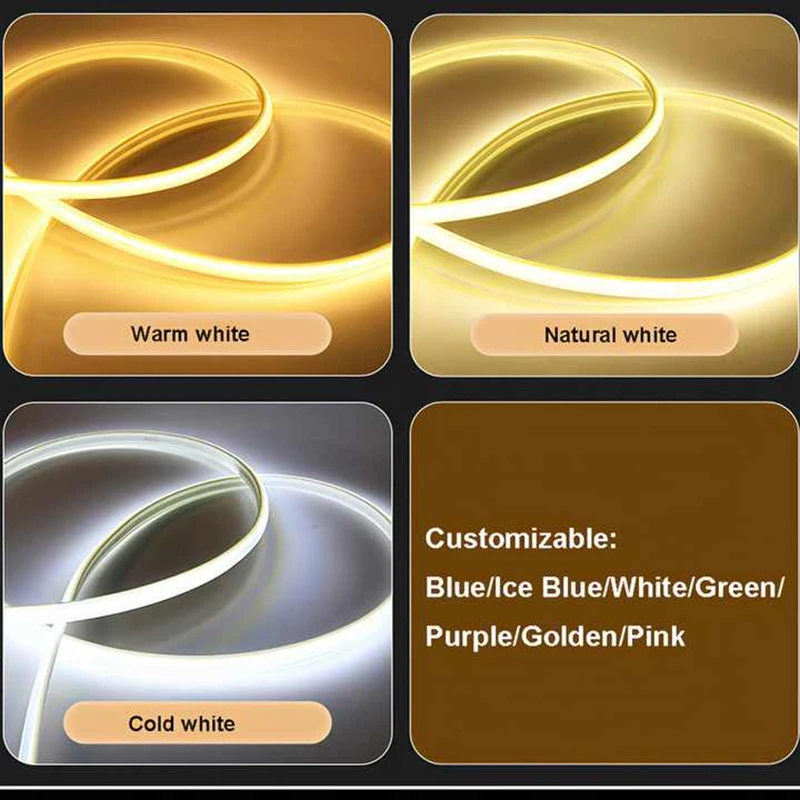
LED strips serve as a key element for ambient lighting in settings such as commercial display cases, residential interiors, and commercial spaces utilizing "lamp-free" (recessed/hidden) lighting designs. The market is primarily divided into COB strips and traditional SMD strips. When selecting products, buyers and interior designers often struggle most with the issue of light uniformity; the visible difference in light output between the two types directly impacts display aesthetics, the quality of the space, and the customer experience.
This article compares COB and SMD strips with a focus on light uniformity, breaking down their light source structures, illumination performance, and typical application scenarios. It clearly outlines the pros and cons of each to help you quickly select the right product for your project needs.
Structural Differences: COB vs. SMD LED Strips
SMD LED Strips
Traditional SMD strips consist of discrete LED chips mounted on a circuit board. Each chip acts as a point-light source with fixed spacing between them. While an external diffusing layer helps soften the light, it cannot eliminate the alternating light and dark zones caused by the gaps between individual chips.
COB LED Strips
COB strips feature dozens of miniature LED chips densely packed onto a single substrate. A continuous layer of phosphor-infused encapsulant covers the entire assembly, creating a seamless, continuous light-emitting surface. There are no visible individual chips or gaps, effectively eliminating the point-source structure at the fundamental level.
Core Comparison: Detailed Differences in Light Uniformity
Light Spots and Dark Zones
SMD Strips: When viewed up close, distinct bright spots are visible, with noticeable dark lines or zones between the chips. If the strip is mounted at a distance from the wall, these alternating light and dark bands become even more pronounced, resulting in significant light-and-shadow fragmentation when used for linear wall-washing or cabinet accent lighting.
COB Strips: These provide a uniform, continuous light source across the entire strip, free from "dotting" effects or alternating light and dark intervals. The light output is smooth and seamless; whether mounted close to a cabinet or used for wall-washing from a distance, there is no segmented lighting effect-only a complete, soft, linear band of light.
Light Softening and Anti-Glare Capabilities
SMD strips are limited by their point-source nature; even with thickened light-diffusing sleeves, they only slightly soften light spots. Under high-intensity settings, harsh, glaring hotspots remain, which can cause visual discomfort due to perceived flicker.
COB strips feature a continuous light-emitting surface that disperses light intensity, naturally producing soft, diffused light. They achieve low-glare output without extra diffusing accessories, resulting in natural light transitions free from harsh, localized hotspots.
Color Uniformity
In multi-color temperature or RGB scenarios, individual SMD chips exhibit slight variations in color temperature and chromaticity. Once illuminated, the strip may show localized shifts toward cooler or warmer (yellowish) tones and visible color banding.
COB strips feature chips uniformly encapsulated on a single substrate and fully covered by phosphor, ensuring highly consistent color temperature and output. There is no color variation across the strip, making high-CRI versions ideal for illuminating exhibits, apparel, and artworks.
Light Output Stability After Bending
Installation often requires bending around corners; with SMD strips, bending causes chip displacement, leading to distorted light-and-dark patterns and enlarged dark zones at the corners.
COB strips feature an integrated light-emitting layer that remains intact after bending; no distinct dark segments appear at corners, ensuring the continuity of the linear light effect regardless of the installation shape.
Differences in Ancillary Performance (Beyond Light Output)
Heat Dissipation and Lumen Depreciation (Indirectly Affecting Long-Term Consistency)
SMD chips dissipate heat independently, concentrating it at specific points. This leads to faster localized lumen depreciation over time, causing noticeable brightness disparities across the strip after six months of use.
COB chips are mounted over a large area on a thermally conductive substrate, allowing heat to disperse evenly. Lumen depreciation occurs uniformly across the strip, maintaining stable, even light output without localized dimming.
Beam Angle Uniformity
SMD point sources project light in a concentrated manner, resulting in a bright center and darker edges. COB strips emit light from a flat surface with a uniform diffusion angle, ensuring consistent brightness across all directions-up, down, left, and right-during wall-washing or shelf lighting applications.
Installation Tolerance
With SMD LED strips, even slight unevenness in the wall or cabinet surface causes noticeable fragmentation in the light spots; COB strips, featuring a continuous light-emitting surface, offer greater tolerance, meaning minor installation errors do not compromise the uniformity of the light strip's appearance.
Application Scenarios: Choosing Between the Two
COB LED Strips (Recommended for High Uniformity Requirements)
Ideal for clothing store windows, jewelry display cases, art galleries, TV background wall-washing, ambient lighting in luxury homes (without central ceiling lights), high-end cabinet shelf lighting, and linear ambient lighting in hotels; suitable for high-end commercial projects requiring seamless, soft linear light free from color spots or dark patches.
SMD LED Strips (Suitable for Basic, Simple Lighting)
Suitable for supplementary lighting in standard home ceilings, decorative lighting for temporary events, budget-friendly advertising light boxes, and basic lighting in underground garages; ideal for basic lighting needs where budgets are limited and strict uniformity of light and shadow is not required.
Summary
In terms of light uniformity, COB LED strips are vastly superior to traditional SMD strips. The fundamental reason lies in their differing light source structures: SMD strips use discrete LED beads, which inherently suffer from issues like gaps between light and dark areas, color variations, and visible light-spot granularity; in contrast, COB strips feature an integrated, continuous light-emitting surface that eliminates issues such as light gaps, color inconsistency, and glare at the source level, while also offering more balanced heat dissipation and stable, non-degrading light output over long-term use.
If your project focuses on high-end displays, linear wall-washing, or refined home ambiance-and you seek smooth, uniform light without visible granularity-COB LED strips are the optimal choice. For basic, simple supplementary lighting or projects with limited budgets, SMD LED strips are a suitable option. Neither is inherently "better" or "worse"; the choice depends entirely on the project's specific requirements for light and shadow quality.
If you are sourcing high-uniformity COB LED strips, custom color temperature/RGB/waterproof specification strips, or need to compare samples with different wattages and voltages, our factory supports OEM/ODM customization. We maintain ample stock of our full COB and SMD series and can provide free samples for lighting effect testing as well as detailed specification sheets and quotes. Please feel free to contact us anytime for professional lighting selection advice and bulk purchasing discounts!