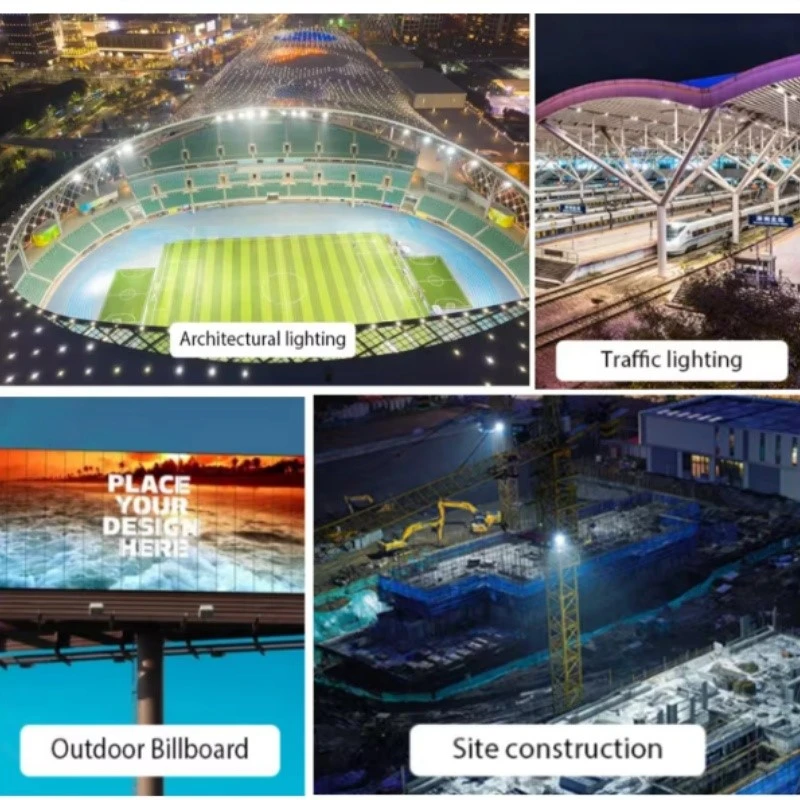
For professional sports venues hosting competitions, high-definition live streaming and 4K slow-motion replays have become standard requirements. When purchasing LED floodlights, many venues focus solely on brightness and glare control while overlooking the critical impact of color temperature on camera imaging. Inappropriate color temperatures can lead to color shifts in jerseys, a grayish appearance on the turf, and distorted skin tones; this necessitates extensive color correction during post-production and severely compromises the viewing experience.
Organizations such as FIFA, UEFA, and professional leagues have established clear standards for lighting color temperatures in broadcast-grade venues. This article analyzes the standards regarding camera compatibility, covering the ideal color temperature ranges for live broadcasting, the visual effects associated with different temperatures, key technical parameters, and common pitfalls to avoid during selection. It aims to help contractors and venue operators accurately select broadcast-specific sports LED lighting.
Standard Color Temperature Ranges for Broadcast-Specific Sports LED Lighting
Based on official lighting specifications from organizations like FIFA, UEFA, MLB, and La Liga, the standard color temperature ranges compatible with broadcast cameras fall into two categories:
Professional HD/4K Live Broadcasts: A fixed range of 5000K–5700K (with an allowable tolerance of ±200K); this is the standard range adopted by mainstream professional venues worldwide.
Basic Broadcasts for Campus or Amateur Events: 4000K–5000K (neutral white light); this meets basic filming needs but does not support slow-motion or ultra-high-definition (UHD) broadcasting.
Ranges Not Recommended: Warm white light below 4000K and cool white light above 6200K; these ranges make camera white balance calibration difficult and result in significant color distortion, making them unsuitable for official live broadcasts.
Comparison of Imaging Differences Under Different Color Temperatures
3000K–4000K Warm White Light
The light has a yellowish cast, making it difficult for the camera's automatic white balance to stabilize. Issues include reddish player skin tones, yellowish distortion of the green turf, and shifted color saturation in team jerseys. Noticeable color casts appear in slow-motion footage; this lighting is suitable only for daily training grounds where no live broadcasting takes place.
4000K–5000K Neutral White Light
The image colors are relatively soft, making it barely adequate for basic filming; however, the light lacks the quality of natural daylight, the contrast between light and dark areas on the field is insufficient, and contrast in high-speed action shots is weak. HD broadcast images appear washed out or grayish; this range is mostly used for small-scale amateur events.
5000K–5700K True Daylight White
Simulates natural midday sunlight; camera sensors are natively optimized for this spectrum. It accurately reproduces the green of the turf, the red and blue of jerseys, and human skin tones. The image is crisp and well-defined, with no color shifting in 4K/8K slow-motion footage. It requires minimal post-production color grading and is the optimal color temperature for broadcasting.
Above 6000K Cool White Light
The blue light component is excessively high, giving the camera image a greenish-blue cast. Shadow areas appear dark, and players' faces look unnaturally pale. Prolonged viewing feels harsh and unnatural, and the light tends to exacerbate glare, interfering with players' vision; it does not meet international standards for event lighting.
Why 5000K–5700K is the Optimal Range for Live Broadcasting
Matches Camera Spectral Sensitivity
Color sensors in professional broadcast and cinema-grade cameras are calibrated to midday sunlight (around 5500K). This color temperature offers a balanced spectral distribution and uniform RGB output, minimizing the effort required for white balance adjustment and ensuring consistent color across multi-camera setups.
Balances On-Site Visibility with Screen Viewing Experience
Light in this range is neither dull like warm light nor glaring like ultra-cool white light. It ensures visual comfort for players and spectators on-site while delivering realistic colors in the broadcast, rendering turf, event logos, and jersey details with clarity and depth.
Meets Unified Global Event Certification Standards
Venues hosting top-tier FIFA events, the World Cup, and major leagues (such as the "Big Five" European leagues) require lighting with a color temperature of 5000K ± 200K. Using fixtures within this range ensures immediate compliance with event lighting inspections, eliminating the need for costly lighting system retrofits.
Controllable color temperature consistency to minimize visual banding
High-quality broadcast-grade LED sports lights undergo strict binning and temperature control, ensuring color temperature fluctuations across the entire fixture remain within ±200K. With uniform color temperature across all lights, camera pans across the field avoid disjointed visuals where some areas appear yellowish while others look greenish.
Core supporting metrics for color temperature and high-definition broadcasting
Color temperature is merely the foundation; for stable camera imaging, the following parameters must be met simultaneously-none can be omitted:
CRI (Color Rendering Index)
≥90 for professional broadcasting (CRI 95 is preferable); high color rendering is essential to accurately reproduce the true colors of jerseys, the playing surface, and skin tones, compensating for color deficiencies beyond just color temperature.
TLCI (Television Lighting Consistency Index)
A specialized evaluation standard for cameras; ≥85 for HD live broadcasts and ≥90 for 4K slow-motion; it directly reflects color stability under the lens and aligns better with broadcasting requirements than CRI.
Absence of high-frequency flicker
Driver power supply flicker depth <1%; this prevents banding or ghosting artifacts during slow-motion replays and is a mandatory requirement for live sports broadcasting.
Duv (color deviation value) ≤ ±0.005
Ensures pure white light without green or pink tints, maintaining consistent color tones when switching between multiple camera angles.
Color temperature selection schemes based on event level
International professional events (World Cup, major league home stadiums)
Fixed at 5500K with color temperature fluctuation controlled within ±100K; CRI ≥90 and TLCI ≥90; utilizes a full suite of broadcast-grade LED sports lights.
Municipal professional venues and commercial event broadcasts
Selectable within the 5000K–5700K range (5200K–5500K preferred); suitable for standard HD live broadcasts and short-form video recording.
Campus and community sports fields (occasional simple broadcasts)
4500K–5000K neutral white light; suitable for limited budgets; does not support 4K slow-motion broadcasting.
Daily training only; no filming requirements
Warm white (3000K–4000K) or cool white (6000K) are both acceptable; camera compatibility need not be considered.
Summary
Based on a comprehensive assessment of camera compatibility, international competition standards, and image quality, "daylight white" (5000K–5700K) is the only recommended color temperature for broadcast-grade LED sports floodlights, with 5500K serving as the gold standard.
Warm light below 4000K or cool light above 6000K causes severe color shifts in cameras, making them unsuitable for live broadcasts of official competitions; the 4000K–5000K range is suitable only for basic filming without high-definition slow-motion capabilities.
When selecting products, one must not look at color temperature alone; it is essential to simultaneously verify four key parameters-CRI, TLCI, flicker, and Duv-to ensure a balance between on-site visual experience and broadcast image quality, thereby passing lighting inspections on the first attempt and avoiding costly retrofitting or rework.
If you are sourcing broadcast-grade LED sports floodlights for professional arenas or campus sports fields and require professional-grade fixtures featuring 5000K/5500K standard color temperature, CRI 90+, TLCI 90, and flicker-free performance, we offer customization options for power, beam angle, and color temperature. We also provide DIALUX lighting simulations, reports on compliance with competition standards, and product samples for testing. Please feel free to contact us for bulk pricing and comprehensive stadium lighting solutions!