

You could be considering replacing any outdated lighting fixtures in your residence and encounter a certain form element. What is the process for purchasing an LED retrofit replacement?
Presented above is a five-step strategy for acquiring a BR30 LED light.
Characterising a BR30 light
BR30 lights are roughly 5 inches in length and little under 4 inches in diameter. They are within the group of directed lighting types, characterised by a generally "wide flood" beam angle.
Initially, let us analyse the acronym. BR denotes "Bulged Reflector," referring to the outward bulge encountered when moving away from the socket, or the flared configuration of the lamp body. This contrasts with a PAR or MR-shaped bulb.
The bulge of incandescent BR30 lamps is designed to facilitate a broad flood beam of 120 degrees or greater. The reflector's flaring design allows the light emitted from the filament to disperse over a broad angle.
Subsequently, we examine the numeral "30." In most lighting devices, the number indicates the lamp diameter in eighths of an inch. The "30" denotes a lamp diameter of 30/8 inches, equivalent to 3.75 inches.
LED lights have retained the BR30 form factor designation. BR30 LED lights, while comparable in size to PAR30 LED lamps, are distinguished largely by their broader beam angle. Mechanically, this is often achieved using a subtly bulged and frosted diffuser cover on a BR30 LED lamp, in contrast to a transparent, collimating lens on a PAR30 LED lamp.
Ascertain the requisite lumens (or comparable watts) needed
Primarily, you must verify that while substituting your incandescent BR30 light with a BR30 LED, you achieve equivalent brightness as previously.
You may be inclined to associate bulb brightness with wattage; a 40-watt bulb is perceived as brighter than a 60-watt light.
However, it is important to remember that watts quantify electrical energy input, rather than the whole light output.
This method was a valid means of estimating brightness, given most incandescent bulbs exhibit similar efficiency levels.
BR30 LED lights have much greater efficiency compared to incandescent BR30 bulbs. This indicates that watts is no longer an effective metric for brightness.
Rather of concentrating on watts consumed, one should prioritise the light output, quantified in lumens.
Uncertain about the required lumens? One may approximate the requirements based on the prior installation before transitioning to LEDs.
This may be computed using an estimated conversion factor of 10 lumens per watt.
Lumens = [watts in incandescent] × 10
For instance, a 65W incandescent BR30 bulb may yield an estimated lumen output of 650 lumens by multiplying 65W by 10.
The lumens count is shown in the product specs.
Manufacturers sometimes include wattage equivalence (e.g., "Equivalent to a 65W incandescent") for user convenience. Regrettably, there is a lack of regulation regarding wattage equivalence claims, leading some manufacturers to be somewhat lenient in their arguments for asserting elevated wattage equivalency.
Although we suggest utilising the 10 lumens-per-watt conversion factor for ease, Energy Star standards indicate that a more precise conversion factor varies with the lamp's wattage, ranging from 10 lumens per watt at lower wattages to 15.0 lumens per watt at higher wattages. For lamps with a power of 100 watts or above, it is advisable to employ a larger conversion factor in accordance with Energy Star regulations.
Note that these conversion factors are inferior to those employed for A-style lamps, aligning with the observation that incandescent reflector lights generally exhibit somewhat worse efficiency.
The table below presents the luminous output equivalencies for different wattages in 5-watt increments:
40 watts = 400 lumens* 45 watts = 450 lumens* 50 watts = 500 lumens* 55 watts = 605 lumens
Verify that the beam angle is roughly 120 degrees (broad flood).
When examining the specs of a BR30 LED bulb, verify that the beam angle is roughly 120 degrees, sometimes referred to as a "wide flood" beam angle.
What is the significance of this?
The perceived brightness of an item is mostly dictated by the number of light particles that strike a surface (illuminance, quantified in lux). Lumens quantify the amount of light emitted from a light source, although they provide no insight about the directionality of that light.
The lamp's beam angle is a crucial characteristic that indicates the dispersion of output light, eventually affecting the illuminance provided across a given region.
We elaborate on this topic in our post on the distinction between lumens and lux.
Sudden alterations to beam angles, such as narrowing to 60 degrees, may unintentionally create illumination "hotspots," resulting in certain areas seeming excessively bright while others remain dull.
Assess light colour - Correlated Colour Temperature (CCT) and Colour Rendering Index (CRI)
Incandescent BR30 lights offered little choice in colour; virtually all models from all manufacturers exhibited the same colour temperature (2700K) and colour quality (100 CRI).
BR30 LED lights provide several possibilities for colour temperature and CRI, complicating the selection process for optimal suitability.
Select 2700K BR30 LED lamps for colour temperature.
Colour temperature quantifies the degree of "yellow" or "blue" in a light's hue.
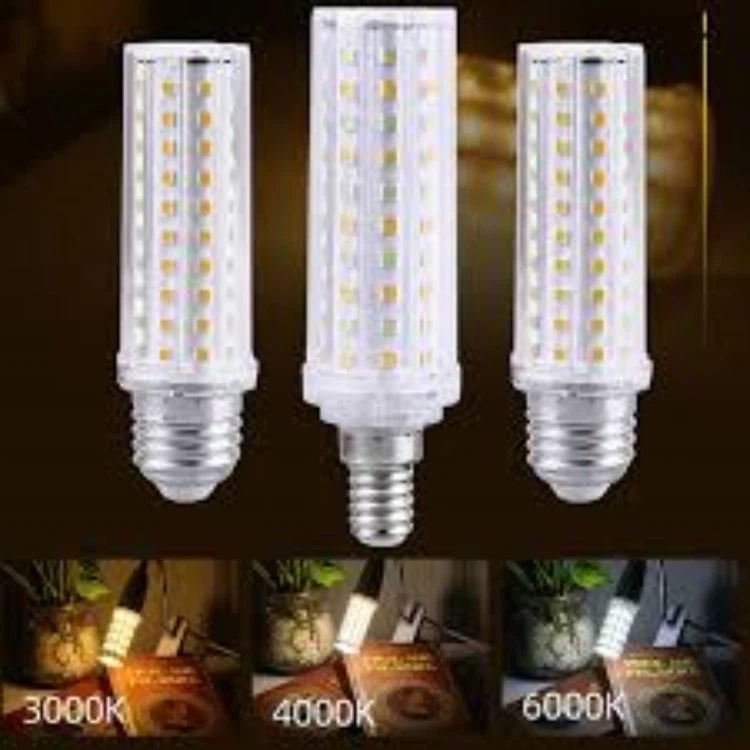
2700K is equivalent to the colour of traditional incandescent light bulbs. 3000K has a little bluer hue, resembling halogen bulb light, yet retains a warm, welcoming yellow tone.
4000K is commonly referred to as "neutral white" because to its absence of blue or yellow tones, positioning it near the midpoint of the colour temperature spectrum.
Any temperature beyond 5000K will have a bluish hue and is not advisable for typical home use, but it is frequently favoured for artistic and studio purposes.
Illumination for your residence is really a subjective decision; nonetheless, we suggest beginning with 2700K BR30 LED bulbs for experimentation. If you believe it emits an excessive "yellow" tint, you may contemplate transitioning to 3000K. Note that the 3000K will operate marginally "cooler" or "crisper" than an incandescent BR30 bulb.
CRI: choose 90 or higher. The Colour Rendering Index (CRI) can be rather complex to comprehend, as it is not readily apparent when merely observing a BR30 LED light directly.
CRI is a value from 0 to 100 that assesses the accuracy of item appearance under illumination. A higher score indicates greater accuracy.
What is the true definition of accuracy?
Suppose you are attempting to illuminate a picture. An impeccably precise BR30 LED lamp would render the artwork identical to its appearance under a halogen bulb.
A low CRI BR30 LED bulb would render the artwork inaccurately, causing the colours to appear mismatched, washed out, or indistinguishable.
This extends beyond paintings or artwork. The visual quality of furniture or food may seem colourless and drab if the LED bulb has an inadequate Colour Rendering Index (CRI).
What is an adequate CRI value?
We advise acquiring BR30 LED bulbs with a minimum Colour Rendering Index of 90.
For improved aesthetics, we advise a CRI of 95 or above.
How can one ascertain the CCT or CRI of a BR30 LED lamp? Nearly all manufacturers may include this information on the product specification sheet or package.
Is a dimmable BR30 LED light required?
An incandescent BR30 bulb is a basic apparatus that warms a filament to an elevated temperature (2700 Kelvin), resulting in light emission. Dimming a bulb is quite simple; by restricting the electrical current to the lamp, the filament cools, hence reducing light output.
The majority of dimmer circuits often placed in residential settings function based on this concept, referred to as TRIAC.
BR30 LED bulbs are complex, functioning as genuine electrical devices. Without the integration of specialised electrical circuits inside the light, automatic compatibility with dimmer systems is not achieved.
Dimming an LED not designated as dimmable may lead to unpredictable flickering or buzzing noises, and in rare instances, pose safety risks.
Ensure that the BR30 light is marked as compatible with dimmers if a dimmer is fitted if dimmability is needed.

Shenzhen Benwei Lighting Technology Co., Ltd was established in 2010. It is a national high-tech enterprise integrating design, R&D, production and sales of indoor and outdoor lighting products and also can do OEM ,ODM .For more details about our offerings, please contact us at bwzm18@ledbenweilighting.com





