

Introduction: The Lifespan Dilemma in Modern Lighting
The Illusion of the "Long-Lasting" LED
Over the past decade, Light Emitting Diodes (LEDs) have completely revolutionized the lighting industry. Consumers have been universally told that LEDs last 50,000 hours or more, effectively meaning you will never have to change a lightbulb again. However, the reality in the field is often starkly different. Many inexpensive LED fixtures fail prematurely-sometimes within a year or two-suffering from severe lumen depreciation (dimming), color shift (turning yellow or blue), or catastrophic driver failure.
The Hidden Cost of Cheap Components
The root cause of this premature failure is a systemic issue in the manufacturing sector: the prioritization of low upfront costs over long-term durability. Manufacturers often use low-grade LED chips, flimsy plastic housings, and inadequate thermal management to hit aggressive price points. The hidden cost to the consumer is immense. Replacing recessed lighting is not as simple as changing a bulb; it often requires hiring an electrician, dealing with faulty wiring, and sometimes even patching drywall.
Why Recessed Lighting Failures Are Uniquely Problematic
A failed recessed downlight is a headache. Because they are hidden in the ceiling, they are difficult to access. In a kitchen or a high-ceilinged living room, a flickering or dead downlight is not just an aesthetic nuisance; it is a significant logistical and financial burden. Therefore, when selecting recessed lighting, the metric of "longevity" is not just a nice-to-have feature-it is the most critical investment criterion.
The Physics of LED Failure
To understand how to prevent failure, one must first understand the mechanisms of failure. LEDs do not typically "burn out" in the traditional sense like an incandescent filament snapping. Instead, they degrade.
Thermal Degradation: The Silent Killer
The primary enemy of LED technology is heat. While LEDs are highly efficient at converting electricity into light, they are not 100% efficient. A significant portion of the energy is still converted into heat. This heat is concentrated in a microscopic area within the LED chip known as the "junction." If this heat cannot be effectively extracted and dissipated into the ambient environment, the junction temperature skyrockets.
The Domino Effect of Poor Thermal Management
When the junction temperature exceeds safe operating limits (typically above 85°C or 185°F), a destructive domino effect occurs:
Lumen Depreciation: The light output drops precipitously. The room becomes noticeably dimmer.
Color Shift: The phosphor coating on the LED degrades, causing the light to shift from a crisp white to a sickly yellow or an unnatural blue.
Driver Failure: The excess heat cooks the sensitive capacitors and microchips on the power supply board, leading to flickering or total failure.
Thesis Statement
This paper posits that the Recessed COB Downlight represents the pinnacle of LED longevity because it solves the heat problem at its source. Through an exhaustive technical deep dive into its structural anatomy, this article will demonstrate that the combination of a highly efficient COB chip, an ultra-massive Seiko die-cast aluminum heat sink, and a smart IC driver creates a closed-loop system of thermal and electrical stability. This architecture guarantees ultimate longevity, making it a definitive, long-term investment for any modern space.
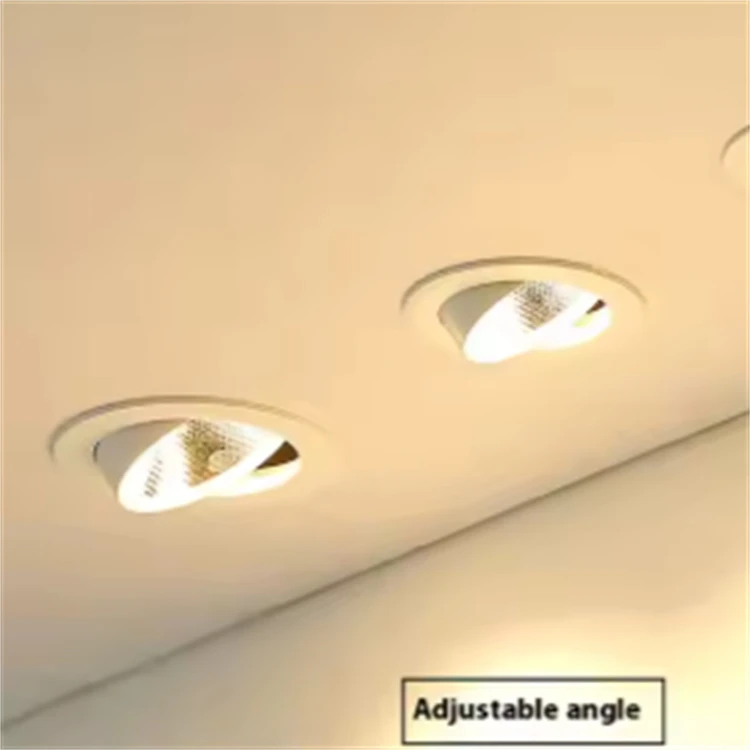
The Heart of Longevity: The COB (Chip-on-Board) Advantage
Deconstructing COB Technology
At the core of this fixture lies the COB (Chip-on-Board) light source. This is a fundamentally different technology from the more common SMD (Surface Mount Device) LEDs used in cheaper fixtures.
From SMD to COB: A Structural Evolution
SMD LEDs are essentially tiny individual LED chips mounted onto a substrate, usually looking like a grid of distinct yellow dots. They are arranged in a matrix to create the desired brightness. COB technology, conversely, involves mounting multiple LED dies directly onto a single, highly thermally conductive substrate (like aluminum or ceramic), and then coating the entire cluster with a single continuous layer of phosphor.
The Engineering Superiority of Single-Module Design
This single-module design offers profound advantages for longevity.
Fewer Failure Points: In an SMD fixture, if one individual diode fails, it creates a visible dark spot and can sometimes break the entire electrical circuit. A COB chip is a single, robust macro-chip. It is highly resistant to individual die failures.
Better Heat Distribution: The direct mounting onto the substrate allows for vastly superior heat transfer away from the junction. The heat is spread evenly across the entire module, rather than being concentrated in tiny, isolated hotspots.
Light Quality and Longevity: The Symbiotic Relationship
The COB chip does not just last longer; it produces a superior quality of light that remains stable over time.
Uniform Luminance and Glare Reduction
Because the COB chip is a single, densely packed module, it produces a highly uniform light source. There are no "multi-shadow" effects or the "dotted" light patterns common with SMDs. As the product literature correctly notes, it "Glows evenly, break through brightness again." When paired with the deep-set honeycomb reflector, this uniform source is diffused into a soft, comfortable beam, reducing eye strain and visual fatigue.
High Efficiency = Less Heat
The COB chip utilized in this fixture is engineered for "Good effect, long life." It boasts high luminous efficacy, meaning it converts a higher percentage of electrical energy into visible light, and less into waste heat. By generating less heat at the source, it inherently reduces the burden on the thermal management system, further extending the lifespan of the entire fixture.
The Skeleton of Longevity: Die-Cast Aluminum Heat Dissipation
While the COB chip generates less heat, it still requires a sophisticated system to dissipate that heat into the room. This is where the Recessed COB Downlight truly distinguishes itself from the competition.
The Anatomy of the Heat Sink
The back of this downlight is dominated by a massive, intricately designed heat sink constructed from "Seiko aluminum die-casting molding." This is not a thin, stamped piece of metal; it is a substantial, solid block of high-grade aluminum.
The Physics of Die-Cast Aluminum
Aluminum is renowned in engineering for its exceptional thermal conductivity. It transfers heat rapidly away from the source. The die-casting process allows for the creation of complex, highly efficient geometries that would be impossible to achieve with stamped metal.
The Radial Fin Geometry: Maximizing Surface Area
The true genius of the heat sink lies in its radial fin design. The deep, thick fins dramatically increase the surface area of the fixture. Heat from the COB chip is conducted into the central core of the heat sink and then radiates outward along the fins. The ambient air circulates between these fins, drawing the heat away through convection.
The Closed Back Cover: A Revolution in Safety and Longevity
An often-overlooked detail that massively impacts longevity is the "Closed aluminum alloy back cover."
Preventing Insulation Contamination
Many cheap recessed lights have an open back, allowing the electronic components and the LED chip to be exposed to the attic or ceiling cavity. This allows loose-fill insulation, dust, and pests to enter the fixture. When insulation covers the back of a hot LED, it acts as a blanket, trapping heat and causing catastrophic failure. The closed design of this product ensures that the heat sink is always exposed to the air, guaranteeing optimal thermal dissipation.
"Closed is Safer": Fire Safety and Durability
Beyond thermal performance, the closed cover is a critical safety feature. It physically separates the hot electronic components from combustible ceiling materials. This prevents fire hazards and also protects the internal components from moisture, dust, and corrosion, significantly extending the mechanical lifespan of the fixture.
The Nervous System of Longevity: Intelligent IC Driver & Optical Resilience
A light fixture is an ecosystem. Even with a great chip and heat sink, a poor power supply will kill the fixture prematurely.
The Intelligent IC Driver: Stable Power for a Long Life
The integrated "Intelligent IC driver" is the brain of the operation, ensuring the electrical current is perfectly regulated.
Constant Current Control and Flicker-Free Operation
LEDs are incredibly sensitive to voltage fluctuations. If the voltage spikes or drops, the LED will flicker, and the internal components will degrade rapidly. The IC driver utilizes an advanced automatic control circuit to provide a stable, constant current to the COB chip. This ensures "Stable voltage, safe" operation. It completely eliminates flicker, which not only protects your eyes but also protects the delicate phosphor coating on the LED, ensuring the light remains consistent and bright for years.
Integrated Power Supply Design
By combining the lamp body and power supply into a single, robust unit, the manufacturer has eliminated the need for external drivers (which are often the first point of failure in traditional LED systems). The driver is built into the base of the fixture, protected by the aluminum housing, ensuring a longer, more reliable service life.
Optical Resilience: Materials that Withstand Time
Longevity also applies to the optical components.
High Reflective Mask (Honeycomb Reflector)
The geometric, diamond-patterned honeycomb reflector is designed to "Lend height to make shops more brilliant." It is made from high-quality materials that resist yellowing and UV degradation. Unlike cheap plastic reflectors that become brittle and discolored over time, this metallic reflector maintains its high reflectivity, ensuring that the light output remains bright and pure.
Lens Scattering Beads
The fine soft light mask with lens scattering beads is engineered to "Increase the scattering surface to soften the light." These micro-structures ensure the light is evenly diffused without causing glare. The material used is highly durable, resisting the thermal stress of the LED chip, ensuring that the optical performance does not degrade over the lifespan of the fixture.
Realizing the Investment: The Economic and Practical Value of Longevity
When you purchase the Recessed COB Downlight, you are not just buying a light fixture; you are buying a decade of peace of mind.
Reduced Maintenance Costs: The "No Ladder" Rule
The most immediate and tangible benefit of ultimate longevity is the total elimination of maintenance headaches. Traditional fixtures require constant dusting, and cheap LEDs require frequent replacement. This downlight is virtually maintenance-free.
No Bulb Replacements: The 50,000+ hour lifespan means you will likely never need to change the light.
No Dusting: The flush, protrusion-free design makes wiping the ceiling a quick, effortless task.
This is particularly valuable in high-ceilinged spaces, commercial environments, or homes of elderly individuals where climbing ladders is a hazard.
Sustained Aesthetic Quality
A lighting failure ruins the aesthetic of a room. The Recessed COB Downlight is designed to maintain its visual integrity. The "Hidden installation" means the sleek, white aluminum alloy trim remains flush and flawless for years, never sagging thanks to the heavy-duty spring clips. The closed back cover ensures no dust or bugs enter the fixture, keeping the lens crystal clear. The light itself will not flicker, buzz, or shift color, maintaining a beautiful, consistent ambiance in your home.
Environmental and Economic Impact
From a macro perspective, buying a high-quality, long-lasting fixture is a sustainable choice. Manufacturing and transporting cheap, disposable lighting creates significant carbon emissions. By investing in a fixture that utilizes high-grade aluminum and advanced COB technology, you are drastically reducing your waste footprint. Furthermore, the high efficiency of the COB chip and the constant current of the IC driver ensure your electricity bills remain as low as possible over the decades of use.
Conclusion: The Ultimate Standard of Durability
In conclusion, the longevity of an LED downlight is not a matter of luck; it is a matter of physics and engineering. The Recessed COB Downlight is a masterclass in thermal management and electrical stability.
Through this deep dive, we have demonstrated that the COB chip provides a robust, highly efficient, and uniform light source that generates less heat and resists failure. The Seiko die-cast aluminum heat sink, with its massive radial fins and closed back cover, acts as a formidable thermal shield, rapidly dissipating heat and protecting the delicate electronics from the environment. The Intelligent IC driver ensures a stable, flicker-free current, preventing electrical degradation.
These components do not exist in isolation; they work in perfect synergy to create a fixture that boasts ultimate longevity. It is a fixture that is not just built to shine today, but engineered to illuminate your space flawlessly for years to come.
Your Long-Term Investment Awaits
Do not settle for the illusion of quality. Choose a lighting solution that is engineered for reality. Upgrade to the Recessed COB Downlight today. Experience the profound peace of mind that comes with a fixture that will not flicker, will not fail, and will not fade. Invest in ultimate longevity, and let the light shine brilliantly, effortlessly, for a generation.
How To Cooperate With Us?
We are happy to have total control over the manufacturing process and the calibre of our products since we have our own facilities. Since we are producers rather than just brokers, we are dedicated to providing our customers with the best pricing. Since we are certain that the price and quality of our products are clear, we invite customers to see our samples first. Our commitment to quality and customer satisfaction drives us to continuously provide top-notch goods.
Our address
3rd Floor, 5th Building, Hebei Industrial Park, Hualian Community, Longhua District, Shenzhen, China





