

Introduction: The Reliability Gap Nobody Advertises
The 50,000-Hour Fiction
A spec sheet is a promise, not a guarantee. A low-cost UFO high bay may list "50,000 hours" on its label, but field data tells a different story. Industry after-sales tracking indicates that fewer than 30% of low-end industrial LED fixtures maintain stable luminous performance beyond three years. The discrepancy arises because the rated life of an LED chip is measured under controlled laboratory conditions at a specified junction temperature. In the real thermal and electrical environment of a warehouse ceiling, that junction temperature is determined not by the chip datasheet but by the driver's stability and the housing's ability to remove heat.
Two Components, One System
The Philips driver and the die-cast aluminum housing are frequently marketed as independent "premium features." In engineering reality, they are coupled reliability determinants. The driver generates its own heat and is itself sensitive to ambient temperature. The housing must dissipate not only the heat from the LED board but also the heat rejected by the driver. A thermally inadequate housing accelerates driver failure; a low-quality driver injects electrical stress into the LED string that no heat sink can compensate for. The power of this product lies in the fact that neither component is treated as a cost-reduction opportunity.

The Philips Xitanium Driver: The Electrical Reliability Ceiling
Why the Driver, Not the Chip, Dictates Survival
The LED chip is a passive semiconductor; the driver is an active power electronics system containing electrolytic capacitors, integrated circuits, and switching components. These are the parts that degrade under thermal and electrical stress. Comparative failure-mode analysis shows that complete luminaire failure (no light output) is attributable to the driver in approximately 90% of cases, and driver-related issues account for roughly 65% of all failure events, including flicker, instability, and catastrophic stoppage.
This asymmetry has a direct procurement implication: a premium driver paired with mid-range LED chips will outlast a premium chip paired with a generic driver by a factor of three to five. The Philips Xitanium occupies the top tier of industrial LED drivers, alongside Mean Well HLG/XLG and Tridonic, with an MTBF (at maximum case temperature) exceeding 100,000 hours and a power factor of ≥0.95. Generic drivers, by contrast, exhibit MTBF figures in the 10,000–30,000-hour range and power factors that can fall to 0.50–0.85.
Surge Immunity: The Invisible Specification That Prevents Premature Death
Industrial environments are electrically hostile. Switching of heavy machinery, capacitor bank corrections, and lightning-induced transients on the facility's distribution network produce voltage spikes that a low-end driver cannot absorb. A surge event does not always destroy a driver instantly; it can degrade the input rectifier or the primary-side capacitor, producing a latent failure that manifests months later as flicker or total loss of output.
The Philips Xitanium driver is engineered for this environment with built-in surge protection rated at 4–6 kV (line-line and line-earth), and certain Xtreme variants reach 6–8 kV. Generic drivers frequently specify surge immunity below 1 kV. For a facility with dozens or hundreds of high bay fixtures, this specification alone determines whether a thunderstorm or a nearby motor start becomes a maintenance event or a catastrophic lighting outage.
Programmable Current and Thermal Derating: Reliability by Design
The Xitanium platform is not a fixed-output driver. Programmable current windows (e.g., 0.2–0.7 A, 0.3–1.0 A, 0.5–1.5 A) allow the luminaire manufacturer to match the driver precisely to the LED load, avoiding the efficiency penalty of over-specifying current capacity. More critically, the driver supports programmable thermal limiting (DTL) : when the internal or external temperature sensor reaches a threshold, the driver reduces output current rather than allowing the system to run to failure. This is a deliberate design philosophy: a temporarily dimmer fixture is preferable to a permanently dead fixture. Commodity drivers lack this feedback mechanism; they continue to deliver full current into an overheating system until a component fails.
Dimming and Controls Readiness
The Xitanium driver's 1–10 V dimming interface (and DALI options in Xtreme variants) enables the fixture to participate in occupancy sensing and daylight harvesting strategies. In a warehouse with intermittent activity, dimming to 30–50% during low-traffic periods can extend driver and LED life while reducing energy consumption. This is not a secondary convenience feature; it is a life-cycle cost reduction mechanism that generic fixed-output drivers cannot provide.
The Die-Cast Aluminum Housing: The Thermal Foundation
The Physics of LED Junction Temperature
The service life of an LED is governed by its junction temperature (Tj). The widely accepted engineering rule of thumb is the "10°C rule" : for every 10°C increase in operating junction temperature, the useful life of the LED is approximately halved. Industrial lighting industry data refines this for system-level behavior: every 10°C increase in long-term operating temperature accelerates lumen depreciation by 15–20% and reduces driver service life by nearly 30%.
The housing is the only passive thermal management system the fixture possesses. If it cannot conduct heat away from the LED board and the driver cavity efficiently, no driver quality and no chip quality can prevent premature degradation.
Material Science: Die-Cast Aluminum vs. the Alternatives
The thermal conductivity of the housing material is the first-order determinant of heat removal capability. The numbers are unambiguous:
| Material | Thermal Conductivity |
|---|---|
| Engineering plastic | ~0.3 W/(m·K) |
| Stamped iron / steel | ~45 W/(m·K) |
| ADC12 die-cast aluminum alloy | ~96 W/(m·K) |
| High-purity die-cast aluminum | 200–230 W/(m·K) |
Data compiled from industry thermal management analyses.
A stamped iron housing conducts heat at roughly one-fifth to one-half the rate of die-cast aluminum. A plastic housing is effectively an insulator. Low-end UFO high bays that use these materials are not "budget versions" of the same product; they are thermally different products whose internal components operate at significantly higher temperatures for the same electrical input.
Integrated Die-Casting: Zero Thermal Resistance at the Interfaces
Material conductivity is necessary but not sufficient. The second determinant is interface thermal resistance. A stamped or assembled housing introduces contact gaps between the LED board, the heat spreader, and the external fins. Each interface is a thermal bottleneck. The integrated die-cast aluminum housing eliminates these bottlenecks by forming the LED mounting base, the heat conduction path, and the radial fins as a single continuous metal body with no spliced joints.
This structural integration produces a radial heat flow pattern: heat moves outward from the center of the LED array uniformly toward the perimeter fins, rather than concentrating in a central hot spot. The hollow radial fin geometry of the UFO form factor is specifically suited to this heat flow, creating a chimney effect in which heated air rises through the hollow center and draws cooler air across the fins. The result is a lower steady-state junction temperature and a narrower temperature distribution across the LED board.
Structural and Environmental Co-Benefits
The die-cast housing contributes to reliability beyond thermal management. ADC12 alloy provides high structural density, pressure resistance, and corrosion resistance, making the fixture resistant to vibration, impact, and the corrosive atmospheres found in food processing, chemical, and coastal industrial environments. The integral construction also supports the IP65 sealing required for washdown and dusty facilities: there are fewer seams and fastening points through which moisture or particulate can ingress. A housing that deforms or corrodes is no longer a thermal management system; die-cast aluminum preserves its thermal geometry over the service life.
System-Level Power: The Driver-Housing Interaction
The Driver Is a Heat Source, Not Just a Heat Victim
The reliability benefit of the Philips driver is conditional on the thermal environment in which it operates. The driver contains its own heat-generating components, and its electrolytic capacitors are the most temperature-sensitive elements in the entire luminaire. A die-cast aluminum housing that keeps the LED junction temperature low simultaneously reduces the ambient temperature within the driver compartment. This is the system-level multiplier: the housing protects the driver, and the driver's stability protects the LED string from current and voltage transients. Neither component's specification captures this interaction, but the field failure rate of the assembled product reflects it directly.
The Economic Case: Total Cost of Ownership, Not Unit Price
The commercial argument for this component pairing becomes clear when the analysis shifts from sticker price to maintained output. LED high bay retrofits already deliver 50–70% energy savings relative to metal halide or fluorescent systems, with UFO-style fixtures accounting for an estimated 45–55% of U.S. high bay unit sales due to their thermal efficiency and installation convenience. Energy savings alone, however, do not differentiate a premium fixture from a commodity one.
The differentiating cost is maintenance labor and access equipment. Replacing a high bay fixture mounted at 10–15 meters requires a scissor lift or a certified technician, and the labor cost frequently exceeds the cost of the fixture itself. A commodity fixture that fails in year two or three imposes a replacement cycle that erases the initial price advantage. A fixture whose driver MTBF exceeds 100,000 hours and whose thermal design keeps junction temperatures within the derating window operates on a replacement cycle measured in decades, not years. The purchase price premium is amortized over an extended service interval during which the luminaire continues to deliver its rated lumen output rather than a degraded fraction of it.
A Procurement Framework: How to Verify "Powerful" Before Purchase
Three Questions That Separate Engineering from Marketing
Procurement decisions for industrial lighting should be driven by verifiable specifications, not adjectives. Three questions cut through the noise:
First, what is the driver brand and MTBF? If the answer is "our own brand" or an unspecified generic, the fixture is designed for a two-year warranty cycle, and the probability of failure rises sharply after the third year. A Philips Xitanium specification is a falsifiable claim: the MTBF, surge rating, and programmable features are documented and auditable.
Second, what is the housing material and construction method? "Aluminum" is insufficient. The relevant specification is die-cast aluminum alloy (ADC12 or equivalent) with integrated fin geometry, not stamped sheet or extruded profile assembled with thermal paste. The difference in thermal conductivity and interface resistance is measurable and directly predictive of lumen maintenance.
Third, what is the system-level thermal design? A fixture that treats the driver as an external afterthought, mounted on a plastic bracket or isolated from the main heat sink, forfeits the interaction described in Section 4. The driver and the LED board should share a common thermal pathway through the die-cast body.
The Payback Calculation That Includes Reliability
A rigorous payback model for an industrial high bay retrofit must include three terms: (1) energy cost reduction, (2) maintenance labor avoidance, and (3) productivity or safety benefits from maintained illuminance. The first term is visible in utility bills and is the primary selling point of LED technology. The second term is where the Philips-driver, die-cast-housing configuration separates itself. A fixture that requires replacement every three years consumes maintenance budget at a rate that can exceed the energy savings in high-ceiling, difficult-access installations. The "power" of this product is therefore not a single dramatic number; it is the absence of a recurring cost that commodity fixtures impose.
Conclusion: Power as the Elimination of Failure Modes
The Philips Xitanium driver and the integrated die-cast aluminum housing are not luxury upgrades or marketing differentiators. They are failure-mode eliminators targeted at the two dominant degradation pathways in industrial LED lighting: electrical instability and thermal overstress.
The driver removes the 65% failure mode attributable to power electronics by providing surge immunity, programmable thermal protection, and an MTBF that exceeds the operational life of the facility's maintenance planning horizon. The die-cast housing removes the thermal bottleneck that accelerates both lumen depreciation and driver aging, converting the housing from a passive cover into an active thermal management system with zero thermal resistance at its internal interfaces.
For the specifying engineer, facility manager, or procurement officer, the implication is direct: the relevant comparison between UFO high bays is not wattage against wattage, but failure rate against failure rate. A fixture built around these two components is more powerful in the only sense that matters over a ten-year horizon: it stays on, stays bright, and stays off the maintenance work order.
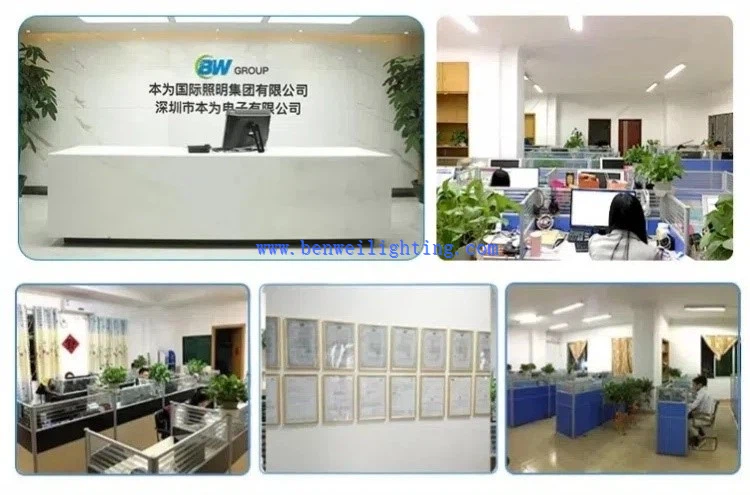
How To Cooperate With Us?
We are happy to have total control over the manufacturing process and the calibre of our products since we have our own facilities. Since we are producers rather than just brokers, we are dedicated to providing our customers with the best pricing. Since we are certain that the price and quality of our products are clear, we invite customers to see our samples first. Our commitment to quality and customer satisfaction drives us to continuously provide top-notch goods.
Our address
3rd Floor, 5th Building, Hebei Industrial Park, Hualian Community, Longhua District, Shenzhen, China





