

Many people are quite satisfied with their PIR-sensor floodlights during the first few days: the lights turn on when someone approaches and off when they leave-convenient, energy-efficient, and reassuring. Before long, however, issues arise. The lights might flick on in the middle of the night, only for you to find a cat strolling along the wall. Or, a gust of wind might cause the lights in the yard to flash incessantly. For homes facing a street, it's even more frustrating-the lights trigger every time a vehicle passes by.
Are these false alarms a result of poor product quality, or are they an inherent characteristic of PIR technology? Can they be avoided? This article explores these common scenarios, helping distributors and procurement professionals make better-informed choices when selecting equipment.
The Basic Principle of PIR Sensors: What Exactly Are They "Sensing"?
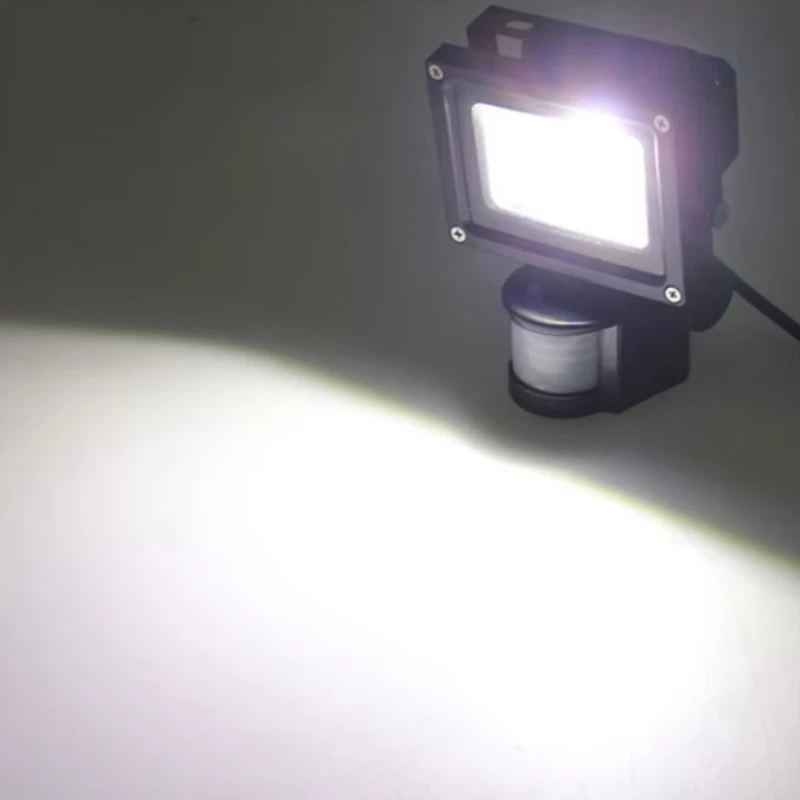
PIR stands for "Passive Infrared." These sensors do not emit any signals; instead, they passively receive infrared radiation from the environment. A Fresnel lens positioned in front of the sensor divides the monitoring area into multiple detection zones. When an object with a temperature different from the background moves across these zones, the sensor detects a change in infrared energy, interprets this as the presence of a "person," and activates the light.
Keep two key points in mind-they explain most false-alarm issues:
The sensor detects "changes in heat," not "people." It cannot distinguish whether the moving object is a human, a cat, or another heat source.
It is more sensitive to lateral (sideways) movement. The signal is strongest when an object moves across multiple detection zones, whereas movement directly toward the sensor produces a weaker signal.
Can Pets Trigger the Lights?
Yes-especially medium-to-large dogs.
Size is the critical factor. Dogs and large felines have high body temperatures and significant physical bulk, making them likely to trigger the sensor. Small birds or rodents typically produce a weaker heat signature and may not always trigger the light, though they could still do so if they pass very close by.
Installation height plays a major role. If a light is mounted low (e.g., around 1.5 meters), animals will likely be within the core detection zone. Mounting it at a height of 2.5 to 3 meters-with the detection angle tilted slightly downward-can help avoid triggering the light due to small animals on the ground.
Don't rely too heavily on "pet immunity" features. Some indoor alarm devices feature "pet immunity," but this function is not always reliable for outdoor floodlights, where the environment is more complex. If you have a large dog, a more practical approach is to lower the sensitivity, reduce the detection range, or adjust the coverage area so that it avoids spots where your pet frequently roams.
Can trees and vegetation trigger the alarm?
While trees themselves do not generate heat, branches moving in the wind can sometimes cause false alarms for two main reasons:
Temperature-related interference: During the day, foliage heated by the sun can reach temperatures significantly higher than the surrounding air. As the wind blows, these "hot spots" shift within the detection zone, which the sensor may misinterpret as a moving heat source.
Proximity: Vegetation located very close to the sensor has a greater impact; even slight swaying can trigger the light repeatedly.
False alarms are more likely to occur during hot, sunny, or windy days. On cool nights, the temperature of the foliage tends to be closer to the ambient background temperature, resulting in fewer false triggers-which is why some users notice that their lights "flicker on constantly during the day, but work fine at night."
Can passing vehicles trigger the alarm?
This type of false alarm typically occurs when the light is oriented toward a road.
Engine and exhaust heat: A moving vehicle acts as a significant, mobile heat source. Even if a car passes by laterally at a distance of several meters, the sensor may still detect it.
Excessive detection range: Many floodlight PIR (passive infrared) sensors have a detection range of 10 to 12 meters. If your home entrance is only five or six meters from a road, passing vehicles will inevitably fall within the detection zone.
Vehicle headlights: Contrary to what some might think, it is usually not the headlights themselves that trigger the sensor; PIR sensors primarily respond to changes in heat. However, some lights include a photosensitive (light-sensing) feature, where intense light can interfere with their operation-a factor distinct from the PIR mechanism itself.
How to reduce false alarms: Installation and setup tips
While it is difficult to eliminate false alarms entirely, they can be significantly reduced:
Adjust the orientation: Position the sensor so that it avoids roads, dense vegetation, or areas outside your property boundary where there is frequent activity. Ideally, it should be directed toward the specific entrance or pathway you wish to monitor. Adjust the tilt angle. Angle the unit slightly downward to limit the detection area to the ground and exclude unwanted zones.
Lower the sensitivity and reduce the detection range. Most floodlights feature adjustable dials; set them according to your actual needs rather than simply turning them to the maximum setting.
Mask off specific areas. You can use opaque tape or dedicated masking covers to block parts of the lens, effectively shielding areas you do not wish to monitor.
Avoid heat sources. Refrain from installing the unit near air conditioning outdoor units, exhaust vents, or chimneys.
Key Parameters to Consider When Selecting Products
If you are involved in procurement or product selection, pay close attention to the following:
Adjustability of detection angle and range. Greater flexibility allows the unit to adapt to a wider variety of environments.
Sensitivity adjustment method. Whether via dials, preset levels, or a remote control, this affects the ease of future adjustments for the user.
Lens design. Different Fresnel lens configurations respond differently to horizontal versus vertical movement.
Support for motion-plus-light sensing. Units that only activate at night (remaining off during the day) save energy and prevent false triggers caused by heat fluctuations from trees or vegetation during the day.
Ingress Protection (IP) rating. For outdoor use, ensure the unit is dustproof and waterproof to protect the sensor from the effects of rain and moisture.
Conclusion
PIR-sensor floodlights can occasionally be triggered by pets, trees, or passing vehicles. This is an inherent characteristic of their "heat-detection" operating principle, not a product defect. False triggers from pets depend on their size and the unit's installation height; those from trees depend on temperature differentials and wind; and those from vehicles depend on whether the detection range extends to the roadway. The good news is that by optimizing the installation angle, height, sensitivity, and range, the vast majority of false alarms can be kept within an acceptable range. When purchasing, prioritize products with adjustable parameters and well-thought-out designs over those that merely boast a "long detection range."
If you are sourcing PIR-sensor floodlights for your brand, project, or retail channel, please get in touch. We offer solutions with various detection angles, sensitivity adjustment methods, and IP ratings tailored to your target market and specific use cases. We also support sample testing and OEM/ODM customization. Please send us your requirements, and we will respond as soon as possible with detailed specifications and a quotation.
Our address
No. 5-3 Niujiao Road, Yanchuan Community, Yanluo Subdistrict, Bao'an District, Shenzhen
bwzm18@ledbenweilighting.com






