Do surface-mounted panel lights require a separate driver? When customers receive their orders, they might wonder why there is a small box attached to the side of the light, or why they cannot find a driver at all. Simply put, panel lights *do* require a driver, but it does not necessarily have to be a "separate" unit. Some drivers are built directly into the light fixture, while others are external, independent power supplies. Let's break this down.
Why panel lights need a driver
LED light sources run on low-voltage direct current (DC), whereas mains electricity is 100–277V alternating current (AC). A "translator" is needed in between to convert AC into stable DC and regulate the output current; this is the function of the driver.
Without a driver, the LED either won't light up or the current will become uncontrolled, causing the light to burn out quickly. Therefore, the key question isn't whether a driver is needed, but where it is located.
Two types of driver configurations for surface-mounted panel lights
Built-in driver (integrated type)
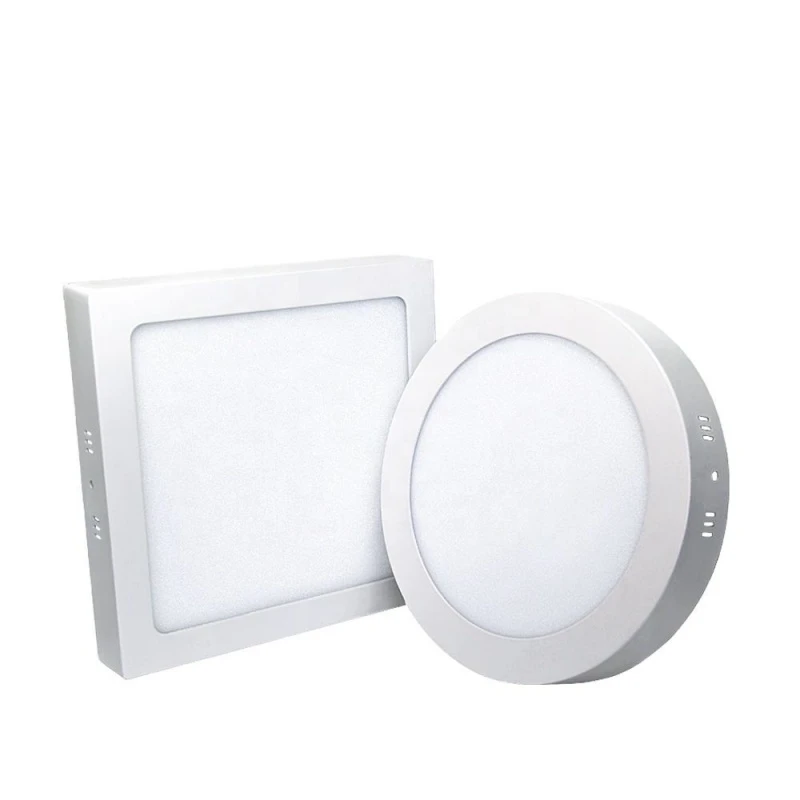
The driver is installed directly inside a compartment at the back or side of the light fixture; simply connecting the mains power cable makes it operational. Most surface-mounted panel lights on the market are of this type, appearing as a single, complete unit.
External driver (separate type)
The driver is a separate small box connected to the light panel via low-voltage wiring. The light fixture itself is thinner, and the driver can be placed inside the ceiling void or in a nearby junction box.
How to choose between built-in and external drivers
Each method suits different scenarios:
Built-in driver: Installation is simple, there are fewer components, and there is less risk of mismatched parts; it is suitable for most standard projects like offices, shops, and classrooms. The downside is that the driver sits close to the light panel, limiting heat dissipation, and the fixture itself is slightly thicker.
External driver: The light fixture can be made thinner, and if the driver fails, it can be replaced individually without discarding the entire fixture, offering greater maintenance flexibility. The downside is the addition of an extra component that requires placement planning, and the wiring is more complex.
If the project has specific requirements regarding fixture thickness or anticipates frequent future maintenance, an external driver is more suitable; if the priority is quick, hassle-free installation, a built-in driver is more practical.
Key parameters to consider when selecting a driver
Whether the driver is internal or external, the following factors should be checked:
Power matching: The driver's rated power must cover the light panel's power requirements; generally, a margin should be allowed to avoid long-term operation at full load.
Output voltage and current: External drivers must match the light panel's specifications; mismatched current can lead to abnormal brightness or a shortened lifespan.
Power Factor (PF) and Total Harmonic Distortion (THD): In large-scale projects, these factors affect the load on the power grid and are often inspection points during project acceptance.
Flicker: Lights with poor-quality drivers are prone to flicker that may not be immediately visible to the naked eye but causes eye fatigue during prolonged exposure; this is particularly important to consider for office and educational environments.
Certifications: Confirm that necessary certifications-such as CE, UL, or ETL-are in place based on the target sales market.
Dimming requirements influence driver selection
If the project requires dimming, the driver choice is critical, as it determines whether and how the light can be dimmed. Common dimming methods include:
TRIAC dimming: Suitable for retrofit projects; compatible with existing wall-mounted dimming switches.
0/1–10V dimming: Commonly used in commercial lighting; offers stable control.
DALI dimming: Suitable for large-scale projects requiring zoned control and networked connectivity.
Note that standard drivers do not support dimming; adding dimming capabilities later often requires replacing the driver, so the control scheme should be finalized before placing an order.
Common pitfalls during installation and replacement
Avoid burying external drivers too deeply: Completely enclosing them in a sealed space hinders heat dissipation, reduces lifespan, and makes maintenance difficult.
Don't cut corners on wire gauge and connections: Improper wiring is a common cause of future malfunctions.
Check parameters when replacing drivers: Do not swap drivers based solely on matching wattage; voltage, current range, and dimming method must also align.
Pay attention to the protection rating: For surface-mounted panel lights used in humid environments, the driver component must also meet the required protection standards.
Summary
Panel lights require a driver; the only distinction is whether it is internal or external. Built-in drivers offer quick, error-resistant installation, making them ideal for standard projects; external drivers allow for a slimmer fixture profile and more flexible maintenance.
When selecting a driver, prioritize power rating, output specifications, PF/THD, flicker performance, and certifications.
If dimming is required, confirm the dimming method before purchasing to ensure driver compatibility.
During installation, pay attention to heat dissipation, wiring standards, and the consistency of replacement parameters.
Different projects have varying requirements regarding dimensions, power, dimming, and driver configuration; incorrect choices often lead to costly rework. If you are selecting products for office, commercial, or engineering projects, please share your application scenario, quantities, and control requirements. Our team will recommend the right surface-mounted panel lights and driver configurations, and provide quotes and samples.Contact us today for a tailored solution and quote.
Our address
No. 5-3 Niujiao Road, Yanchuan Community, Yanluo Subdistrict, Bao'an District, Shenzhen
bwzm18@ledbenweilighting.com