When working on outdoor lighting projects, the question clients ask most often isn't about brightness, but rather: "If I put this light outside, will it break when it rains or snows?" It is true that floodlights are often installed in courtyards, parking lots, on building facades, and in sports arenas or storage areas, where exposure to wind and rain is the norm. However, the term "waterproof" is actually quite broad in the industry; a light labeled as waterproof might not necessarily withstand a damp winter. This article looks at real-world applications to help you determine exactly what level of protection an LED floodlight needs to be considered "sufficient."
Understanding IP Waterproof Ratings
An IP rating consists of two digits: the first indicates dust resistance, and the second indicates water resistance. Common ratings for floodlights include:
IP65: Completely dust-tight; protects against low-pressure water jets from any direction. Suitable for most outdoor scenarios.
IP66: Protects against powerful water jets; a safer choice for environments with heavy rain or high-pressure washing.
IP67: Withstands temporary immersion in water (approx. 30 minutes at a depth of 1 meter). Suitable for low-lying areas prone to water accumulation.
IP68: Withstands continuous immersion; typically used for underwater lights and rarely required for standard floodlights.
It is important to note that IP ratings are determined under laboratory conditions and reflect the fixture's state at the time of manufacture; they do not guarantee that the same level of sealing will be maintained five years later.
Is IP65 Sufficient for Rainy Conditions?
For most clients, the answer is yes-though it depends on the type of rain.
IP65 can handle standard rainfall, wind-driven drizzle, and everyday splashing. If you are located in a temperate climate and the fixture is installed under an eave or high up on a wall, IP65 is perfectly adequate. However, in the following situations, it is advisable to choose IP66 or higher directly:
Coastal areas or regions prone to typhoons, where rain drives horizontally.
Upward-facing installations, where rainwater tends to pool on the fixture surface.
Locations requiring frequent high-pressure washing, such as factory exterior walls or car washes.
Spending a little more upfront for a higher rating is often far more cost-effective than replacing faulty fixtures later.
Special challenges posed by snow and freezing conditions
Snow and rain test lighting fixtures differently-a fact often overlooked.
Snow accumulation. Snow piling up on the fixture doesn't cause immediate water ingress, but as it melts, it creates a persistent film of water that keeps seals saturated for extended periods.
Freeze-thaw cycles. Water seeps into tiny gaps and expands upon freezing, widening the gaps and making it easier for water to enter during the next thaw. This is a common cause of fixture failure in northern regions.
Low-temperature impact on materials. Inferior silicone gaskets and plastic components can harden and become brittle in the cold, losing their elasticity.
One advantage is that LEDs generate heat during operation, which can help melt accumulated snow-provided the fixture has sufficient wattage and an effective thermal design. When purchasing products for cold regions, ensure the operating temperature range covers local minimums; a common specification is -30°C to 50°C.
Key structural details affecting waterproofing performance
Even with the same IP65 rating, actual performance can vary significantly between products; the difference lies in these details:
Gasket material: High-quality silicone gaskets resist aging and low temperatures, whereas inferior rubber gaskets harden and crack after just a year or two.
Fixture body material: A one-piece die-cast aluminum body minimizes seams and is more reliable than a multi-part housing.
Glass cover: Tempered glass is more resistant to aging than plastic covers and is less prone to yellowing or deformation.
Cable entry point: The spot where the power cord enters the fixture is the most vulnerable area; it should feature a waterproof connector and a secure clamping mechanism. Breather Valve Design: Temperature fluctuations cause internal air pressure changes, potentially "sucking" in external moisture. A breather valve equipped with a breathable membrane balances internal and external pressure while blocking water vapor.
How Installation Determines Waterproofing Success
Some customers experience water ingress even with high-rated waterproof lights; the issue often lies in the installation:
Wire connections must be waterproofed individually. No matter how well-sealed the light fixture itself is, water entering the junction box or connector can still cause a short circuit. Waterproof terminals or potting compounds are recommended.
Create a drip loop. Allow the wire to curve downward slightly before entering the light fixture; rainwater will drip off the curve rather than traveling along the wire and into the light.
Avoid facing the light surface upward for extended periods. If an upward orientation is necessary, a slight tilt is recommended to minimize the accumulation of water or snow.
Ensure secure mounting. Excessive swaying in strong winds can loosen connections over time, compromising the seal.
Distinguishing Genuine Waterproofing When Purchasing
Exaggerated IP ratings are common in the market; consider these steps before placing an order:
Request third-party test reports (e.g., from SGS or TÜV) rather than relying solely on the ratings listed on the product page.
Clarify whether the IP rating applies to the entire fixture or just specific components. Some manufacturers only certify the LED chips or the driver, while the complete fixture does not meet the standard.
Request samples for independent testing. Power up the sample and expose it to spraying water or submersion for a period to check for moisture ingress or malfunctions.
Understand the warranty policy. Manufacturers confident in their waterproofing capabilities typically offer warranties of three years or longer.
Summary
For standard rainy conditions, IP65 is generally sufficient; for heavy rain, coastal areas, or environments requiring wash-downs, IP66 or higher is recommended.
In snowy or extremely cold regions, consider low-temperature tolerance and sealing materials in addition to the IP rating, as freeze-thaw cycles pose the greatest risk. Structural details-such as seals, the fixture housing, cable entries, and breather valves-along with the installation method, are just as critical to actual waterproofing performance as the IP rating itself.
When sourcing products, prioritize third-party test reports rather than relying solely on promotional materials. Waterproofing is not merely a number; it is the result of the combined performance of design, materials, and installation.
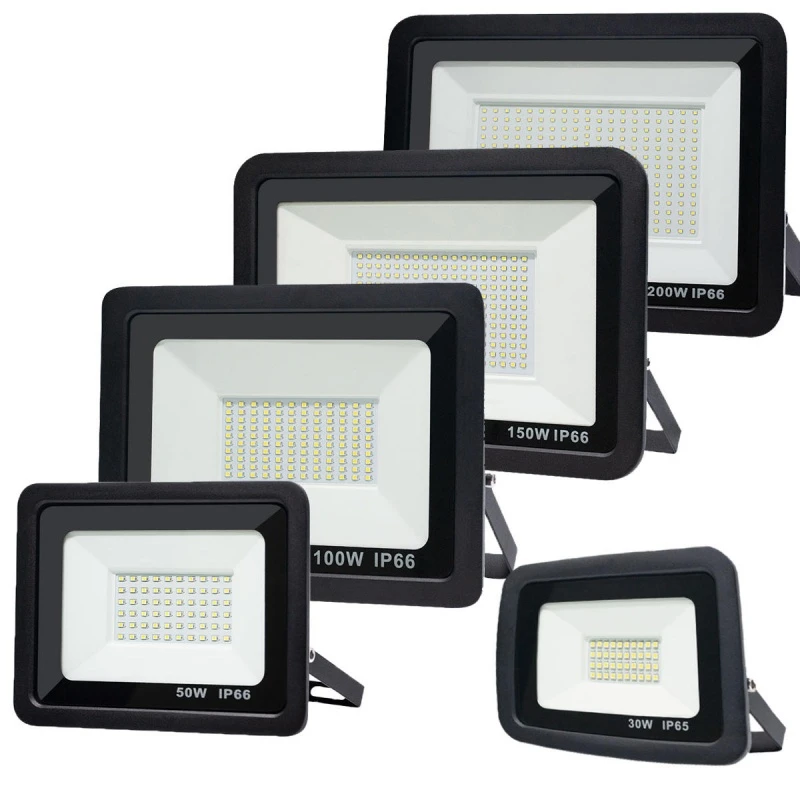
We offer a range of IP65/IP66-rated LED floodlights in various wattages, suitable for applications such as courtyards, parking lots, sports venues, factories, and building facades; we can also recommend models tailored to your local climate conditions. If you are currently selecting products or would like information on samples, pricing, third-party test reports, or warranty policies, please feel free to leave a message or send us an email. Simply let us know your intended application and installation environment, and we will provide recommendations customized to your needs.
Our address
No. 5-3 Niujiao Road, Yanchuan Community, Yanluo Subdistrict, Bao'an District, Shenzhen
bwzm18@ledbenweilighting.com