Anyone involved in the procurement or selection of LED corn lights has likely asked or been asked this question: which is more durable-an aluminum housing or a plastic one? While aluminum corn lights are indeed more durable in most high-wattage, continuous-use scenarios, this isn't always the case. Durability depends on the application, wattage, and internal design. Let's break this down by the key factors that actually affect lifespan.
Heat Dissipation: The Key to Longevity
LED chips are sensitive to heat-this is the "Achilles' heel" of corn lights. Every rise in junction temperature accelerates lumen depreciation and shortens the lifespan of the electrolytic capacitors in the driver.
Aluminum housing: Offers excellent thermal conductivity; heat generated by the chips and driver is quickly transferred to the housing and dissipated, resulting in lower internal temperatures.
Plastic housing: Poor thermal conductivity; heat tends to get trapped inside the lamp. This issue becomes more pronounced as wattage increases.
Real-world performance: For corn lights rated at 30W or higher, aluminum models typically exhibit slower lumen depreciation and lower failure rates.
A quick note: Many "plastic-clad aluminum" products on the market feature a plastic exterior with only a small aluminum substrate inside; these offer limited improvements in heat dissipation and should not be confused with full aluminum housings.
High-Temperature Resistance and Aging
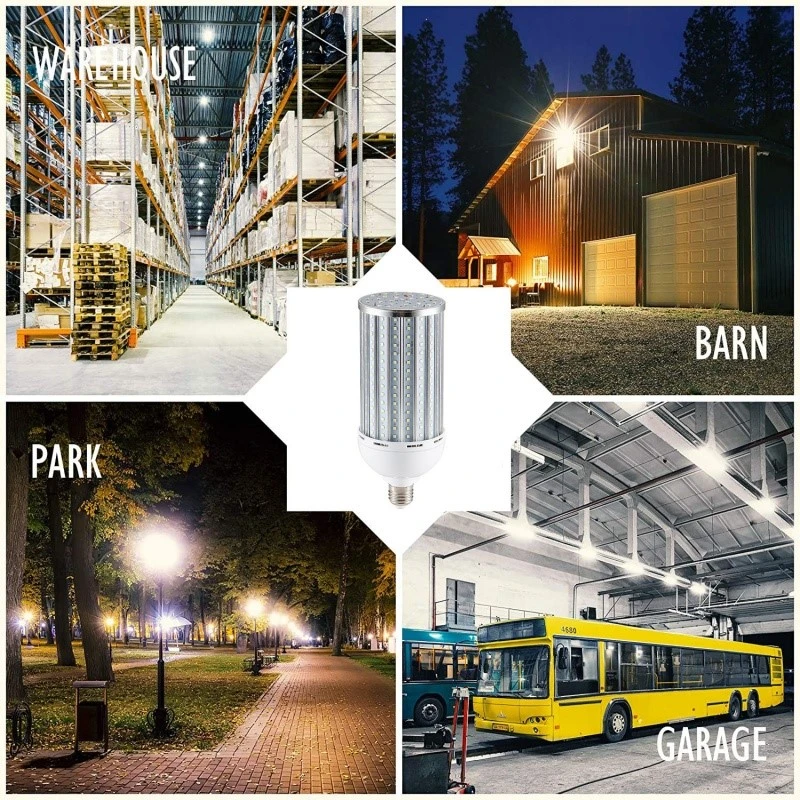
Corn lights are often installed in enclosed fixtures, factory ceilings, or workshops, exposing them to high temperatures over long periods.
Aluminum does not deform or discolor when temperatures rise, maintaining structural and aesthetic stability over the long term.
Plastics (commonly PC, PBT, etc.) may yellow, become brittle, or warp slightly when exposed to high heat and prolonged lighting. While high-grade, flame-retardant, and heat-resistant plastics can mitigate these issues, they also increase costs.
For outdoor applications, the aging effects of UV radiation on inferior plastics cannot be overlooked.
Impact and Drop Resistance
In this category, plastic actually holds its own-and may even have an advantage.
Aluminum housings are hard and resistant to scratches or crushing, but they can dent upon significant impact. High-quality plastic housings possess a degree of toughness and do not shatter easily upon impact, whereas inferior plastics are prone to cracking.
Susceptibility to damage from bumps during transport and installation depends more on packaging and wall thickness than on the material itself.
Therefore, if your application involves frequent handling or a high risk of impact, plastic is not necessarily at a disadvantage; it all comes down to the material grade.
Moisture resistance, corrosion resistance, and sealing
Aluminum housings are typically anodized or spray-coated, making them suitable for standard humid environments; however, in corrosive settings-such as coastal areas with salt spray or chemical plants-corrosion can occur if the surface treatment is inadequate.
Plastic is inherently rust-proof and corrosion-resistant, but if the sealing gasket at the joints ages, moisture can still penetrate.
For outdoor or damp locations, prioritize the ingress protection rating (IP rating) and sealing design rather than simply asking "aluminum or plastic."
Trade-offs: Weight, installation, and cost
Weight: Aluminum housings are heavier than plastic ones; for older light sockets or pendant fixtures, consider the long-term load-bearing implications.
Price: Aluminum housings entail higher material and processing costs, whereas plastic versions are more affordable and suitable for budget-sensitive projects.
Safety: Aluminum housings require proper internal insulation and adequate creepage distances-standard requirements for legitimate products. You can request relevant certifications from suppliers during procurement.
Summary
Extended operation, high wattage, or high ambient temperatures: Prioritize aluminum housings for their clear advantages in heat dissipation and longevity.
Low wattage, short-duration use, or limited budget: Plastic versions are sufficient; there is no need for over-specification.
Coastal or corrosive environments: Look beyond the material itself; consider surface treatment and the IP protection rating.
Don't be misled by "plastic-clad aluminum" marketing; true durability results from a combination of heat dissipation design, driver quality, and LED chip quality. Ultimately, an aluminum housing is a strong factor contributing to a "corn light's" durability, but it is not the only one. We offer a wide range of LED corn lights-including aluminum and plastic housing options-covering various wattages, base types, and color temperatures, with customization available to meet specific needs. Whether you are looking for bulk orders, samples for testing, or detailed information on heat dissipation designs and lifespan data, please contact us; simply let us know your application scenario, and we will provide tailored recommendations and a quote.
Our address
No. 5-3 Niujiao Road, Yanchuan Community, Yanluo Subdistrict, Bao'an District, Shenzhen
bwzm18@ledbenweilighting.com