

Why Heat Is the Silent Killer of Outdoor LED Lighting
Specifiers who only compare initial lumens per watt on a datasheet are usually surprised when a newly installed batch of LED street bulbs looks dramatically brighter in month one than in month eighteen. The diode is still on. It is not broken. What has happened is light decay - the irreversible, continuous loss of luminous flux caused by years of heat stress inside the lamp body. In outdoor applications this problem is amplified because the same fixture that protects the LED from rain also traps heat, and because most corn lamps are retrofitted into old sodium-vapor housings that were never designed to cool a dense cluster of high-power chips.
The thermal mechanism inside an LED package
An LED converts roughly 25–40% of its input electrical power into visible light and the remaining 60–75% into heat. That heat must travel along a defined path: from the InGaN junction, through the sapphire or silicon substrate, the solder layer, the printed circuit board, the thermal interface material, the aluminum heatsink and finally into the surrounding air. Every interface in that chain adds thermal resistance. If any link is too thin, too dry, or made of cheap material, the junction temperature climbs even when the external aluminum body feels only slightly warm to the touch.
Reliability engineers describe LED aging with the Arrhenius equation: every 10 °C rise in junction temperature roughly doubles the chemical reaction rate inside the package. In practice this means a corn lamp running at a 95 °C junction temperature will age roughly twice as fast as the same lamp running at 85 °C, and four times as fast at 75 °C. Because outdoor lamps typically operate 10–12 hours per night through summer ambient temperatures of 35–45 °C, the thermal margin of the heatsink is the single most important variable determining how many years the lamp will hold its initial brightness. Cheap bulbs often appear to meet initial lumen specs but fail this temperature test within one summer season.
Three environmental factors stack the deck against retrofitted corn lamps. First, sealed outdoor housings create stagnant air pockets around the bulb, so natural convection is weaker than in open indoor luminaires. Second, direct solar radiation on the fixture body during the pre-dawn and post-dusk switch-on period pre-heats the heatsink before the LED even reaches full power. Third, dust, road grime and insect residue coat the cooling fins over time, further reducing convective exchange. A thermal design that works on a clean bench in the factory will degrade after two winters of road-side operation unless the radiator surface is sized with real-world margin.
How heat translates into visible light decay
Heat damage in an LED does not happen at one point - it accumulates across three subsystems, and each one produces a different signature of decay. Understanding these signatures is what separates a professional buyer from a price-only buyer.
The white light of a corn lamp is produced by a blue LED pumping a yellow phosphor layer. At elevated temperature the phosphor loses conversion efficiency (thermal quenching) and slowly darkens (phosphor aging). The visible symptom is not just lower brightness but also a measurable shift in correlated color temperature - the warm-white 3000 K lamp you specified begins to look pale, greenish or washed out after a year, creating uneven lighting across a street or industrial yard.
Inside every LED package the die is connected by tiny gold or copper bond wires. Thermal cycling - the daily heat-up and cool-down - makes these wires expand and contract, gradually weakening the joint. Once the joint loosens, contact resistance rises, heat rises further, and the package enters a self-accelerating failure loop. Our corn lamp uses pure gold wire bonding rather than copper-clad or aluminum alternatives, specifically because gold wire has a proven longer fatigue life under outdoor cycling.
Statistical field data consistently shows that the LED driver, not the diode array, is the most common failure point in LED retrofit lamps. The electrolytic capacitor inside the driver is rated at a maximum case temperature; for every 10 °C above its rated temperature its service life halves. A driver squeezed into a cramped E27/E40 base, sitting directly against the hot PCB, will cook its capacitor in 6–12 months even if the chips themselves are fine. This is why our design uses an isolated driver with high-temperature-rated electrolytic capacitors and dedicated protection circuits.
What Light Decay Actually Costs Your Project
Light decay is not an abstract engineering concern. It is a budget line item that most municipal and industrial procurement teams discover only after the first year of operation. A lamp that retains 70% of its initial lumen output after 25,000 hours (the industry L70 benchmark) is acceptable for most outdoor applications; a cheap lamp that falls below 60% by 12,000 hours forces re-lamping halfway through the maintenance cycle.
Reading lumen maintenance specifications
Credible LED performance is described by two industry-standard documents: IES LM-80 measures lumen depreciation of the LED package itself at controlled case temperatures, and IES TM-21 extrapolates that measured data into a long-term L70 lifetime. A marketing claim of "50,000-hour life" is meaningful only when it is backed by LM-80 data at the actual case temperature the corn lamp will reach in service. When evaluating suppliers, always ask for the LM-80 test report and the extrapolated TM-21 curve - not the headline number.
The number on the box - for example "5000 lm" - is the initial lumen output measured within the first 100 hours of operation. The number that actually illuminates your street five years later is the maintained lumen output. A lamp with excellent initial flux but poor maintained flux creates a dangerous illusion of quality on day one, and a predictable maintenance crisis in year two. Our corn lamps are binned and screened so that both initial and maintained lumen figures are specified, and the L70 rating is derived from tested chip data rather than estimated.
The hidden cost of premature re-lamping
Outdoor lighting maintenance is expensive not because the bulb itself is expensive, but because of the labor and access cost. A street lamp requires a lift truck, a trained crew, traffic control and often a night shift. Replacing a failed 50 W corn lamp costs the price of the bulb plus several times that amount in service labor. A project manager who buys a cheap bulb that fails in 18 months is not saving money - he is pre-paying a second maintenance cycle during the first year of the contract.
Engineering Breakdown: How Our Corn Lamp Controls Heat and Decay
Every design decision in our high-power LED corn lamp traces back to one objective: keep the LED junction and the driver capacitor as cool as possible, for as many hours as possible. The sections below walk through the four subsystems that deliver that objective.
Thickened aluminum fin radiator
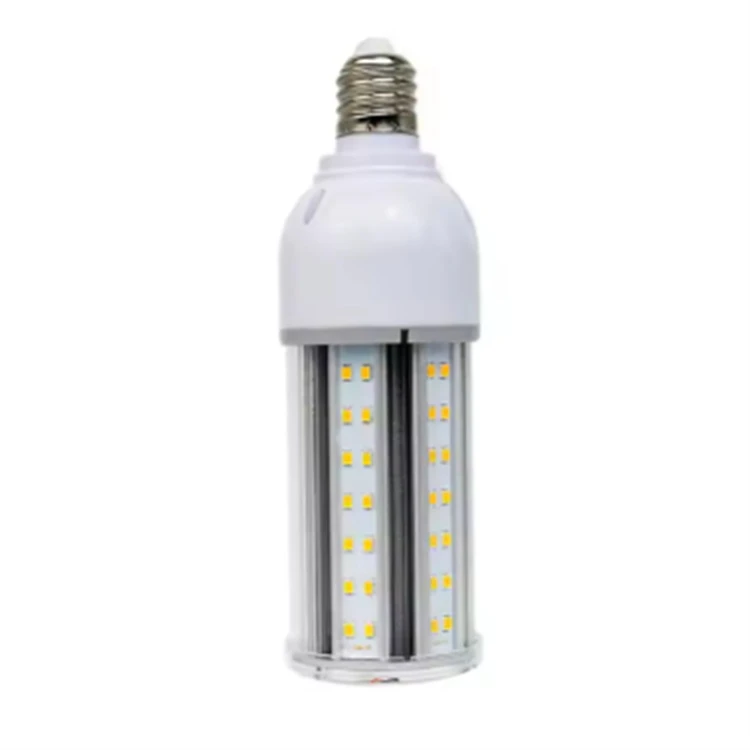
The outer body of the corn lamp is a die-cast and machined aluminum radiator with an enlarged fin array. Aluminum is chosen because of its high thermal conductivity (typically 180–200 W/m·K in this alloy), light weight and natural corrosion resistance after surface treatment. The fins are deep, closely pitched and extend along the full length of the lamp body rather than being concentrated only near the base. This geometry maximizes the convective surface area exposed to ambient air, which is the dominant heat-removal mechanism for a bulb-shaped lamp with no forced fan.
Each multi-sided PCB holding the LED chips is mounted in direct contact with the aluminum radiator through a thermally conductive pad. The multi-sided layout - typically three to six faces of chips around the body - gives the lamp its namesake corn appearance and, more importantly, spreads heat evenly over the entire radiator rather than concentrating it on one face. This is why our corn lamp achieves 360° illumination: every face emits light, and every face simultaneously contributes to cooling. The result is a junction temperature that stays well within the safe operating envelope even under full-load summer conditions.
High-quality LED chips with pure gold wire bonding
Not all LED chips with the same nominal wattage are equal. Bin grade determines forward voltage consistency, wavelength consistency and - most relevant here - high-temperature lumen maintenance. Our lamp uses screened, high-bin LED dies with pure gold wire bonding. Gold wire is more expensive than copper or aluminum alternatives, but it is the most reliable interconnection under repeated thermal cycling and is the material of choice for outdoor, long-life luminaires. The gold-wire package is the single most cost-effective upgrade a manufacturer can make to fight light decay.
Because the chips are distributed around the full cylindrical body rather than mounted on a single flat board, the lamp produces genuine 360° omnidirectional light with no dead angle behind the socket. This matters for retrofit applications: in an old HPS street luminaire, a directional flat LED bulb often leaves half the road width unlit. A corn lamp fills the existing reflector symmetrically and restores the original lighting distribution without requiring fixture replacement.
Isolated LED driver with protected circuits
The driver is built around an isolated switching topology, which physically separates the input AC side from the low-voltage DC side driving the LEDs. This is both a safety requirement and a reliability feature: it prevents ground-loop currents and reduces stress on the output rectifiers. More importantly for decay control, the driver uses high-temperature-rated electrolytic capacitors rather than generic consumer-grade parts. Even with the warm base of the E27/E40 socket, the capacitor case stays below its rated temperature, preserving the long service life of the driver.
Outdoor power grids - particularly in industrial yards, mining sites and emerging-market street-lighting networks - are exposed to voltage spikes, phase imbalance and occasional lightning surges. Our driver integrates over-current protection, short-circuit protection and surge-absorbing components. Without these protections, a single voltage transient can instantly kill the lamp or quietly stress the capacitor and shorten its life by thousands of hours. With them, the lamp rides through grid disturbances the way a professional outdoor fixture should.
Sealed PC shade: dust, insects and anti-yellowing
The polycarbonate lampshade is often treated as a cosmetic part, but in a corn lamp it is central to both protection and thermal performance. The shade seals the internal chamber against dust, flying insects and rain splash. Insects in particular are a chronic problem in outdoor retrofit bulbs: moths and beetles enter unsealed lamps, die inside, accumulate on the PCB and insulate the chips. A sealed shade prevents this and keeps the cooling surfaces clean over time.
Cheap polycarbonate yellows under ultraviolet exposure, turning brown and cutting light output by 20–30% within two years. Our shade uses stabilized PC raw material formulated for outdoor use, with UV inhibitors that prevent yellowing and preserve light transmittance across the product's service life. This is the difference between a lamp that still looks new after three summers and one that looks like an aged fluorescent tube.
Real-World Performance: Lifespan, Decay and Protection Grade
The engineering above translates into three numbers that a procurement team can put on a comparison sheet: rated service life, lumen maintenance and protection level.
Rated lifespan and expected decay curve
Under nominal operating conditions our corn lamp is rated for long service life, with L70 lumen maintenance extrapolated to exceed 30,000 hours. For a street lamp running 12 hours per night, 30,000 hours corresponds to roughly 6.8 years of continuous operation before the luminous flux drops to 70% of its initial value. For industrial and mining applications running two-shift lighting, the same 30,000-hour rating still delivers well over four years of stable service before any planned re-lamping cycle. The decay curve is deliberately conservative: most cheap bulbs show steep decay in the first 5,000 hours followed by a flatter tail, whereas our design flattens the early slope by keeping junction temperature low from day one.
Protection grade and environmental sealing
The sealed PC shade combined with the gasketed lamp body delivers reliable dustproof and insect-proof performance, with splash resistance suitable for outdoor exposed positions. It is engineered for the conditions found in street, garden, landscape, factory and mining applications - where dust, rain spray, humidity and flying insects are the daily reality. It is not designed for permanent water immersion; for floodlight or underwater positions a dedicated sealed fixture is required, but for a corn-bulb retrofit inside a standard street or garden luminaire it is the right protection level.
The driver accepts a wide input voltage range, which makes the lamp suitable for municipal street networks, factory feeders and rural installations where voltage may fluctuate. Combined with the surge and short-circuit protection described in Section 3.3, this means the lamp will not simply blow on a bad night - it will ride through the disturbance and continue lighting the area.
Total Cost of Ownership: A Side-by-Side Comparison
The most persuasive argument for a thermally well-designed corn lamp is not the bulb itself but the total cost of ownership over five years. The table below compares three typical options a specifier will evaluate: a legacy high-pressure sodium lamp, a low-cost generic LED corn bulb, and our high-performance LED corn lamp.
|
Dimension |
Legacy HPS lamp |
Generic cheap LED corn bulb |
Our high-power LED corn lamp |
|---|---|---|---|
|
Typical wattage for equivalent light |
100–150 W |
30–50 W |
30–50 W |
|
Initial luminous efficacy |
~80–100 lm/W |
100–120 lm/W |
120–140 lm/W, screened bins |
|
Expected L70 service life |
~16,000–24,000 h |
~10,000–15,000 h (driver fails first) |
30,000+ h (TM-21 extrapolated) |
|
Thermal design |
High operating temperature by design |
Thin radiator, cramped driver cavity |
Thickened aluminum fins, isolated driver, HT capacitors |
|
Wire bonding |
N/A |
Copper or aluminum clad, cost-driven |
Pure gold wire, outdoor cycling grade |
|
Shade protection |
Open reflector, insects accumulate |
Thin PC, yellows in 1–2 years |
Sealed, dust/insect proof, UV-stabilized PC |
|
Re-lamping cycles over 5 years |
2–3 cycles + high energy cost |
2+ cycles, often mid-year failures |
0–1 planned cycle, stable lumen output |
|
5-year total cost (energy + bulb + labor) |
Highest |
Appears low, but labor drags it up |
Lowest over full life cycle |
The takeaway is straightforward: the cheapest bulb on a price list is almost never the cheapest bulb over five years. What you save on the unit price you repay in lift-truck hours, in night-shift crews, in uneven street lighting, and in the cost of dealing with a failed mid-winter installation.
Applications and Retrofit Compatibility
Where this lamp is designed to work
The corn lamp form factor is a retrofit-first product. It is designed to screw directly into existing E27 or E40 holders without modifying the fixture, making it the most cost-effective path to LED conversion for:
Street and roadway lighting - replacing 70 W to 250 W HPS and mercury-vapor bulbs in existing cobra-head and post-top luminaires.
Garden and landscape lighting - decorative pole lights, plaza lighting and pathways where 360° illumination fills existing reflectors.
Industrial and mining lighting - high-bay retrofits, warehouse perimeter lighting, works yards and mining camp lighting where durability and low maintenance matter more than aesthetics.
Commercial area lighting - parking lots, gas stations, building façades and freight depots where a long-life lamp avoids frequent lift-truck visits.
Why E27/E40 retrofit is a business decision, not just a technical one
For municipalities and industrial property owners, the most attractive feature of a corn lamp is that it leverages an existing investment. The pole, the arm, the wiring and the reflector are already in place. Replacing the internal light source with a thermally engineered corn bulb converts an old sodium installation to LED quality in a single operation, with no civil works, no rewiring and no new procurement of complete fixtures. When that retrofit bulb is engineered to resist light decay, the conversion delivers its promised energy savings - instead of quietly losing 30% of its brightness before the first maintenance cycle.
Conclusion: Buy the Decay Curve, Not the Initial Brightness
Heat and light decay are not side issues in outdoor LED procurement. They are the two factors that decide whether your lighting project looks as good in year five as it did on installation day. A cheap corn lamp can match our initial lumen output on a bench test; what it cannot match is the thickened aluminum radiator, the gold-wire screened chips, the isolated high-temperature driver and the UV-stabilized sealed shade that together hold that lumen output over 30,000 hours of outdoor operation.
For street-lighting contractors, municipal procurement teams, industrial estate managers and lighting wholesalers, the decision is simple: the lowest unit price is a false economy, and the maintained lumen curve is what pays back over the contract period. Our LED corn lamp is engineered to win that comparison - cool running, slow decay, sealed protection and a lifespan measured in years rather than months.
Next step. If you are planning an HPS-to-LED retrofit, a street-lighting upgrade, or an industrial lighting project, ask for our LM-80/TM-21 test reports, decay-curve data and E27/E40 sample bulbs for a side-by-side trial. We support volume orders, OEM/ODM specification and project-based technical consultation.
How To Cooperate With Us?
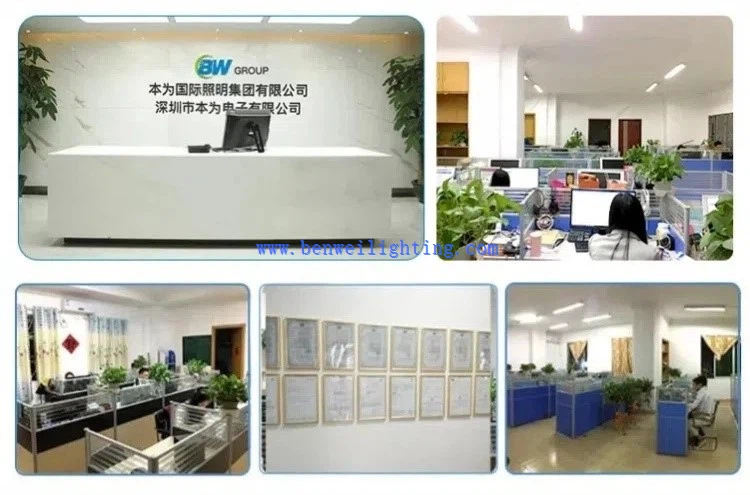
We are happy to have total control over the manufacturing process and the calibre of our products since we have our own facilities. Since we are producers rather than just brokers, we are dedicated to providing our customers with the best pricing. Since we are certain that the price and quality of our products are clear, we invite customers to see our samples first. Our commitment to quality and customer satisfaction drives us to continuously provide top-notch goods.
Our address
3rd Floor, 5th Building, Hebei Industrial Park, Hualian Community, Longhua District, Shenzhen, China





