

The Hidden Cost of Lighting Failure in Harsh Environments
Why Ordinary Fixtures Fail Where It Matters Most
Harsh environments do not fail lighting products by dramatic events. They fail them through slow, cumulative attack. Moisture condenses inside unsealed housings every time the ambient temperature drops at night. Conductive dust from concrete cutting, grinding, or food processing settles on live driver boards and creates leakage paths. Sulfur and chlorine fumes blacken silver-plated contacts and embrittle polycarbonate diffusers. Impact from fork-lift traffic, falling inventory, or cleaning equipment cracks fixtures that were never designed to take a knock. Each of these mechanisms is invisible during a site walk-through, yet each one shortens fixture life from a planned ten years to twelve to eighteen months.
The true cost is not the fixture. It is the labor, the downtime, and the safety exposure. In a warehouse, a failed row of luminaires means emergency repairs at height, blocked racking, and insurance risk. In a food plant, a failed fixture may trigger a line stop and a sanitation investigation. In a covered parking garage, inadequate light degrades the performance of every security camera and increases the probability of slips and vehicle accidents. Tri-proof lighting is therefore not a premium accessory; it is a risk-mitigation component whose payback shows up in maintenance schedules, not on the first invoice.
What "Tri-Proof" Actually Means
The term "tri-proof" describes a luminaire built to resist the three dominant enemies of industrial lighting: water, dust, and impact. In modern practice it has expanded into a broader promise: the fixture should also resist corrosion, vibration, and thermal stress, while delivering stable LED output over a very long service life. A genuine tri-proof light is not an open LED batten with a plastic cover snapped on. It is a sealed system in which the housing, diffuser, gaskets, end caps, and cable entries are engineered as one enclosure, tested together, and certified as a complete unit. Buyers should treat any product that quotes only a wattage and a lumen number without an IP rating, an IK rating, and a declared lumen-maintenance curve as a commodity, not as a tri-proof solution.
Decoding the IP65 Rating: Protection You Can Engineer Around
Breaking Down IP65: Dust-Tight and Water-Jet Resistant
The "IP65" marking follows the IEC 60529 ingress-protection system. The first digit, 6, is the highest dust rating available: the fixture is fully dust-tight, meaning no dust can enter the enclosure in harmful quantities. This is the rating that matters in concrete plants, flour mills, woodworking shops, and underground parking garages, where airborne particulates never stop. The second digit, 5, means protection against low-pressure water jets from any direction; water projected by a 6.3 mm nozzle at 12.5 liters per minute from three meters must have no harmful effect on the luminaire. That covers hose-down cleaning in food processing, steam wash-down in commercial kitchens, rain and standing splash in covered canopies, and condensation in pool halls.
It is important to understand what IP65 does and does not promise. It is not immersion, and it is not high-pressure car-wash spray. A luminaire rated IP65 handles rain, splash, hose-down, and continuous high humidity with complete confidence; for fully submerged or pressure-wash situations, a higher IP class is required. Within the ordinary universe of wet industrial, commercial, and public-space lighting, IP65 is the sweet spot: it seals out the real-world enemies without the cost, bulk, and optical compromises of over-engineering.
The Sealing Architecture: Gaskets, End Caps and Cable Glands
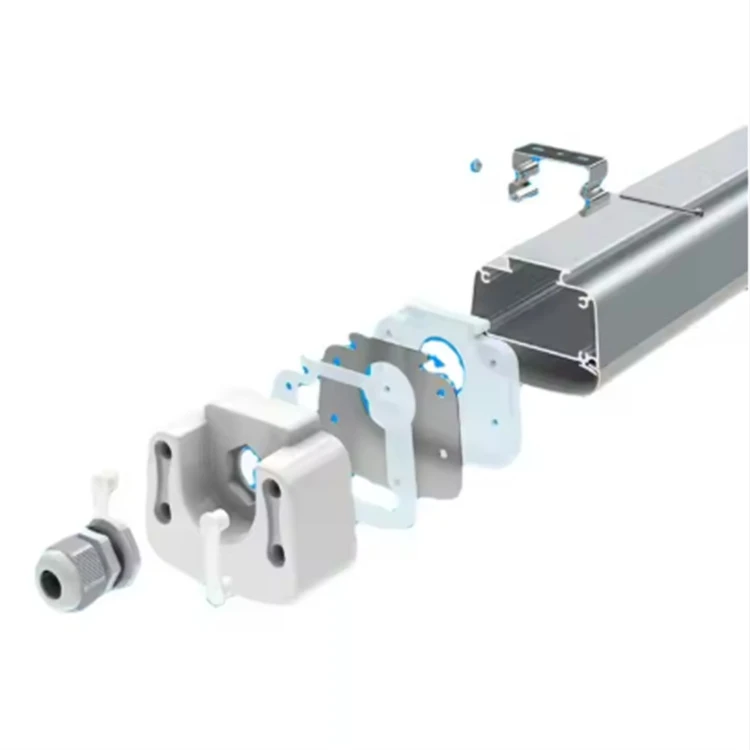
An IP rating is only as good as the weakest seam. A tri-proof light achieves IP65 through a continuous compression seal rather than point seals. A continuous silicone gasket runs the full length between the aluminum housing and the polycarbonate diffuser, so there is no gap where water can ride along the extrusion. The end caps are molded and compressed against the housing with fixed fasteners, not held by friction clips. The cable entries use certified plastic or brass cable glands with rubber inserts that grip the outer jacket of the supply cable and seal against the gland body. This matters because most field failures in cheap vapor-tight lights start at a cable gland that was torqued too loosely or that accepted a cable too thin for its insert.
The same sealed architecture that keeps water out also keeps the internal environment stable. Condensation is managed because the driver chamber and LED chamber share a controlled volume; there are no unsealed crevices where water can pool and sit against electronics. Over years of heat cycling, the silicone gasket retains its elasticity, which is why gasket material selection is as important as the gasket geometry itself.
Beyond IP65: IK10 Impact Resistance and Corrosion Protection
A harsh environment is not only wet and dusty. It is also mechanical. The fixture in a loading bay, a tunnel, a gymnasium, or a school corridor takes knocks from forklifts, trolleys, basketballs, and accidental contact. The IK code from IEC 62262 rates mechanical impact on a scale from IK00 to IK10. IK10 is the highest common rating, corresponding to a 20-joule impact from a 5 kg mass dropped from 400 mm. In practice that means a properly built tri-proof light survives the everyday collisions that would shatter a standard plastic batten and crack a thin glass tube.
Corrosion resistance completes the protection story. The aluminum housing is treated and coated to resist humid, saline, and chemically aggressive air; the polycarbonate diffuser is UV-stabilized so it does not turn brittle or yellow after years of exposure near skylights or outdoor canopies; stainless or coated hardware prevents rust streaks. The result is a fixture that keeps its sealed rating and its optical clarity for its entire service life, rather than degrading into a cosmetic and functional problem after the first winter.
Engineering the Aluminum Housing: Thermal Performance as the Foundation of Long Life
Why Aluminum Is the Backbone of a Harsh-Environment Luminaire
Plastic housings are cheap, but in a sealed tri-proof fixture they create a fatal problem: heat cannot escape. LED chips and electronic drivers are sensitive components; every 10°C rise in junction temperature roughly halves the expected life of the semiconductor and the electrolytic capacitors inside the driver. A sealed plastic enclosure traps that heat, accelerates lumen decay, and shortens the very lifespan the product claims. The aluminum alloy housing solves this by acting as a continuous heat sink. The extruded body presents a large surface area to ambient air, and the ribs and fins formed into the extrusion conduct heat away from the LED PCB and the driver cavity. Two housing widths, 90 mm and 120 mm, are offered so that higher-wattage 50 W and 75 W versions get the larger thermal mass they require without over-sizing the lower-wattage units.
Heat Dissipation Path: From LED Junction to Ambient Air
Understanding the thermal path explains why the aluminum housing is not just a shell but the core performance component. Heat generated at the LED junction crosses the SMD2835 package, the solder joint, and the metal-core PCB, then conducts into the aluminum extrusion through the thermally interface layer. From the extrusion it radiates and convects to the surrounding air. Because the housing is exposed on three sides and mounted with ventilated brackets, natural convection carries heat away continuously. The driver, housed in its own thermally coupled cavity along the rear of the extrusion, benefits from the same heat-sink effect, keeping its electrolytic capacitors well below their rated maximum operating temperature. This is why a 75 W fixture at 1800 mm can run comfortably in a sealed IP65 enclosure: the housing is doing the cooling work, rather than relying on a fan or on unsealed vents that would defeat the IP rating.
How Thermal Design Extends LED and Driver Life
LED depreciation follows temperature. Datasheet lifetime is measured under controlled conditions; in the field, a fixture that runs 15°C hotter loses years of life. By keeping the LED junction within the manufacturer's recommended envelope, the aluminum housing directly protects the 50,000-hour rating rather than letting it become a marketing number. The driver benefits equally. Electrolytic capacitor life is the dominant driver-failure mode, and capacitor manufacturers quote a doubling of life for every 10°C reduction in core temperature. A thermally well-designed fixture therefore protects both the light source and the power electronics, which is why total luminaire failure rates in the field correlate far more closely with housing quality than with LED brand name.
Optical and Electrical Performance: Brightness, Consistency and Flexibility
High-Efficacy SMD2835 Chips at 120 lm/W
Brightness in a tri-proof light is only useful if it is efficient, because every wasted watt becomes heat that the sealed housing must remove. The luminaire uses premium SMD2835 mid-power LED chips arranged along the PCB, delivering a luminous efficacy of up to 120 lumens per watt. At 40 W in a 1200 mm fixture that means roughly 4,800 lumens of smooth, linear output, enough to replace two conventional 36 W fluorescent tubes while consuming nearly half the energy. The high-transmittance polycarbonate diffuser spreads the light evenly across the working plane, eliminating the visible dot matrix that characterizes cheap strip fixtures and producing the soft, uniform line of light that makes linear lighting so effective in corridors, parking rows, and production lines.
Tunable Color Temperature: One Fixture, Four Lighting Atmospheres
Commercial and industrial projects rarely want a single color temperature. A warehouse wants cool 5000 K or 6000 K light for alertness and security camera performance; a care home, a restaurant prep area, or a walkway wants warm 3000 K light for comfort; an office corridor or retail back-of-house wants neutral 4000 K. The tri-proof light addresses this with an integrated tunable switch covering 3000 K, 4000 K, 5000 K, and 6000 K. The same SKU can therefore be deployed across an entire mixed-use building, reducing spare-parts inventory, simplifying procurement, and giving specifiers the freedom to tune zones after installation without swapping hardware. This is a concrete commercial advantage: one product, four lighting moods, zero rework.
Constant-Current Driver: Flicker-Free, Stable Output
A sealed environment is a harsh one for drivers, and driver quality is where low-price fixtures fail first. This luminaire uses a constant-current LED driver with active power-factor correction and thermal foldback protection. The current delivered to the LED strings is held stable across input voltage variations, so output does not flicker when grid voltage dips and does not strobe at 100 or 120 Hz. The absence of flicker matters both for visual comfort in occupied spaces and for compatibility with high-speed security cameras, which otherwise capture rolling bands across the light. Because the driver is thermally coupled to the aluminum housing and protected inside the sealed enclosure, it is immune to the moisture, dust, and voltage transients that destroy open-board drivers in ordinary batten fittings.
Lifespan, Light Decay and Total Cost of Ownership
The 50,000-Hour Rating Explained
The rated service life of this tri-proof light is 50,000 hours. Under typical industrial usage of 12 hours per day, six days per week, that is more than sixteen years of operation; under 24/7 operation in a tunnel or parking garage it still exceeds five and a half years of continuous duty. The rating is not a "time to failure" promise. LEDs rarely fail catastrophically; they dim over time, and the industry defines end-of-life as the point at which lumen output falls below a threshold, conventionally 70% of initial output (the L70 point). Specifying 50,000 hours means the manufacturer commits that, under rated conditions and with the thermal design described above, the fixture will still deliver at least 70% of its original brightness at that hour mark.
Lumen Maintenance: Why Low Light Decay Matters
Light decay is the hidden cost that buyers most often forget. A fixture that starts at 4,800 lumens but decays to 3,000 lumens by year three forces the owner to over-specify the installation from day one, spending more on fixtures, poles, and wiring just to maintain adequate light levels later. A fixture with strong lumen maintenance allows the engineer to design to the actual required lux and trust that the light level will hold for the life of the building. The combination of SMD2835 chips, low thermal resistance through the aluminum housing, and a driver held at low junction temperature keeps depreciation slow and predictable, so the maintained lux values used in lighting design remain accurate throughout the project. This is the difference between a lighting calculation that stays true and one that has to be re-done after year two.
Return on Investment: Replacing Fluorescent Batten Fixtures
The economic case is straightforward. A traditional 36 W T8 fluorescent batten delivers around 3,200 lumens, consumes 40 W including ballast, needs tube replacement every two to three years, and offers no meaningful ingress protection in wet or dusty sites. A 40 W tri-proof LED delivers roughly 4,800 lumens, consumes 40 W all-in, requires no tube changes for over a decade, and is rated IP65 and IK10. Across a large project such as a parking garage with several hundred fittings, the energy saving alone typically pays back the fixture premium within two to three years, and the elimination of re-lamping labor becomes pure savings thereafter. When you add the avoided cost of water-damaged drivers, short-lived diffusers, and emergency call-outs, the tri-proof light is not the more expensive option over a five-year horizon; it is the cheapest one.
Application Scenarios: Where This Luminaire Earns Its Keep
Wet and Humid Spaces: Pools, Car Washes and Showers
Swimming halls, spa areas, commercial kitchens, and vehicle wash bays are the canonical tri-proof applications. High humidity, chlorine or detergent vapor, and regular hose-down defeat ordinary fittings within months. The IP65 sealed enclosure, the corrosion-resistant aluminum body, and the UV-stabilized polycarbonate diffuser keep these spaces illuminated safely and continuously, with no rust streaks on ceilings and no cracked tubes. Because the fixture has no exposed glass or lampholder, it also removes the safety risk of broken fluorescent tubes in wet public areas.
Dusty, Cold and Chemically Aggressive Facilities
Underground parking garages, warehouse aisles, production workshops, cold storage rooms, food processing lines, and tunnels present the opposite challenge: fine dust, vibration, wide temperature swings, and sometimes oil or chemical mist. The dust-tight IP6x rating prevents particulates from entering the driver cavity; the IK10 housing survives trolley and forklift knocks; the aluminum extrusion handles the wide temperature range without warping. In cold storage, where conventional LEDs lose efficacy and drivers struggle at low temperatures, the sealed, thermally managed enclosure keeps the driver in its comfort zone and maintains stable output from the first switch-on.
Linear Continuous Layout: Series Connection and Installation Flexibility
Linear lighting is at its best when it reads as one continuous line, not as a row of separate boxes. The end-cable-gland design allows fixtures to be linked in series, running supply and inter-connect cables between units so that long corridors, parking rows, and production lines become uninterrupted linear runs. The included metal mounting brackets support both surface mounting and suspension mounting, and the brackets can be repositioned along the housing on site. Length options of 600 mm at 20 W, 1200 mm at 40 W, 1500 mm at 50 W, and 1800 mm at 50 W or 75 W let the lighting designer match the fixture length and wattage to each zone, rather than forcing a one-size solution.
Key Specifications at a Glance
|
Parameter |
Detail |
|---|---|
|
Product type |
IP65 sealed LED tri-proof linear light (vapor-tight batten) |
|
Wattage / length |
20 W / 600 mm; 40 W / 1200 mm; 50 W / 1500 mm; 50 W or 75 W / 1800 mm |
|
Housing width |
90 mm and 120 mm options to match thermal demand |
|
LED source |
Premium SMD2835 chips, up to 120 lm/W luminous efficacy |
|
Color temperature |
Tunable 3000 K / 4000 K / 5000 K / 6000 K via on-board switch |
|
Rated life |
50,000 hours, L70 lumen maintenance |
|
Ingress protection |
IP65, dust-tight and protected against water jets from any direction |
|
Impact resistance |
IK10 mechanical impact protection |
|
Materials |
Corrosion-treated aluminum alloy heat-sink housing, UV-stabilized polycarbonate diffuser, continuous silicone gasket |
|
Driver |
Constant-current, flicker-free, thermally coupled to housing |
|
Installation |
Surface or suspension mounting with included brackets; end glands support series connection |
|
Typical uses |
Parking garages, warehouses, factories, cold storage, food processing, swimming halls, tunnels, covered canopies |
Conclusion: A Tough Investment, Not Just a Tough Fixture
The best lighting decision in a harsh environment is the one you do not have to revisit. An IP65 LED tri-proof light earns its specification not by surviving one inspection, but by staying bright, sealed, and intact through years of humidity, dust, vibration, impact, and thermal cycling. The aluminum housing is the quiet reason that works: it is the heat sink that protects the LEDs and the driver, the rigid structure that holds the IK10 seal, and the corrosion-resistant shell that keeps the IP65 rating intact. Pair that engineering with 120 lm/W efficacy, tunable color temperature, flicker-free drive, and a 50,000-hour L70 commitment, and the fixture stops being a line item and starts being a maintenance strategy. For specifiers, contractors, and facility managers who have lived through the old cycle of failed batten fittings, water-damaged drivers, and yellowed diffusers, this is the luminaire that ends the cycle. It is tough on environments, and it is tougher on the total cost of ownership.
How To Cooperate With Us?
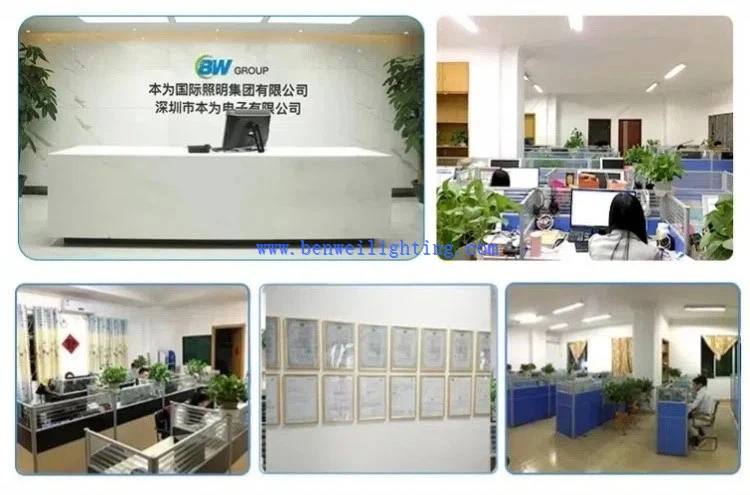
We are happy to have total control over the manufacturing process and the calibre of our products since we have our own facilities. Since we are producers rather than just brokers, we are dedicated to providing our customers with the best pricing. Since we are certain that the price and quality of our products are clear, we invite customers to see our samples first. Our commitment to quality and customer satisfaction drives us to continuously provide top-notch goods.
Our address
3rd Floor, 5th Building, Hebei Industrial Park, Hualian Community, Longhua District, Shenzhen, China





