

Thermal emission performance is one of the core evaluation indicators of indoor commercial and industrial lighting fixtures, which directly affects equipment operating stability, indoor ambient temperature, energy consumption efficiency, and long-term service life of lighting systems. Traditional T8 fluorescent tube lights have been widely adopted in office buildings, supermarket interiors, factory workshops, and educational facility lighting for decades due to their moderate cost and basic luminous performance. However, the inherent technical defects of gas discharge lighting determine their high thermal radiation output during continuous operation. Excessive heat generation not only raises indoor ambient temperature and increases the load of air-conditioning and cooling systems but also accelerates the aging of internal circuit components and peripheral installation accessories, resulting in higher maintenance costs and hidden safety hazards.
With the rapid iteration of solid-state lighting technology, T8 LED tube lights have gradually become the mainstream replacement solution for traditional fluorescent lighting fixtures. Against the background of global energy conservation and green building upgrading, the thermal control advantage of LED tubes has become a key concern for engineering purchasers, interior designers, and end users. This paper focuses on the core question of whether T8 LED tube lights deliver lower heat emission than conventional fluorescent tubes. By analyzing internal luminous mechanisms, heat generation principles, structural heat dissipation designs, and comprehensive application performance, this study systematically compares the thermal performance differences between the two lighting technologies, and further summarizes the comprehensive technical and economic advantages of T8 LED tubes, providing professional theoretical support for lighting renovation and new engineering selection.
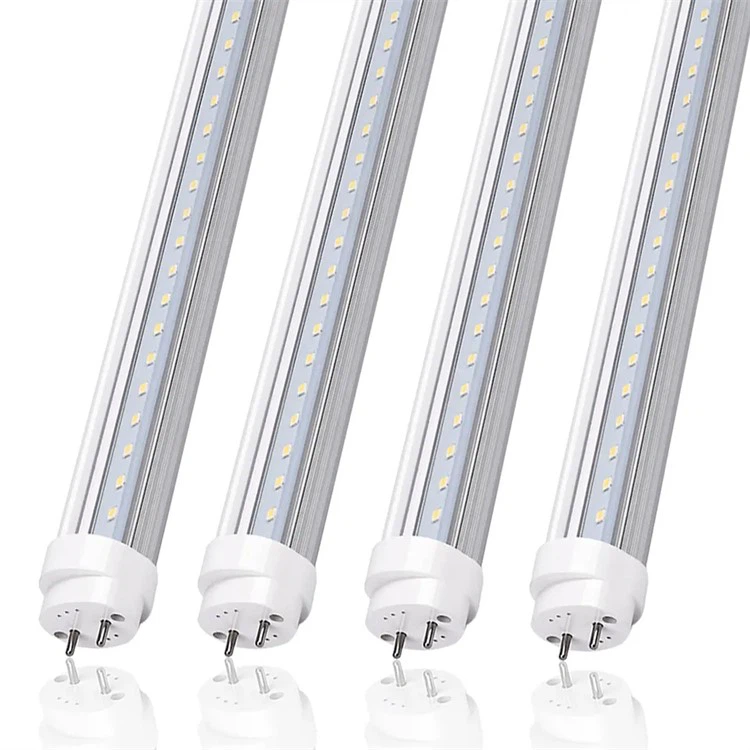
Core Conclusion: Thermal Emission Comparison Between T8 LED Tubes and Fluorescent Tubes
Quantitative Thermal Emission Gap
Through professional photoelectric testing and engineering application verification, T8 LED tube lights exhibit extremely superior low-heat performance compared with traditional fluorescent tube lights. Relevant photometric experimental data shows that T8 LED tube lights can reduce effective heat emission by up to 90% under the same luminous flux output and rated power operating conditions. Different from the continuous high-temperature thermal radiation of fluorescent tubes after long-term operation, qualified T8 LED tubes maintain low and stable shell surface temperature during full-load continuous working cycles. The low-heat operating characteristic not only makes the lamp body safe for direct contact but also effectively avoids the indoor heat island effect caused by long-term lighting operation, realizing dual optimization of lighting comfort and auxiliary energy consumption.
Operational Temperature Stability Performance
In long-cycle continuous operation tests (24-hour uninterrupted power-on), traditional fluorescent tubes show a continuous temperature rise trend. The internal gas discharge and electrode heating will cause the tube surface temperature to rise sharply and remain at a high level, accompanied by unstable heat output. In contrast, T8 LED tube lights adopt a stable electro-optical conversion mode. After completing short-term power-on temperature stabilization, the overall temperature tends to be constant without abnormal heat accumulation, maintaining consistent low-heat operating status throughout the service cycle.
Technical Mechanism Analysis of Heat Generation Differences
Luminous Principle of Traditional Fluorescent Tubes and Heat Generation Causes
Traditional T8 fluorescent tube lights belong to gas discharge lighting devices. Their internal working principle relies on low-pressure mercury vapor gas discharge to generate ultraviolet radiation, which excites the surface phosphor layer to produce visible light. The entire working process involves multi-stage energy conversion including gas ionization, electrode discharge, ultraviolet radiation excitation, and light energy conversion. The energy conversion efficiency of this technical mode is extremely low. Most of the electric energy input into the fluorescent tube is converted into invalid thermal energy rather than effective luminous energy.
Moreover, the electrodes at both ends of the fluorescent tube will generate continuous high-temperature heat during long-term discharge operation. The sealed tubular structure cannot form effective heat convection and heat dissipation, resulting in continuous heat accumulation inside the lamp tube. Long-term high-temperature operation will not only cause overall heat radiation but also accelerate the aging of internal phosphor powder, reduce luminous efficiency, and further aggravate energy waste and heat emission, forming a vicious cycle of performance attenuation.
Luminous Principle of T8 LED Tubes and Low-Heat Technical Advantages
T8 LED tube lights are typical solid-state semiconductor lighting devices, whose core luminous mechanism is electroluminescence of semiconductor chips. The internal high-quality LED chips convert electric energy into visible light energy through carrier recombination. This direct electro-optical conversion process omits intermediate energy conversion links such as gas ionization and radiation excitation required by fluorescent tubes, fundamentally reducing invalid energy loss and heat generation sources.
In terms of structural design, T8 LED tubes are equipped with high thermal conductivity aluminum substrates and professional heat dissipation profiles. The heat generated by the chip during operation can be quickly conducted and dissipated to the external environment through the metal heat dissipation structure, avoiding internal heat accumulation. The optimized circuit constant-current drive design further reduces invalid power consumption and additional heat generation. The combination of advanced luminous mechanism and efficient heat dissipation structure enables T8 LED tubes to maintain ultra-low heat emission under long-term stable operation.
Multi-Dimensional Comprehensive Performance Advantages of T8 LED Tube Lights
Environmental and Safety Performance Optimization
In addition to outstanding low-heat performance, T8 LED tube lights have significant environmental and safety advantages compared with traditional fluorescent tubes. Traditional fluorescent tubes contain toxic and harmful substances such as mercury and lead. Once the tube is broken or improperly disposed of, heavy metal leakage will cause pollution to soil and water resources, which does not conform to modern green building and environmental protection standards. In contrast, T8 LED tube lights adopt fully eco-friendly material configuration, with no mercury, lead, or other harmful components inside, achieving zero pollution during use and post-scrap disposal. The low-heat operating characteristic also avoids potential fire risks caused by high-temperature lamp body contact with flammable materials, improving the overall safety level of indoor lighting systems.
Service Life and Long-Term Economic Benefits
The low-heat working state of T8 LED tubes also brings a substantial extension of service life. High temperature is the core factor leading to the aging and attenuation of lighting fixtures. The long-term high-temperature operation of fluorescent tubes will accelerate the aging of phosphors, electrode loss, and circuit aging, with a nominal service life of only about 20,000 hours. Benefiting from low heat generation and stable working environment, the service life of T8 LED tube lights can reach up to 50,000 hours, more than twice that of traditional fluorescent products.
Longer service life effectively reduces the frequency of lamp replacement and daily maintenance labor costs for commercial and industrial lighting projects. Although T8 LED tubes have a slightly higher upfront procurement cost, they can greatly reduce long-term operating costs such as equipment replacement, maintenance, and auxiliary energy consumption, with prominent long-term economic benefits.
Lighting Flexibility and Scene Adaptability
T8 LED tube lights surpass traditional fluorescent tubes in terms of lighting design flexibility and scene adaptability. The product series covers diversified power specifications, color temperature options, and luminous efficiency grades, which can meet the customized lighting needs of different scenarios such as office lighting, commercial display lighting, industrial lighting, and teaching lighting. In addition, T8 LED tubes support intelligent dimming and brightness adjustment functions. Users can flexibly adjust the output luminous power according to ambient light demand, further reducing unnecessary energy consumption and heat generation, realizing precise control of lighting energy efficiency, and making the lighting system more intelligent and humanized.
Comprehensive Benefit Analysis and Application Prospects
Traditional fluorescent tube lighting technology has inherent defects such as low electro-optical conversion efficiency, high heat emission, short service life, and environmental pollution risks. In contrast, T8 LED tube lights achieve comprehensive upgrades in thermal performance, energy efficiency, safety, environmental protection, and economic performance by virtue of advanced semiconductor luminous technology and optimized structural design. The ultra-low heat emission characteristic not only optimizes indoor lighting comfort and reduces building cooling energy consumption but also improves the stability and service life of the entire lighting system.
In the context of global advocacy of energy-saving emission reduction and sustainable green buildings, T8 LED tube lights have become the optimal replacement choice for traditional fluorescent lighting equipment. Despite the slight disadvantage in initial installation cost, their excellent low-heat performance, ultra-long service life, zero pollution, and intelligent control compatibility make them have irreplaceable comprehensive advantages in long-term engineering application and commercial operation.
Conclusion
In conclusion, T8 LED tube lights produce far less heat emission than traditional fluorescent tube lights, with a maximum heat reduction rate of 90% under equivalent lighting conditions. The fundamental difference in heat generation lies in the different luminous mechanisms: fluorescent tubes rely on inefficient gas discharge luminescence with massive invalid thermal energy loss, while LED tubes adopt high-efficiency semiconductor electroluminescence, matched with efficient heat dissipation structures to achieve low-heat stable operation. At the same time, T8 LED tube lights integrate multiple advantages including environmental safety, long service life, low maintenance cost, and flexible dimmable performance. It is foreseeable that T8 LED tube lights will completely replace traditional fluorescent lighting fixtures in more commercial, industrial, and civil lighting scenarios, becoming the mainstream low-carbon and high-efficiency lighting solution for modern architectural spaces.

How To Cooperate With Us?
Our firm prides itself on owning its own factory, guaranteeing complete control over the production process and the quality of our goods. We are not only agents; we are manufacturers committed to offering our clients the most competitive rates available. We invite consumers to evaluate our samples first, as we are assured that the quality and pricing of our items are self-evident. Our dedication to excellence and client satisfaction compels us to consistently perform at our best and provide superior quality products.
Our address
3rd Floor, 5th Building, Hebei Industrial Park, Hualian Community, Longhua District, Shenzhen, China





