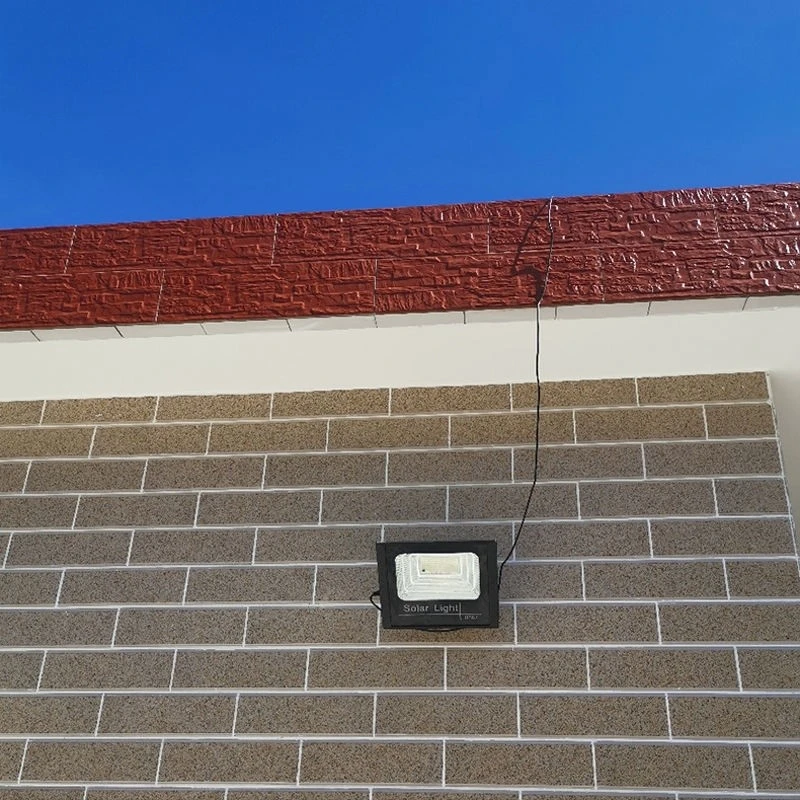
If you work in outdoor lighting procurement, you've likely been asked this question by a client: "If it rains for a week straight, will the light just shut off?"
The short answer: Solar floodlights generally continue to work during rainy weather-they just charge more slowly, relying on the energy stored in their batteries. A well-designed product can typically last through 2 to 5 consecutive days of rain or overcast weather. The exact duration, however, depends on a few key specifications. Let's break down these factors to help you with product selection and client communication.
Can solar panels still generate power during rainy weather?
Yes, though with reduced efficiency.
Solar panels absorb light, not just "direct sunlight." Even on cloudy days or during light rain, the diffused light that filters through the clouds is enough to generate power.
Generally speaking, power generation on a rainy or overcast day is only about 10% to 25% of what it would be on a sunny day-the thicker the cloud cover or the heavier the rain, the lower the output.
Consequently, the battery often experiences a "deficit" during such periods: it gains a small amount of charge during the day but loses more at night, causing the stored energy to gradually deplete until it runs out.
This is why determining how many nights a light can last depends less on the solar panel and more on the battery's storage capacity.
The key to "how many nights it lasts": Battery capacity
The battery acts as the "granary" for the light fixture; the larger its capacity, the more rainy days it can withstand.
Capacity: For a given light, doubling the battery capacity roughly doubles its runtime. When selecting a product, look at the Ah (amp-hour) or Wh (watt-hour) ratings-don't just focus on claims of "high power."
Battery Type: Lithium iron phosphate (LiFePO4) batteries offer a longer cycle life and better resistance to temperature extremes, making them more reliable for outdoor use. Standard lithium batteries are more compact and cost-effective, but they generally have a shorter lifespan and are less tolerant of temperature fluctuations.
Usable Capacity: Batteries are never drained to 0%. The controller typically maintains a safety margin, meaning only about 80% to 90% of the nominal (rated) capacity is actually available for use. Aging and Degradation: After a year or two of use, battery capacity naturally declines, leading to a shorter runtime.
The Impact of Lamp Power and Brightness Settings
With the same battery, the brighter the light and the longer it stays on, the shorter the total runtime will be.
Rated Power: Higher power consumption means more energy is used each night. For areas requiring intense illumination, you must pair the light with a larger battery and a larger solar panel.
Nightly Duration: The difference in power consumption between a light that stays on from dusk till dawn versus one that runs for only 5 hours can be more than double.
Brightness Levels: Many lights offer high, medium, and low brightness settings. Reducing the brightness during overcast or rainy periods is the most direct way to extend runtime.
Built-in Smart Controls: How They Save Energy
A high-quality solar floodlight doesn't just stay at full brightness; it adjusts itself dynamically.
Light-Sensing (Dusk-to-Dawn): Automatically turns on at night and off at dawn, ensuring no energy is wasted.
Motion Sensing: Stays in a low-brightness standby mode when no one is around, then brightens when motion is detected-ideal for courtyards, garages, or warehouse perimeters.
Low-Battery Protection: Automatically dims the light when the battery runs low, prioritizing extended runtime over maximum brightness.
Scheduled Operation: Some models allow you to set the light to full brightness for the first few hours and dim it during the latter part of the night, balancing security needs with battery life.
These features significantly impact runtime; given the same battery, a model with smart controls can often last one or two nights longer.
Waterproofing and Construction: Can Rain Cause Issues?
When it rains, the concern isn't just about running out of power-it's also about water ingress.
Ingress Protection (IP) Rating: For outdoor use, an IP65 rating is the minimum recommendation; in regions with frequent rainfall or coastal areas, an IP66 rating or higher is a safer choice.
Connectors and Cabling: The connection points and cables between the solar panel and the lamp head are the most vulnerable to water entry-check to ensure they feature waterproof connectors.
Panel Design: A slight tilt on the solar panel allows rainwater to run off, preventing water accumulation that could obstruct light. Once the rain stops, a clean panel also recovers its power-generation efficiency more quickly.
How to estimate the required battery backup duration
You can use a simple formula for a rough estimate:
Required usable battery capacity (Wh) ≈ Average power of the light (W) × Hours of operation per night × Number of consecutive rainy/cloudy nights to cover
For example: A light with an average power of 20W, running for 5 hours each night, consumes approximately 100Wh per night. To sustain operation through 3 consecutive rainy or cloudy nights, you would need a usable battery capacity of about 300Wh. If motion-activated dimming is used, the average power consumption might drop to around 10W, allowing the same battery to last even longer.
A quick note: This is only an estimate. Actual performance will also be affected by temperature, battery aging, and the amount of sunlight the solar panel receives.
Often-overlooked details during purchase and installation
Panel orientation: In the Northern Hemisphere, panels should generally face south, with a tilt angle roughly equal to the local latitude; this helps maximize light collection, even on cloudy days.
Avoid obstructions: Shadows from trees, eaves, or walls-even if they only cover a small corner of the panel-can significantly reduce power generation.
Opt for split-design models: Models with separate solar panels and light fixtures offer greater flexibility, allowing you to place the panel in the sunniest spot while positioning the light exactly where illumination is needed.
Regular cleaning: Dust or bird droppings on the solar panel can further diminish power generation, which is already limited during cloudy weather.
Winter and low temperatures: Cold temperatures reduce a battery's discharge capacity; in cold, rainy regions, you should build in a larger buffer for battery backup.
Summary
Solar floodlights do not stop working immediately during rainy or cloudy weather; they rely on a combination of limited ongoing charging and stored battery power. The number of nights a light can remain operational depends primarily on four factors: battery capacity, the power and duration of the light's operation, the effectiveness of smart controls, and the placement of the solar panel. Well-designed products can typically last for 2 to 5 consecutive rainy or cloudy nights. To achieve a longer duration, you would need to increase the battery capacity or utilize dimming modes. When selecting a model, accounting for local weather conditions-such as the frequency of overcast or rainy days-is a more reliable approach than simply chasing a higher wattage rating.
Looking for the right solar floodlight for your project?
Climate conditions, installation environments, and lighting duration requirements vary by location. Please share your specific use case, project location, and the desired number of days of autonomous operation (backup capacity) with us. Our team will recommend the optimal power output, battery configuration, and ingress protection (IP) rating to suit your needs. We can also provide samples, price quotes, and customized solutions. Simply click "Contact Us" on the page or leave a message with your inquiry, and we will get back to you promptly.