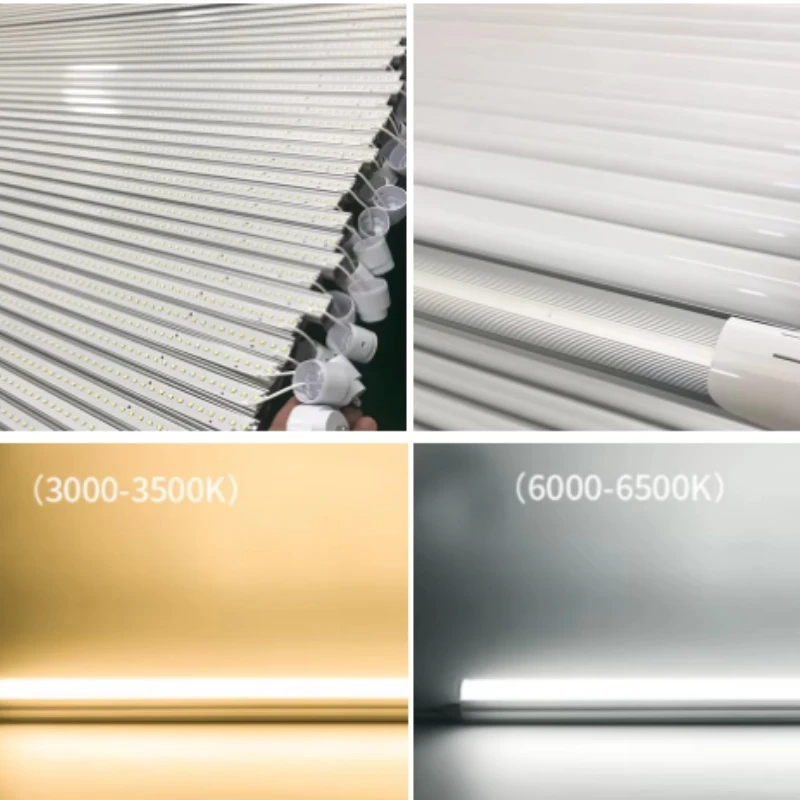
When sourcing lighting for freezers, display cabinets, or shelving units, you may have encountered this scenario: a supplier's specification sheet for a "V-shaped T8 LED tube" labels it as "Integrated"-without further clarification. Some might interpret this as "the tube and its fixture are combined into a single unit," while others might assume it means "the LED driver is built-in, requiring no external power supply." Both interpretations have led to procurement pitfalls.
This article focuses on one specific question: what does "Integrated" mean when applied to V-shaped T8 tubes, and does it require a separate LED driver? By the end, you will know exactly what to ask your supplier before placing an order.
How do V-shaped T8 tubes differ from standard T8 tubes?
Let's start with the design. In a standard T8 tube, the LED chips are typically arranged on a flat surface, directing light in a single direction. In a V-shaped T8 tube, the LED board is bent into two angled planes-forming a "V"-with a row of LED chips on each side, casting light outward toward both the left and right.
This design is specifically tailored for environments like freezers and display cabinets. The tubes are usually mounted along the door frames or the sides of the shelving, where the goal is to illuminate the front of the products rather than causing glare by reflecting light off the glass. Standard T8 tubes cannot achieve this, which is why the V-shaped configuration was developed.
The true meaning of "Integrated" in this context
In the specification sheets for most V-shaped T8 products, "Integrated" means that the LED driver (power supply) is housed inside the tube itself-the tube and the driver are combined into one unit.
In other words, the tube you receive already contains a constant-current circuit. Once connected to the specified input voltage, it will light up without the need for an additional, separate power supply unit.
It is important to note that there is no universal industry standard for this term. Some manufacturers use "Integrated" to mean "built-in driver," while others use it to mean "the tube and its mounting fixture are a single, combined unit." Therefore, relying on this term alone is not enough; you should check the specification sheet for details on input voltage and wiring methods-or simply ask the supplier for clarification.
Built-in drivers vs. external drivers
Both approaches have their own trade-offs; neither is inherently "better" than the other. Integrated Driver
Simple to install; the tube itself functions as a complete lighting fixture.
No need to find extra space for a separate driver box-ideal for tight cabinet interiors.
If it fails, the entire unit is typically replaced; the driver cannot be swapped out individually.
External Driver (Separate)
The tube itself usually operates on low-voltage DC, making it thinner and lighter.
If the driver fails, it can be replaced independently without disturbing the tube.
Requires additional space for the driver, and the wiring process involves an extra step.
For large-scale projects-such as retrofitting refrigeration units in convenience store or supermarket chains-an integrated driver primarily saves on installation labor. In scenarios where long-term maintenance is a priority, a separate (external) driver system offers greater flexibility for future replacements.
When is a separate driver still required?
Even if a product is labeled "Integrated," you should exercise caution in the following situations:
The tube is rated for low-voltage DC input (e.g., DC 12V / 24V): Such tubes do not contain an internal driver and must be paired with an external power supply. In some refrigeration projects, low-voltage systems are specifically chosen for electrical safety in cold environments.
Dimming is required: If the project calls for dimming, verify whether the integrated driver supports it and which dimming method is used. If it is not supported, you will need to switch to an external driver system that includes dimming capabilities.
Integration into an existing lighting system: If a cabinet is already equipped with a centralized power supply and control module, replacing the existing lights with integrated-driver tubes may lead to compatibility issues.
A simple rule of thumb: Check the input voltage. If it specifies a wide AC voltage range (e.g., 100–240V), it almost certainly has an integrated driver; if it specifies a low DC voltage, an external power supply is required.
Wiring considerations during installation
When using integrated-driver tubes to replace old fluorescent tubes, one detail is frequently overlooked: what to do with the existing electronic or magnetic ballast.
Many T8 tubes with integrated drivers-designed to connect directly to mains power-require the ballast to be bypassed, allowing the mains voltage to be applied directly to the pins at the ends of the tube. If you install them without bypassing the existing ballast/circuitry, the best-case scenario is that the lights simply won't turn on; the worst-case scenario is that they could burn out.
Another critical factor is the power input method. Some T8 tubes are designed for single-ended power input, while others require dual-ended input. Connecting them incorrectly poses a risk of electric shock or short circuits. Once you receive your samples, be sure to verify the wiring diagram against the instruction manual before proceeding with a bulk installation.
Summary
In the context of V-shaped T8 tubes, the term "integrated" generally indicates that the LED driver is built into the tube itself. This means the unit can be powered directly by the specified voltage without the need for an external driver box. However, as there is no standardized definition for this term, you should not rely solely on the label.
The key to determining the configuration is the input voltage: tubes designed for a wide range of AC voltages typically feature an integrated driver, whereas those requiring low-voltage DC input will need an external power supply. Furthermore, factors such as dimming requirements, how to handle existing ballasts, and the specific power input method must all be confirmed before installation.
If you are selecting lighting for projects involving cold storage units, display cabinets, or commercial shelving-and are unsure whether to choose an integrated-driver model or a separate-driver solution-please feel free to contact us. Simply provide details regarding the dimensions of your units, power supply conditions, and the operating environment; our engineering team will help you identify the most suitable V-shaped T8 model and can even provide samples for testing.