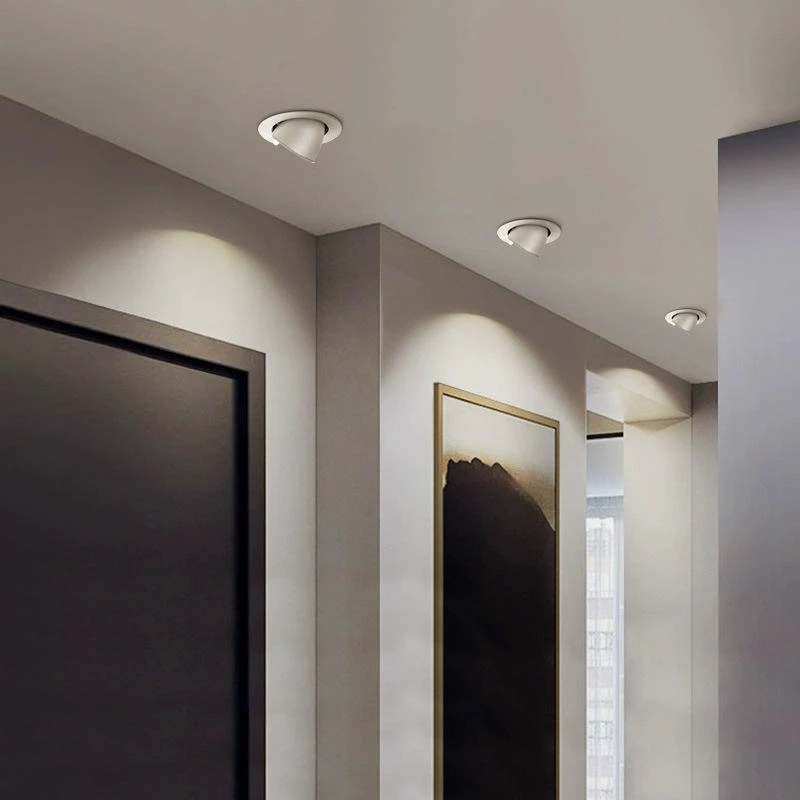
If you work in lighting procurement, you've likely been asked this question by a client: "Since the fixture housing is so long, won't part of the light get 'blocked'?" The answer is: it's possible, but in most cases, it can be avoided. It all comes down to design and installation. This article breaks down the common causes of light obstruction, how to identify it, and how to prevent it-useful information for both product selection and client consultations.
How does light obstruction occur?
In fixtures with long housings, the light source is typically recessed deep within the cylinder. Once emitted, some light travels directly toward the opening, while other light strikes the inner walls of the housing.
If the beam angle of the light source exceeds the field of view of the fixture's opening, the excess light is intercepted by the inner walls. This is what is commonly referred to as a "truncated" or "cut-off" beam. This isn't necessarily a defect; in fact, it is often an intentional design choice to achieve anti-glare effects-though those unfamiliar with lighting design might mistakenly perceive it as the light being "blocked."
The relationship between housing length and beam angle
Think of the fixture housing like the barrel of a telescope:
A longer housing with a smaller opening produces a more concentrated beam, sharper edges on the light spot, and reduced glare.
A shorter housing with a larger opening results in a wider beam, softer edges on the light spot, and less effective glare control.
There is a clear trade-off: the more light intercepted by the inner walls, the lower the overall luminous flux efficiency. Consequently, a long-housing fixture might deliver slightly lower actual illuminance than a short-housing version, even when both are rated at the same wattage. This is a point worth discussing with clients during the product selection process.
Common Causes of Unwanted Shadows
The "shadows" that cause the most trouble are rarely created by the fixture housing itself; rather, they typically arise from the following scenarios:
Mounting brackets or stems obstructing the light path: After the fixture is tilted or rotated, a mounting component ends up blocking the light output.
Fixture positioned too low or too close: When the fixture is placed too near the target object, the housing itself casts a shadow onto the illuminated surface.
Multiple fixtures installed in close proximity: The housing of one fixture blocks the lateral light emitted by an adjacent unit.
Use of multiple accessories: Adding components like honeycomb grids, snoots (light shields), or color filters can lead to secondary clipping of the light at the edges.
How Internal Surface Treatment and Reflector Design Affect Light Output
For fixtures with the same housing length, the treatment of the internal surface significantly alters the lighting effect.
A matte black interior absorbs stray light, reducing light spots and halos caused by internal reflections-though this comes at the cost of slightly lower efficiency.
A mirrored or highly reflective interior redirects lateral light outward, increasing efficiency, but may result in uneven, bright rings around the edges of the beam.
A threaded or stepped (baffled) interior helps diffuse reflections, offering a balanced approach that minimizes glare while ensuring a more uniform light spot.
If you notice "dark corners" or "stray light rings" around the edges of a light spot, check the internal surface treatment first, rather than immediately questioning the light source itself.
Avoiding Obstructions During Installation
Even the best-designed fixture can underperform if installed incorrectly. Here are a few practical tips:
Before installation, verify the intended tilt angle and rotation range to ensure that mounting brackets do not obstruct the light path.
Maintain an adequate distance from the target object; you can calculate the expected light spot diameter based on the product's beam angle.
When installing multiple fixtures, ensure sufficient spacing between them, or adjust their orientations so they do not interfere with one another.
When adding accessories, select models that precisely match the fixture's aperture size to prevent any further obstruction of the light at the edges.
How to Verify Potential Light Obstruction Before Purchase
Don't just rely on descriptions-you can verify this yourself using the following methods:
Examine the light distribution curve (IES file): Check if the curve is smooth and free of any unusual gaps or notches.
Check the cut-off angle: A larger value generally indicates better glare control, though it often means more light is being "cut off."
Conduct a practical test: Project the light onto a wall or white board to observe the edges of the light spot, checking for dark corners or unwanted shadows.
Test from multiple angles: Rotate the fixture to different positions to ensure the mounting bracket does not obstruct the light path.
Summary
Whether a long-barrel fixture causes light obstruction cannot be generalized:
The barrel walls may block some light, but this is a deliberate design trade-off made to achieve superior glare control and a more focused light beam.
Actual shadow issues usually stem from the positioning of the mounting bracket, installation distance, or the addition of extra accessories.
The treatment of the inner barrel walls and the design of the light distribution determine whether the resulting light spot is clean and uniform.
When purchasing, always review the light distribution curve and cut-off angle, and-most importantly-perform a physical test with a sample.
Need help determining which long-barrel fixture is best for your project?
Different combinations of barrel length, aperture size, and beam angle can lead to significantly different lighting effects. If you are selecting fixtures for a specific application, please share the installation height, the target object, and the desired light spot size with us. Our engineers will help you find the right solution, provide light distribution curves, and offer free samples for testing. Leave a message or send an inquiry today, and we will get back to you promptly.