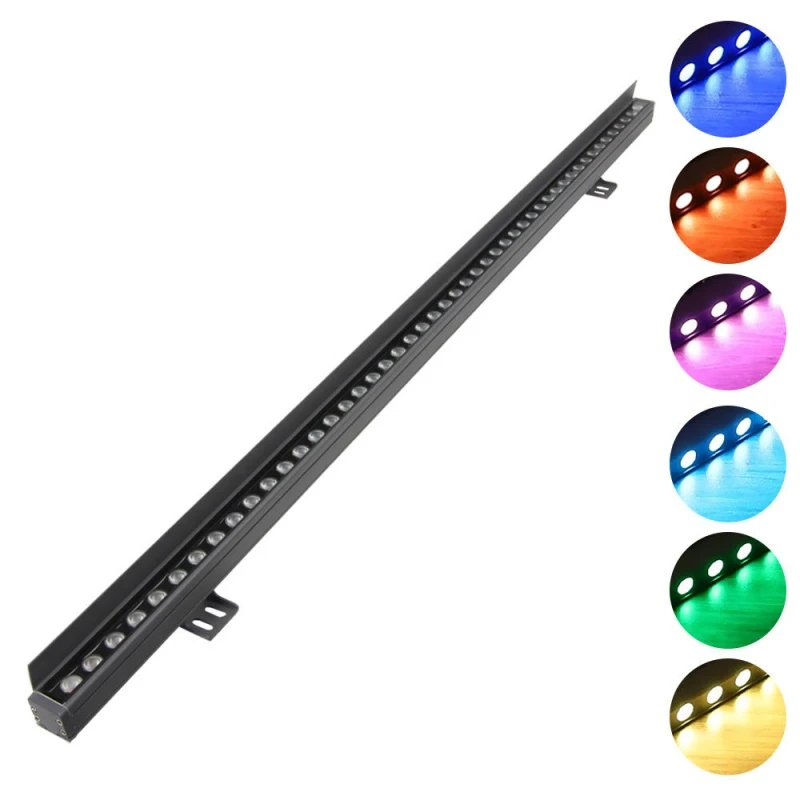
For those working on outdoor lighting projects, the question of whether to choose 24V low-voltage wall washers or 220V mains-voltage versions is a common dilemma. There is no single "correct" answer, but choosing the wrong one can be costly: at best, voltage drop along the line may cause uneven brightness (brighter at one end, dimmer at the other); at worst, it can lead to frequent maintenance requirements and the added expense of rework. This article cuts through the fluff, focusing on practical engineering selection. We will break down the differences between the two options and their ideal use cases, helping you make quick, informed decisions during the planning, quoting, and procurement phases.
The Core Difference Between the Two Types of Wall Washers
Let's start by clarifying the basic concepts.
24V low-voltage wall washers operate on DC power. The fixtures themselves cannot be connected directly to the mains; they require an external switching power supply (to convert 220V AC to 24V DC). These power supplies are typically housed in a central distribution box or a waterproof enclosure, with low-voltage wiring running from there to the individual fixtures.
220V wall washers, by contrast, connect directly to the mains. They feature integrated internal driver circuitry, eliminating the need for an external power supply-much like standard mains-powered lighting fixtures.
In short: the 24V approach uses "external power supplies + low-voltage fixtures," while the 220V approach uses "internal drivers + direct mains connection." Virtually all other differences stem from this fundamental distinction.
Safety: Which Is Better for High-Traffic Areas?
The primary advantage of low-voltage systems is safety. 24V falls within the "safe voltage" range; even if a fixture's housing becomes slightly damaged or water ingress occurs over time, the risk of electric shock to people is significantly lower compared to mains-voltage equipment. Therefore, a 24V system is a safer, more reassuring choice in the following scenarios:
Areas where people can come into close contact with lighting fixtures, such as pedestrian streets, commercial plazas, and parks.
Locations where fixtures are installed at a low height (e.g., near the base of a wall or on the sides of steps).
Tourist attractions or public spaces frequently visited by children and visitors.
While 220V lighting is not inherently unsafe, it demands stricter adherence to installation standards. Proper grounding and the installation of residual current devices (RCDs/leakage protectors) are mandatory, and there can be no shortcuts when it comes to waterproofing junction boxes and electrical connections. If the installation team's skill level is inconsistent, this is the area most prone to issues.
Cable Length and Voltage Drop: A Critical Factor for Long-Distance Projects
This is where the two approaches differ most significantly.
Low-voltage systems involve relatively high currents; the longer the cable run, the more pronounced the voltage drop becomes. In practice, this manifests as fixtures near the power source appearing at normal brightness, while those further away appear dimmer-or even exhibit a shift in color temperature. Generally, the maximum cable run for a 24V wall-washer light is limited. Exceeding this distance requires one of the following solutions:
Using cables with a larger cross-sectional area (thicker wires).
Adding more power supply points to distribute power across segments.
Supplying power from both ends of the circuit simultaneously.
The 220V approach is far more flexible in this regard. Because the current is lower for the same power output, line loss is minimized, allowing a single circuit to cover a much greater distance. This makes it better suited for projects with long, linear spans, such as the facades of large buildings, bridges, or embankments.
The exact maximum distance depends on the fixture's power rating, cable specifications, and the manufacturer's design. Before finalizing your selection, it is advisable to provide the supplier with the maximum single-circuit run length and the total power load for your project. Ask them to propose a specific wiring scheme rather than relying solely on the parameters listed in a product catalog.
Installation and Total Cost: Look Beyond the Unit Price of Fixtures
When comparing prices, many procurement professionals focus exclusively on the unit cost of the lighting fixtures-a narrow view that often leads to an incomplete picture of the total investment. Hidden Costs of 24V Systems:
Requires additional switching power supplies; for large-scale installations, this necessitates waterproof enclosures or centralized power distribution cabinets.
Low-voltage wiring requires thicker cables, leading to higher material costs over long distances.
A higher number of power connection points increases the complexity of troubleshooting and maintenance.
Hidden Costs of 220V Systems:
Stricter requirements for installation personnel; some regions mandate that work be performed by certified electricians.
Essential safety components-such as waterproof connectors and residual-current devices (RCDs/GFCI)-cannot be omitted.
Significant labor and materials are required for conduit installation, grounding, and related infrastructure.
Therefore, a more accurate way to compare these options is to calculate the total cost: "fixtures + power supplies + wiring + labor + long-term maintenance." For smaller, decentralized projects with fewer connection points, 24V systems often offer greater flexibility; for large-scale, centralized projects with long cable runs, 220V systems are generally more efficient to install.
Waterproofing and Durability: The Real Test of Outdoor Environments
Regardless of whether a system is 24V or 220V, the ingress protection (IP) rating of an outdoor wall-washer light is critical. Common ratings include:
IP65: Protected against water jets; suitable for areas under eaves or walls with some overhead shelter.
IP66: Protected against powerful water jets; suitable for most exterior wall-washing applications.
IP67: Protected against temporary immersion in water; suitable for locations near the ground where water may accumulate.
A key distinction: 220V fixtures contain built-in drivers. If the waterproofing fails and water enters, the risks and potential damage are significantly higher; therefore, these units require more rigorous sealing, specialized cable-exit waterproofing, and secure connection methods.
In contrast, 24V fixtures do not contain internal power supplies, resulting in a simpler structure that is easier to seal effectively-though one must ensure that the external power supply itself also meets the necessary protection standards for the environment.
Furthermore, outdoor installations require consideration of UV resistance, tolerance to temperature fluctuations, and the durability of housing materials (such as the aging resistance of aluminum alloys or polycarbonate covers). These factors should be evaluated during the selection process, rather than relying solely on an IP rating.
Control Methods: Dimming, DMX, and Dynamic Effects
If your project requires features like color changing, gradual transitions, chasing effects, or zoned control, this will directly influence your selection.
24V fixtures generally offer better compatibility with a wide range of control systems. With a mature ecosystem of DMX512 controllers and decoders, they are well-suited for creating dynamic RGB or RGBW wall-washing effects and allow for precise, segmented control.
220V wall washers can also support DMX control, but they require built-in drivers and decoding circuitry. Consequently, there are fewer models to choose from, and they often come at a higher price point. If your project only requires static single-color lighting or simple scheduled on/off switching, these differences become negligible.
Therefore, if complex lighting effects are needed, it is best to confirm the control protocol during the selection phase-don't wait until the fixtures arrive only to discover they aren't compatible.
Summary
To wrap things up:
For projects where safety is paramount, foot traffic is high, or precise control is required, prioritize 24V low-voltage wall washers.
For projects involving long cable runs, concentrated lighting points, or a need to minimize the number of power supplies, 220V wall washers offer a distinct advantage.
When comparing costs, consider the total project expenditure rather than just the unit price of the fixtures.
Regardless of your choice, always pay close attention to the ingress protection (IP) rating, sealing quality, and the weather resistance of the materials.
For complex projects, a combination of both solutions is often the most practical approach.
Ultimately, selecting the right equipment is about weighing factors such as distance, environment, control requirements, and installation conditions; neither voltage is inherently "better" than the other.
Need advice on product selection or a price quote? Get in touch with us.
If you are working on an outdoor wall-washing project and are unsure whether to choose 24V or 220V, our engineers can assess your specific requirements to recommend the ideal fixtures, wiring schemes, and pricing. We can also arrange for sample testing. Please leave a message at the bottom of this page or send us an email; we typically respond within 24 hours.