

Exit Emergency Lights: An Essential Guide to Safety, Compliance, and Smart Sourcing

Few components in the intricate ecosystem of building safety are as universally important but usually disregarded as the exit emergency light. These silent, often dormant sentinels have an unquestionable role in saving lives during fires, power outages, and other emergencies. Understanding these devices is important for construction managers, contractors, architects, and global procurement specialists since it demonstrates moral responsibility and operational resilience. This study digs into the critical importance, growing technology, significant international standards, and important sourcing considerations for exit emergency lights in the worldwide marketplace.
The Unseen Lifeline: Why Exit Emergency Lights Are Essential.
When primary power fails, smoke fills the hallways, and panic threatens to set in, a clear, illuminated path to safety becomes the most important factor for survival. This route is marked by emergency exit lights. Their primary functions are dual.
To Illuminate Escape Routes: They clearly indicate exits, stairwells, corridors, and directional changes, directing occupants away from danger.
To Ensure Safe Shutdown: In commercial and industrial environments, they provide backup illumination for important regions, allowing for the orderly shutdown of equipment.
The absence or failure of these systems can result in confusion, delays, and disaster, making them a critical component of any building's life safety system. In addition to the human cost, failure to comply with emergency lighting rules can result in serious legal penalties, costly fines, and invalidated insurance policies.
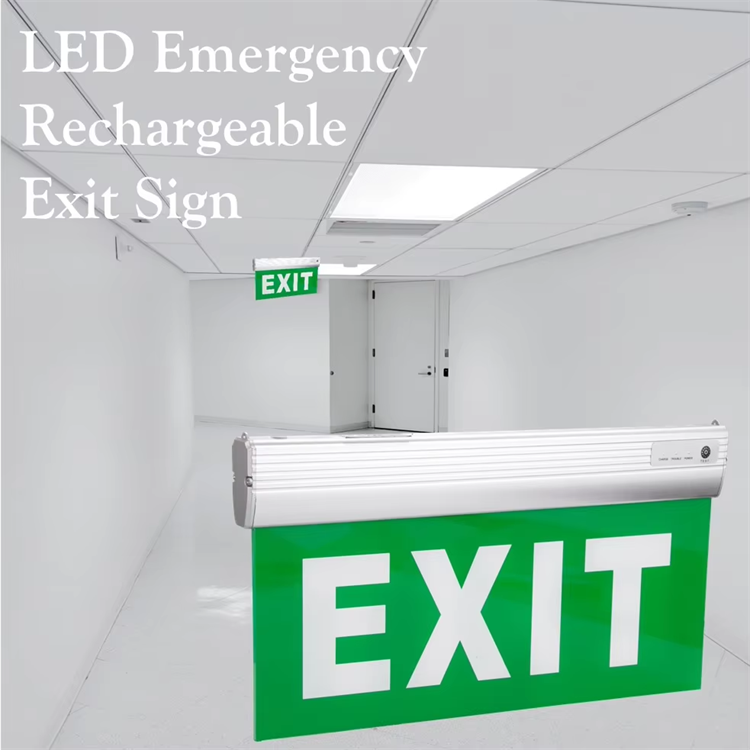
Core Components and Developing Technology
A modern emergency exit light is more than just a light bulb and a battery. It is a sophisticated, self-contained unit that often includes:
Housing: The long-lasting body, which is generally comprised of flame-retardant plastic or metal.
Light Source: Previously fluorescent, LED technology has taken over because to its ultra-low energy usage, quick illumination, excellent lifetime (50,000+ hours), and superior dependability.
The battery functions as the system's heart. Sealed Lead-Acid (SLA) batteries have been the norm, but Lithium Iron Phosphate (LiFePO4) batteries are rapidly increasing in market dominance. LiFePO₄ has a longer lifespan (up to ten years), is lower in weight, performs better over a wide temperature range, and is more environmentally benign.
Charging and control circuitry: This sophisticated board controls battery charging, monitors health, and automatically switches to battery power during an outage.
Test Mechanism: Required for compliance, enabling routine human or automated self-testing.
The Smart Revolution: The most recent breakthrough is the combination of self-testing and networked systems. Advanced models can run monthly functionality checks and annual duration tests automatically, logging the findings and notifying facility management to defects such as battery degeneration or lamp failure via central control panels or even wireless networks. This shifts maintenance from a reactive, manual task to a proactive, data-driven procedure.

Navigating the Global Maze: Key Standards and Certifications.
For foreign buyers and sellers, understanding regional certifications is critical. Compliance isn't optional. The key standards include:
UL 924 (United States and Canada) is the North American benchmark. To be approved for use, products must be UL listed. It addresses longevity, brightness (lumens), and duration (usually 90 minutes).
EN 60598-2-22 / BS 5266 (Europe and UK): The primary European standard. The CE certification is necessary for the EU market. In the United Kingdom, the UKCA mark is now necessary following Brexit. These standards define photometric performance (illuminance levels along the escape path), test cycles, and construction criteria.
AS/NZS 2293 (Australia and New Zealand) is the region's regulatory standard, with stringent testing and performance criteria.
IEC Standards: The International Electrotechnical Commission establishes international benchmarks upon which many national standards are based.
Other regional approvals include CCC for China, BIS for India, and Inmetro for Brazil.
A credible worldwide supplier will have a well-defined range of items designed and verified for these specific target areas. Never compromise on certification.
Key Specifications for Informed Procurement
When purchasing Exit Emergency Lights, especially in bulk for projects, consider the following critical specifications:
Luminous flux and illuminance are measured in lumens. Ensure that the output matches the local standard's minimum lux (lumens per square meter) level along the escape path (for example, 1 lux in the EU and 10.8 lux in the USA at floor level).
Duration: The amount of time the light must function on a battery. 90 minutes is the global standard, while 180-minute units are frequently specified for high-risk or complicated buildings.
Battery Type and Lifespan: Choose SLA or LiFePO₄. LiFePO₄, although initially more expensive, has a lower total cost of ownership.
Ingress Protection (IP) Rating: For areas with dust or moisture (e.g., parking garages, warehouses, food processing industries). An IP65 classification, for example, denotes dust resistance and protection against water jets.
Mounting and design options include recessed, surface-mounted, or centrally located battery systems with remote heads. The design should complement the building's beauty.
Maintenance Features: To save long-term personnel expenses, choose models with self-testing/diagnostic capabilities.
Strategic Sourcing in the Global Market
Finding the right manufacturer is an important strategic decision for overseas buyers using services such as "Foreign Trade Express." Here is a roadmap:
Look Beyond Price: The lowest price frequently indicates inferior components (low-grade LEDs, low-quality batteries), resulting in premature failure, noncompliance, and reputational damage.
Request and check official test reports and certificates from certified labs (such as TÜV, Intertek, and UL) to ensure authenticity of certifications. A professional supplier will have them readily available.
Assess Technical and OEM/ODM Capability: Can the provider clarify the product specifications in detail? Do they provide OEM/ODM services to personalize products (logos, housing colors, and voltage specifications) for your brand or project?
Evaluate Production Scale and Quality Control: Inquire about factory audits, production methods, and in-house quality testing (aging, photometric).
Check Logistics and After-Sales Support: Make sure they have experience with export documents, packaging, and delivery to your region. Confirm the warranty period (3-5 years is typical for quality units) and the availability of technical assistance.
In conclusion, exit emergency lights combine safety, technology, and regulation to promote smart business practices. In today's international construction and facilities management industries, acquiring these devices necessitates a combination of technical knowledge and strategic sourcing skills.
Buyers want a dependable, completely compliant product from a reputable partner who ensures their projects are safe and follow all legal requirements. For forward-thinking manufacturers and exporters, it is an opportunity to demonstrate their expertise, quality, and commitment to global safety standards.
Purchasing high-quality, technologically advanced emergency exit lights is more than just a transaction; it is an investment in risk mitigation, operational continuity, and, most importantly, human life. Prioritizing certification, performance, and partnership ensures that when a crisis occurs, the way to safety is clearly and dependably lit.
https://www.benweilight.com/industrial-lighting/led-floor-light/adjustable-track-lighting.html
Shenzhen Benwei Lighting Technology Co., Ltd.
Email: bwzm15@benweilighting.com
Web: www.benweilight.com





