

LED Grow Lights for Roses: Enhancing Bloom Quantity and Shortening Blooming Cycles with BENWEI Lighting Solutions
Roses (Rosa spp.) are among the most valuable ornamental and commercial crops globally, with their market value closely tied to bloom abundance, flowering timing, and plant vitality. Light quality, as a critical environmental factor regulating plant photomorphogenesis and reproduction, plays a pivotal role in rose cultivation. A recent study investigating the effects of different LED light qualities on rose growth reveals groundbreaking insights: tailored combinations of red (R), blue (B), and far-red (FR) light outperform natural light simulations, significantly boosting bloom numbers, accelerating flowering cycles, and promoting new bud formation. This research highlights the necessity of precision lighting for rose cultivation, and BENWEI Lighting emerges as a leading provider of LED solutions engineered to meet these specialized horticultural needs.

The Scientific Foundation: How Light Quality Shapes Rose Growth
The study, conducted with 30 uniform rose plants under controlled conditions, tested five lighting treatments-including a xenon lamp control (simulating natural light) and four LED combinations (R:B=2:1, R:B=2:1+FR, R:B=6:1, R:B=6:1+FR)-over 24 days. The results underscored the transformative impact of optimized spectral blends, particularly those incorporating far-red light, on key rose growth metrics.
Boosting Bloom Quantity and New Bud Formation
Far-red light emerged as a game-changer for bloom and bud production. The R:B=2:1+FR treatment yielded the highest average blooms per plant (21.17), a significant increase of 52 blooms compared to the R:B=2:1 group without FR. Similarly, this combination stimulated the most new flower buds, with a statistically significant advantage over all other treatments. Even the R:B=6:1+FR group showed improved bloom counts (14.00 blooms per plant) compared to non-FR LED groups and the control, highlighting that FR supplementation consistently enhances reproductive output. This effect is attributed to FR's role in regulating phytochrome activity, which promotes leaf expansion and photosynthetic efficiency, ultimately channeling more energy into flower and bud development.
Shortening Blooming Cycles
Red-blue LED blends alone accelerated flowering, but FR supplementation amplified this effect. The R:B=6:1 treatment triggered an earlier bloom peak than the natural light control, while adding FR to this ratio (R:B=6:1+FR) advanced the peak flowering period most dramatically-starting as early as the 3rd observation period (6th day of illumination), compared to the control's peak at the 9th period (18th day). For R:B=2:1, FR supplementation also pushed the bloom peak earlier, with visible differences from the non-FR group emerging by the 6th period (12th day). This aligns with the rose's nature as a long-day plant, where FR light modulates photoperiod sensing to hasten the transition from vegetative to reproductive growth.
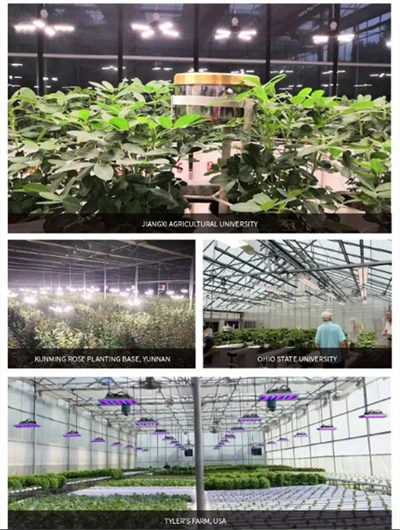
Optimizing Spectral Balance
The study confirmed that red (640nm) and blue (455nm) light-critical for photosynthesis and photomorphogenesis-form the foundation of effective rose lighting. However, the addition of FR (740nm) was the key differentiator. Without FR, the R:B=2:1 and R:B=6:1 groups showed no significant bloom advantages over the natural light control, emphasizing that FR is not merely supplementary but essential for unlocking the rose's full reproductive potential. This underscores the limitations of one-size-fits-all lighting and the need for spectral customization.
BENWEI Lighting: Engineered for Rose Cultivation Excellence
BENWEI Lighting's product lineup is meticulously designed to translate the study's scientific findings into practical, high-performance solutions for rose growers. Their LED grow lights address the core spectral needs identified-precise R:B ratios, FR integration, and consistent light delivery-while offering the efficiency and durability required for commercial and hobbyist cultivation.
Customizable Spectral Blends
BENWEI's full-spectrum LED grow lights cover the critical wavelengths identified in the study: red (640nm), blue (455nm), and far-red (740 nm). Unlike fixed-spectrum lights, their advanced models allow growers to adjust the R:B ratio (from 2:1 to 6:1 and beyond) via PWM dimming technology, enabling tailored lighting for different growth stages. For bloom enhancement, the lights can be set to R:B=2:1 with FR activation to maximize flower and bud counts; for accelerating flowering, switching to R:B=6:1+FR delivers the most significant cycle shortening. This flexibility ensures growers can adapt lighting to their specific goals, whether prioritizing bloom quantity, early harvest, or plant vigor.
Superior Performance Metrics
BENWEI's lights meet the study's optimal environmental parameters with precision. They deliver a stable photosynthetic photon flux (PPF) of 380±5 μmol·m⁻²·s⁻¹-matching the study's effective light intensity-ensuring consistent energy supply without photoinhibition. With luminous efficiency reaching 140–160 lm/W and power factors above 0.95, these lights are 50% more energy-efficient than traditional xenon or fluorescent lamps, reducing operational costs for long-term cultivation. The 120°–180° beam angle ensures uniform light distribution across rose canopies, critical for consistent bloom development and avoiding shaded, non-productive growth.
Durable, Grower-Centric Design
BENWEI's LED grow lights are built to withstand the demands of rose cultivation environments. Featuring 6063 aluminum alloy housings for superior heat dissipation, they maintain stable performance during 12-hour daily operation (the study's optimal photoperiod) without overheating. With an IP67 waterproof rating, they are suitable for high-humidity greenhouses-common in rose production-while their 50,000-hour lifespan ensures long-term reliability (equivalent to 5+ years of continuous use). The modular design allows for easy FR module integration, making it simple to upgrade existing setups to match the study's optimal configurations.
Versatility Beyond Roses
While optimized for roses, BENWEI's lights are versatile enough to support other ornamental crops (e.g., chrysanthemums, lilies) and long-day plants that benefit from FR supplementation. Their adjustable spectral output makes them ideal for multi-crop greenhouses, where lighting needs may vary by species or growth stage. For hobbyists, compact models are available for indoor potted roses, delivering the same spectral precision as commercial-grade fixtures in a space-saving design.

Conclusion
The study on rose cultivation confirms that LED grow lights are not just energy-saving alternatives but precision tools for regulating plant reproduction. By leveraging the optimal R:B:FR combinations-R:B=2:1+FR for maximum blooms and R:B=6:1+FR for early flowering-growers can significantly enhance the economic and aesthetic value of their roses. BENWEI Lighting's customizable, high-performance LED grow lights bridge the gap between scientific research and real-world application, offering growers the spectral control, efficiency, and durability needed to thrive in competitive markets.
Whether for commercial greenhouses, floral farms, or indoor gardening, BENWEI's products deliver the exact light quality roses need to produce more blooms, flower earlier, and maintain robust growth. As the demand for high-quality roses continues to rise, BENWEI Lighting stands as a trusted partner, empowering growers with science-backed lighting solutions that turn research insights into tangible results.
Would you like me to create a stage-specific lighting guide for roses using BENWEI products? This guide would outline optimal R:B ratios, FR usage, and light duration for vegetative growth, bud initiation, and bloom development to maximize yield and quality.
https://www.benweilight.com/lighting-tube-bulb/greenhouse-grow-lights.html
Shenzhen Benwei Lighting Technology Co., Ltd.
Email: bwzm15@benweilighting.com
Web: www.benweilight.com
Whatsapp :19113306783





