

The Aesthetic Revolution in Urban Lighting
For decades, street lights were viewed merely as necessary infrastructure-functional poles with bulbs. Today, they are architectural elements that define the character of a neighborhood, a commercial district, or a highway.
The Role of Lighting in Modern Urban Design
Urban planners and architects increasingly recognize that public lighting does more than just provide safety; it shapes the nighttime identity of a city. A fashionable housing design with clean lines and a modern profile contributes to the aesthetic value of the surrounding environment. Whether installed along a scenic promenade, a high-end commercial avenue, or a residential boulevard, a sleek luminaire blends seamlessly into the landscape, reducing visual clutter and enhancing the overall appeal of the public space.
Aerodynamic Excellence and Wind Load Reduction
Beyond mere aesthetics, the "fashionable" exterior of this new heat sink design serves a critical engineering purpose: aerodynamics.
Traditional, blocky fixtures act as giant sails, catching the wind and placing immense stress on mounting brackets and poles. This is especially dangerous in coastal regions or areas prone to high winds and hurricanes.
The streamlined, angled profile of this fixture-measuring a remarkably compact 310mm x 311mm x 72mm (12.2in x 12.2in x 2.8in)-is meticulously shaped to slice through the air. This aerodynamic housing drastically reduces wind load, preventing the fixture from swaying or tearing loose during severe storms. By minimizing wind resistance, the lifespan of the mounting brackets (Types A, B, C, D, E) and the lighting pole itself is significantly extended.
The Role of Premium Powder Coating
A fashionable design must also be durable. The exterior of this die-cast aluminum heat sink is treated with an advanced, electrostatically applied powder coating. This specialized finish not only provides a smooth, premium aesthetic but also acts as an impenetrable barrier against UV radiation, acid rain, and salt spray. In coastal and industrial environments, this anti-corrosion coating ensures the fixture remains visually stunning and structurally sound for decades, resisting fading and chalking that plague cheaper painted alternatives.
The Thermodynamics of LED: Why Heat is the Enemy
To truly appreciate the engineering behind this new heat sink design, one must understand the fundamental physics of LED (Light Emitting Diode) technology. LEDs are not traditional bulbs; they are complex semiconductor devices.
The Illusion of "Cool" Light
Unlike incandescent or halogen bulbs that emit a massive amount of heat as infrared radiation (which is why they are hot to the touch), LEDs generate very little forward-emitted heat. However, this does not mean LEDs are "cool."
In fact, approximately 70% to 80% of the electrical energy powering an LED is converted into heat at the semiconductor junction-a microscopic point inside the chip. If this junction heat is not efficiently extracted, the consequences are severe and rapid.
The Triple Threat of Thermal Failure
When an LED fixture suffers from poor thermal management, it experiences a cascading failure known as thermal degradation:
Lumen Depreciation: The light output drops drastically. A fixture rated for 15,000 lumens might degrade to 8,000 lumens in just two years.
Color Shift (MacAdam Ellipse Drift): The heat degrades the phosphor coating on the LED chip, causing the light color to shift from a crisp, clean white to an unpleasant, sickly green or yellow hue.
Catastrophic System Failure: Extreme heat destroys the delicate driver electronics and can literally melt the solder joints connecting the LED chips, leading to total fixture failure.
The Concept of Thermal Resistance
In thermal engineering, "thermal resistance" measures how difficult it is for heat to travel from one point to another. The goal of any heat sink is to minimize thermal resistance between the LED junction (the heat source) and the ambient air. The new die-cast aluminum heat sink design achieves this by providing an unbroken, highly conductive thermal path, acting as a massive highway for heat to escape the delicate LED chips.
Anatomy of the New Die-Cast Aluminum Heat Sink
The centerpiece of this fixture is its groundbreaking heat sink design. This is not merely a block of metal; it is a triumph of material science and precision manufacturing.
Why Die-Cast Aluminum Outperforms Extruded Aluminum
While extruded aluminum is common in budget lighting, it is inherently limited. Die-cast aluminum, manufactured by injecting molten metal into a highly precise steel mold under immense pressure, offers distinct advantages:
Complex Geometries: Die-casting allows for the creation of deep, intricate, and uniquely shaped fins that are impossible to extrude.
Superior Structural Rigidity: Die-cast housings are significantly more robust, ensuring the fixture can withstand the physical impacts of hail, vandalism, and extreme weather.
Exceptional Thermal Conductivity: Premium-grade die-cast aluminum alloys possess high thermal conductivity, rapidly absorbing heat from the LED PCB and distributing it throughout the housing.
Maximizing Surface Area with Deep Fin Technology
The most visible feature of this design is the array of deep, angular fins on the top and rear of the housing.
Convection Efficiency: Heat transfer to the air is entirely dependent on surface area. By utilizing dozens of closely spaced fins, the fixture exponentially increases its surface area without increasing its overall footprint.
Stack Effect: As the hot air rises between the fins, it creates a continuous "chimney" or "stack effect," pulling cooler ambient air in from below. This passive convection cycle creates a constant flow of cooling air, dissipating heat even on the hottest, most stagnant summer nights.
Direct Thermal Path to the LED Engine
The heat sink does not work in isolation; it is directly coupled to the LED light engine. High-performance thermal interface materials (TIMs) are applied between the aluminum substrate of the LED PCB and the die-cast housing. This ensures that the heat travels from the junction to the fins with virtually zero resistance, keeping the LEDs operating at optimal, safe temperatures.
The Synergistic Ecosystem: Heat Sink Meets Premium Components
A great heat sink is only one piece of the puzzle. This fixture is engineered as a complete ecosystem, where the thermal management works in perfect harmony with the other premium components.
Protecting the IP66 Driver Box
As highlighted in the product features, this fixture utilizes a dedicated IP66 waterproof driver box.
Isolation: The driver (the "brain" of the light) generates its own heat during AC-to-DC conversion. By placing the driver in a separate compartment, the intense radiant heat from the LED array cannot cook the driver.
Thermal Harmony: The massive aluminum heat sink of the main housing also draws heat away from the driver box compartment, ensuring that the premium Meanwell, Moso, or Sosen drivers operate at ideal temperatures. This synergy is what enables the industry-leading 5-Year Warranty.
Advanced Optics and Reduced Thermal Stress
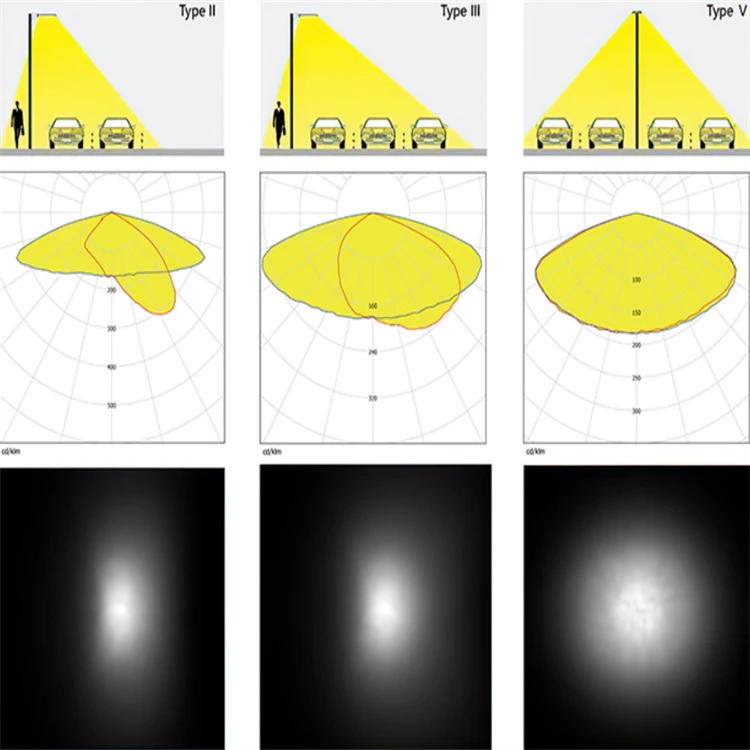
This fixture features high-precision optical lenses (Types II, III, IV, V). Because these lenses are highly efficient at redirecting light exactly where it is needed (eliminating spill light), the fixture can operate at a lower power draw to achieve the same ground-level illuminance. Lower power draw means less heat generated at the junction, which further reduces thermal stress on the heat sink. It is a self-reinforcing cycle of efficiency.
Smart Control and Thermal Modulation
The integration of a Photocell (Feature #5) adds another layer of thermal protection. By automatically turning the light off during daylight hours, the fixture is given time to completely cool down. This prevents the continuous 24-hour heat buildup that drastically shortens the lifespan of fixtures connected to faulty timers.
The Commercial Impact: Why Buyers Should Care About Heat Sinks
For B2B buyers, lighting distributors, and facility managers, the design of a heat sink is not just an engineering curiosity; it directly impacts the bottom line.
Slashing Maintenance Costs and Total Cost of Ownership (TCO)
In outdoor lighting, the initial purchase price is only a fraction of the total cost. The true cost lies in maintenance: renting bucket trucks, paying union electricians, and closing lanes of traffic.
When a light fails due to heat degradation, the cost to replace it can be hundreds or even thousands of dollars. Because this die-cast aluminum heat sink drastically lowers the operating temperature, the fixture will last its full 50,000+ hour rated life. This virtually eliminates unscheduled maintenance, delivering a massive Return on Investment (ROI).
The 5-Year Warranty: Confidence Backed by Engineering
The manufacturer is so confident in the thermal management of this fixture that it offers a 5-year warranty. A warranty is only as good as the engineering behind it. Because the heat sink prevents the premature failure of the LEDs and the premium Meanwell/Moso drivers, the manufacturer can confidently back the product. For the buyer, this is a guarantee of safety and financial security.
Preserving Light Output and Safety
As the heat sink prevents lumen depreciation, the fixture will maintain its required foot-candle levels for safety and security. A parking lot or roadway that gradually becomes darker over time due to thermal degradation becomes a liability. By maintaining consistent light output, the heat sink ensures the environment remains safe for drivers and pedestrians for years to come.
Aesthetic Value and Community Approval
Finally, the fashionable housing design is a powerful PR tool. Modern municipalities are highly sensitive to public feedback regarding the appearance of infrastructure. A sleek, well-designed fixture enhances the visual appeal of a neighborhood, reducing complaints and generating positive public sentiment toward local government and utility providers.
Conclusion: The Perfect Union of Form and Function
The days of ugly, heavy lighting fixtures are over. The modern outdoor environment demands a luminaire that is as beautiful as it is durable.
This fixture represents the pinnacle of this evolution. Its fashionable housing design boasts a compact, aerodynamic profile that enhances urban aesthetics and withstands high winds. More importantly, its great heat dissipation die-cast aluminum heat sink is a thermodynamic masterpiece. By utilizing deep fins, premium materials, and a direct thermal path, it obliterates the threat of heat degradation.
When combined with the IP66 waterproof driver box, premium Meanwell/Moso/Sosen power supplies, and advanced optical lenses, the new heat sink design proves that you no longer have to choose between looking good and performing flawlessly. For municipalities, contractors, and distributors seeking the ultimate outdoor LED street light, this fixture is the definitive investment in aesthetic brilliance and uncompromising reliability.

How To Cooperate With Us?
We are happy that we have total control over the manufacturing process and the quality of our products since we have our own facilities. Since we are producers rather than just brokers, we are dedicated to providing our customers with the best pricing. Since we are certain that the price and quality of our products are transparent, we advise customers to examine our samples first. Our commitment to quality and customer satisfaction drives us to continuously provide top-notch goods.
Our address
3rd Floor, 5th Building, Hebei Industrial Park, Hualian Community, Longhua District, Shenzhen, China





