

The Definition Problem: What "Full Spectrum" Should Mean, and What It Often Does
The Technical Baseline: 380–780 nm with Deliberate Spectral Engineering
A credible full-spectrum LED grow light emits radiation across the complete photosynthetically relevant waveband-conventionally cited as 380 to 780 nm-with intentional spectral shaping at the absorption peaks of chlorophyll and other plant photoreceptors. In practical T8 tube design, this is typically achieved by blending 3000 K warm-white and 5000 K cool-white phosphor-converted diodes with discrete 660 nm deep-red and 730–750 nm far-red emitters. The resulting spectral power distribution should show measurable photon flux in the blue region (≈430–480 nm), a broad green-yellow shoulder (≈500–600 nm), a dominant red peak (≈630–680 nm), and a non-trivial far-red tail above 700 nm.
This definition is agronomic, not aesthetic. A tube that looks white to the human eye can still be spectrally deficient if its emission lacks sufficient blue to regulate stomatal conductance and internode extension, or lacks far-red to engage phytochrome-mediated photomorphogenesis.
The Marketing Loophole: "White Plus a Little Red" Is Not a Recipe
The term "full spectrum" migrated into horticulture from the commercial lighting industry, where a CRI above 90 once served as a rough proxy for daylight-like color rendering. That standard has no direct bearing on photosynthetic or photomorphogenic performance. The result is a market in which "full spectrum" frequently denotes nothing more than standard white LEDs supplemented with a small number of red diodes, with no evidence of optimization for plant photoreceptor response.
The consequence for buyers is that the label carries almost no discriminating power. Two tubes can both claim "full spectrum" while differing by a factor of two in photon efficacy and by a wide margin in blue-to-red balance and far-red content. The only reliable defense is to demand the measured spectral distribution graph and to read it against the photobiological criteria in Section 2.
Why the Distinction Matters Financially
A grower who buys on the label rather than the spectral curve is not merely making a suboptimal purchase; they are exposing themselves to the failure mode documented by a commercial greenhouse purchasing manager who outfitted a propagation room with 40 industrial LED tubes at $80 each. The tubes were bright enough for a warehouse, but the spectrum was wrong and the PPFD distribution was inconsistent. Fifteen percent of clones were lost in the first four weeks due to uneven intensity-a **$3,750 crop loss on top of the $3,200 hardware expenditure**. The lesson is not that cheap tubes always fail; it is that the absence of spectral and PPFD verification shifts the cost of failure onto the buyer.
The Photon Metrics That Actually Predict Performance
Efficacy (μmol/J): The Only Energy Number That Belongs in a Purchase Decision
Photosynthetic photon efficacy-μmol of PAR photons delivered per joule of electricity consumed-integrates LED binning, driver efficiency, and optical losses into a single figure that predicts the electricity cost of producing a given photon dose. The current quality thresholds are unambiguous. A minimum of 2.5 μmol/J is the entry point for a professionally credible fixture; ≥2.7 μmol/J is the target for competitive installations; and top-tier tubes reach 2.9 μmol/J or slightly above. Sub-2.0 μmol/J fixtures are not merely inefficient; they are structurally disadvantaged in any multi-year operating calculation, because every hour of operation locks in a higher electricity cost per photon than a superior tube would have required.
For a T8 tube operating 16 hours per day, the annual energy difference between a 2.2 μmol/J legacy design and a 2.9 μmol/J current-generation lensed tube is approximately 70 kWh per tube per year-a figure that compounds into tens of thousands of kilowatt-hours across a multi-tier rack system.
PPFD at Shelf Distance: Why Generic "PPFD" Claims Are Inadequate
PPFD specifications without a stated measurement distance are analytically useless. Shelf-based cultivation operates at 15–30 cm canopy-to-fixture distance, an order of magnitude closer than overhead greenhouse lighting. At these distances, secondary optics and lens design become primary determinants of delivered intensity.
Measured data from a T8 tube family with three optical/spectral configurations illustrates the magnitude of the effect. A bare 36 W tube delivers 270 μmol·m⁻²·s⁻¹ at 0.15 m; a lensed 32 W tube in the same family delivers 365 μmol·m⁻²·s⁻¹ at the same distance; and a higher-output lensed variant reaches 416 μmol·m⁻²·s⁻¹-a 54% increase in delivered PPFD relative to the bare tube despite consuming 4 W less power. The lens accomplishes this by redirecting side-emitted photons downward, simultaneously increasing intensity and improving uniformity across the canopy.
The practical implication is that a buyer comparing two tubes at the same wattage may be comparing fixtures that deliver materially different photon doses to the plant. The correct question is not "what is the PPFD?" but "what PPFD is delivered at my shelf height, and how uniform is it across the usable width? " A credible supplier will provide a PPFD map or at minimum a distance-indexed table.
DLI and Photoperiod: Closing the Loop from Fixture to Crop
PPFD at canopy is an instantaneous intensity; the cumulative daily photon dose is the Daily Light Integral (DLI) . For leafy greens such as lettuce and basil, the practical target range is PPFD 200–350 μmol·m⁻²·s⁻¹ with DLI 12–17 mol·m⁻²·d⁻¹; microgreens target 100–200 μmol·m⁻²·s⁻¹ with DLI 6–10 mol·m⁻²·d⁻¹. A T8 tube that delivers 275–316 μmol·m⁻²·s⁻¹ at 0.2 m across the central 80% of a 1200 mm shelf is therefore appropriately specified for full-cycle leafy-green production under a 16–18 hour photoperiod.
This framework matters for purchasing because it prevents the two most common sizing errors: selecting a tube whose delivered PPFD is below the crop's threshold (producing slow, etiolated growth regardless of spectrum quality), and over-specifying intensity for a low-DLI crop, which wastes capital and electricity without a proportional yield response.
The Spectrum Decision: Red–Blue Balance, Green, and Far-Red
Red and Blue Are Not Interchangeable "Channels"
Blue light (≈430–480 nm) drives stomatal opening, compact internode spacing, and the sturdy architecture that allows a canopy to support fruit load. Red light (≈630–680 nm) supplies the bulk of photosynthetic photon flux for many species and, through the phytochrome system, regulates stem elongation and the transition to reproductive development. Neither can substitute for the other without morphological consequences. A spectrum deficient in blue produces elongated, structurally weak growth; a spectrum dominated by blue at the expense of red underutilizes photosynthetic capacity.
In full-spectrum tube design, the practical consequence is that the red-to-blue ratio must be verified, not assumed. A tube that looks balanced to the eye may be heavily red-weighted; a tube marketed as "full spectrum" may be blue-deficient relative to the needs of a compactness-sensitive crop.
Green Light's Non-Cosmetic Role
Green light (≈500–600 nm) is sometimes treated as photosynthetically irrelevant because chlorophyll absorbs it less efficiently than red or blue. This inference is incorrect at the canopy scale. Green photons penetrate deeper into leaf tissue and into lower canopy layers than red and blue photons, which are preferentially absorbed in the upper leaf strata. The result is that green light supports photosynthesis in shaded leaves that red and blue light cannot reach efficiently, improving whole-canopy carbon assimilation at high planting densities.
For shelf-grown leafy greens and herbs, where self-shading within a dense canopy is a primary constraint on yield, the green component of a full-spectrum tube is therefore a functional attribute, not merely a concession to human visual comfort-though the improved color rendering under white full-spectrum light is itself operationally valuable, because it allows growers to detect leaf yellowing, pest pressure, and nutrient deficiency with the naked eye.
Far-Red: The Photomorphogenic Signal Above PAR
Far-red radiation (700–800 nm) falls largely outside the conventional PAR definition, but its biological activity is unambiguous. It is absorbed by phytochrome, shifting the photostationary state toward the inactive Pr form and regulating shade-avoidance responses, flowering timing, and-at low supplemental doses-leaf expansion and canopy architecture. In full-spectrum tube formulations, a small but measurable far-red component (≈730 nm) is a marker of deliberate spectral engineering rather than incidental white-light leakage.
The buyer's takeaway is that a spectral graph showing zero photon flux above 700 nm is not a neutral omission; it indicates a tube designed for PAR delivery alone, without the phytochrome-signaling component that distinguishes a horticulturally complete spectrum from a merely "bright" one.
Reliability Specifications That Determine Five-Year Performance
Thermal Design: The Junction Temperature Nobody Measures
LEDs generate less radiant heat per photon than legacy sources, but the heat that is produced originates at the semiconductor junction and must be conducted away to preserve efficacy and spectral stability. In a T8 tube, the aluminum housing is the primary thermal pathway. A thick aluminum extrusion-not a thin cosmetic shell-conducts junction heat to the tube surface for convective dissipation. Tubes that rely on plastic housings or minimal aluminum backing operate at higher junction temperatures, accelerating lumen depreciation and spectral shift.
The operational consequence extends beyond lamp longevity. Poor thermal design in a sealed indoor environment imposes an additional HVAC cooling load that partially offsets the electricity savings from LED conversion. A tube that runs cooler at the surface is not merely longer-lived; it reduces the parasitic cooling energy required to maintain the grow space within setpoints.
Ingress Protection: IP65 Is the Floor, IP66 Is the Working Standard
Hydroponic and vertical-farm environments are continuously humid. Irrigation spray, condensation, and routine washdown expose fixtures to water ingress that will destroy unprotected drivers and LED boards. IP65 (dust-tight, protected against water jets) is the minimum defensible rating for greenhouse and rack use; IP66 is preferable for food-production environments where direct washdown is routine. Integrated T8 tubes that carry IP66 with twist-lock daisy-chain connectors preserve the ingress seal across the entire linked run, not merely at the fixture body.
Lifespan and Warranty: Reading the Denominator Correctly
Modern T8 LED grow tubes are rated at 35,000–50,000 hours to L70, the point at which output has declined to 70% of initial. At 16 hours of daily operation, a 35,000-hour rating corresponds to roughly six years of service before first replacement. A three-to-five-year warranty is therefore a meaningful signal of manufacturing confidence, not an arbitrary marketing concession. Fluorescent tubes, by contrast, require replacement every 8–12 months to maintain acceptable output-a recurring labor burden that LED tubes eliminate from the maintenance schedule entirely.
The Procurement Framework: What to Verify Before You Buy
A Due-Diligence Checklist for Full-Spectrum Claims
The following verification sequence reflects the criteria established in the preceding sections. A tube that fails any of the first three items should be eliminated from consideration regardless of price.
First: Demand the measured spectral distribution graph. Verify non-zero photon flux across blue (430–480 nm), green (500–600 nm), red (630–680 nm), and far-red (730 nm). A graph that shows only a blue spike and a red spike-with no meaningful green shoulder or far-red tail-is a red–blue tube in white packaging, not a full-spectrum tube.
Second: Require efficacy at or above 2.5 μmol/J, with ≥2.7 μmol/J preferred for commercial installations. Cross-reference the stated PPF against the input wattage: PPF (μmol/s) ÷ input power (W) should equal the claimed efficacy. A high PPF figure paired with low efficacy is an inefficient fixture that will consume more electricity per delivered photon over its service life.
Third: Request PPFD at your intended mounting distance, with a uniformity statement. At shelf distance (15–30 cm), demand a distance-indexed PPFD table or map. The relevant figure is not the center-point maximum but the average PPFD across the central 80% of the usable shelf width, with an explicit statement of edge fall-off.
Fourth: Confirm the thermal and ingress specifications. Aluminum housing of meaningful mass, IP65 minimum (IP66 preferred), and a rated lifespan with a stated L70 endpoint and warranty term.
Fifth: Calculate five-year PPFD per dollar, not sticker price per tube. A higher-efficacy, higher-PPFD tube at a modest price premium will deliver more usable photons per dollar of total energy expenditure over a five-year horizon than a cheaper, lower-efficacy alternative. The lensed 2.9 μmol/J tube in the measured dataset delivers 61% more usable PPFD per dollar over five years than its older 2.5 μmol/J bare counterpart.
Matching the Tube to the Cultivation Scenario
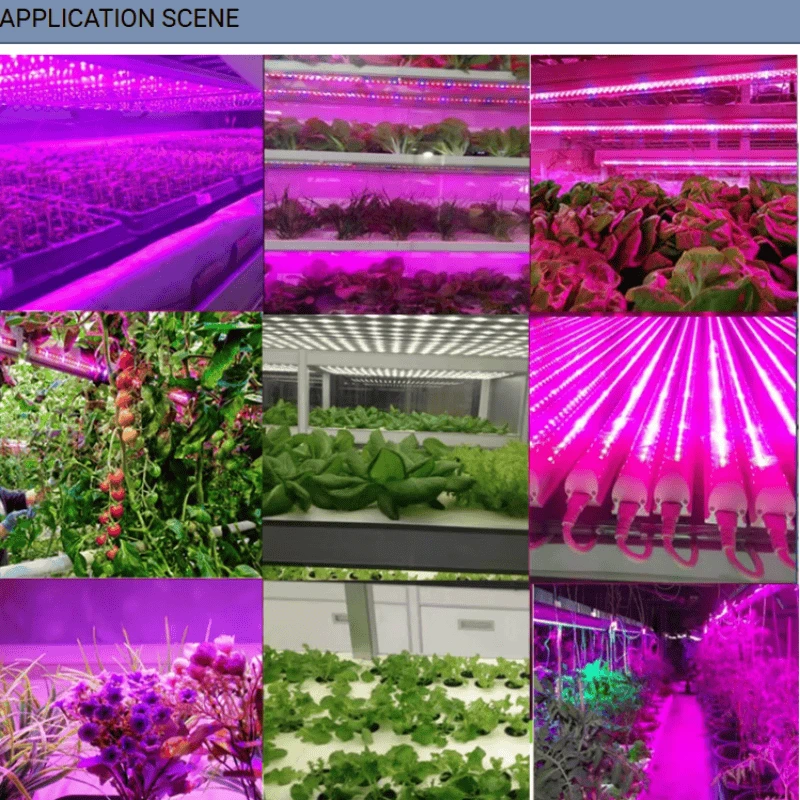
Full-spectrum T8 tubes are the appropriate default for most shelf-based indoor cultivation, but the optimal configuration varies by objective. For multi-layer leafy greens and herbs, a full-spectrum tube delivering 275–316 μmol·m⁻²·s⁻¹ at 0.2 m is correctly specified for full-cycle production. For seedling propagation and tissue culture, a full-spectrum tube with a higher blue fraction supports compact, sturdy transplants, and the white light output allows continuous visual health assessment without the eye strain associated with pink-purple red–blue lighting. For fruiting and flowering crops, a full-spectrum formulation with enhanced 660 nm red and a deliberate far-red component better supports flower initiation, fruit set, and quality-associated secondary metabolism. For large-scale, cost-sensitive supplemental lighting where human inspection is infrequent, red–blue tubes retain a legitimate efficiency advantage, but they are not full-spectrum substitutes and should be evaluated as the distinct category they are.
The Cost of Getting It Wrong
The commercial propagation-room failure cited earlier is instructive precisely because the tubes were not defective-they were bright, functional light sources applied to a biological process they were never optimized for. The $3,200 hardware cost was the smallest part of the loss. The 15% clone mortality, the installation labor, and the replacement fixtures compounded into a total cost several times the purchase price. A buyer who verifies spectral distribution, efficacy, and distance-indexed PPFD before committing avoids this outcome not through superior technical knowledge alone, but through the discipline of treating "full spectrum" as a claim requiring evidence rather than a category requiring no further thought.
Specification Verification Sheet for Full-Spectrum T8 Grow Tubes
| Parameter | What to Request | Passing Threshold |
|---|---|---|
| Spectral graph | Measured SPD, 380–780 nm | Blue, green, red, and far-red all present |
| Photon efficacy | μmol/J (PPF ÷ input W) | ≥ 2.5; ≥ 2.7 preferred |
| PPFD at canopy | Distance-indexed table or map | ≥ 250 μmol·m⁻²·s⁻¹ at shelf height, central 80% uniformity |
| Housing | Material and construction | Aluminum extrusion, not plastic shell |
| Ingress protection | IP rating | IP65 minimum; IP66 for washdown |
| Lifespan | Hours to L70 | ≥ 35,000 h |
| Warranty | Years of coverage | 3–5 years |
| Linkability | Connector type and maximum run | Waterproof twist-lock, ≥ 8-tube chain |
The full-spectrum T8 tube is a mature, high-performance format-but "mature" and "uniform" are not synonyms. The market contains both precisely engineered photon-delivery instruments and cosmetically similar tubes that will underperform from the first photoperiod. The difference is visible on the spectral graph, the efficacy figure, and the distance-indexed PPFD table before a single tube is installed. Buy the specifications, verify the evidence, and the lighting system becomes a silent, durable contributor to every harvest.
How To Cooperate With Us?
Our firm prides itself on owning its own factory, guaranteeing complete control over the production process and the quality of our goods. We are not only agents; we are manufacturers committed to offering our clients the most competitive rates available. We invite consumers to evaluate our samples first, as we are assured that the quality and pricing of our items are self-evident. Our dedication to excellence and client satisfaction compels us to consistently perform at our best and provide superior quality products.
Our address
3rd Floor, 5th Building, Hebei Industrial Park, Hualian Community, Longhua District, Shenzhen, China





