

Introduction: The Hydroponic Lighting Problem
Hydroponic cultivation decouples plant production from geography and season, but it does not decouple it from physics. In a recirculating nutrient-film technique (NFT) system, a deep-water culture (DWC) raft, or a multi-tier vertical rack, every photon delivered to the canopy is generated at a measurable electricity cost and dissipated as heat that the HVAC system must remove. The lighting fixture is therefore not a peripheral accessory; it is the primary determinant of both the energy intensity and the biological productivity of the entire operation.
For two decades, the default hydroponic lighting choice was the T8 or T5 fluorescent tube-cheap to purchase, widely available, and physically compatible with standard shelving. That default is now obsolete on every metric that matters to a commercial or serious hobbyist grower. The integrated T8 LED grow tube-a self-contained lamp with driver, optics, and linkable connectors-delivers the same physical form factor while fundamentally changing the energy, spectral, and maintenance economics of hydroponic production.
This paper presents the five reasons that justify switching, in order of their financial and agronomic impact. Each reason is treated as an engineering and economic argument, supported by measured performance data and framed for the grower who is evaluating a conversion decision rather than browsing a product catalogue.
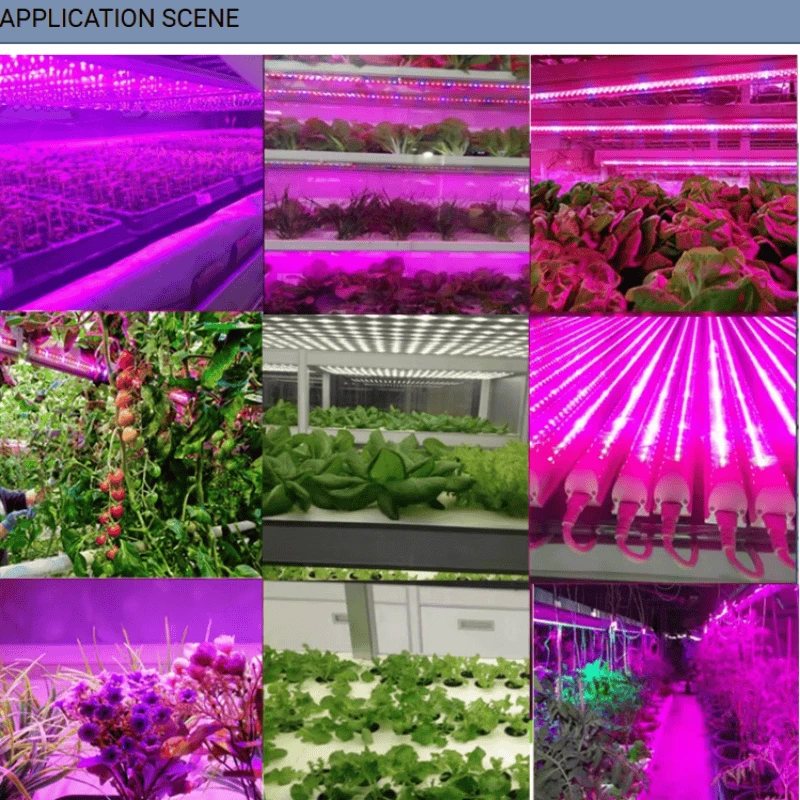
Reason One: Energy Efficiency That Converts Directly into Operating Margin
The Efficacy Gap Between Fluorescent and LED Tubes
The foundational metric for any horticultural lighting comparison is photosynthetic photon efficacy-micromoles of PAR photons delivered per joule of electrical energy consumed (μmol/J). Legacy fluorescent T8 tubes deliver approximately 0.6–1.0 μmol/J. The integrated LED tubes specified for hydroponic use operate in the 2.5–2.9 μmol/J range, with premium lensed variants reaching the upper bound. This means that for every kilowatt-hour consumed, a modern LED tube produces two to four times the photosynthetically usable photons of the fluorescent tube it replaces.
The practical consequence is not a marginal improvement; it is a structural change in the energy cost of production. A 1,000-tube vertical lettuce farm operating 16 hours per day illustrates the scale. Replacing 40 W fluorescent tubes with 32 W LED tubes of equivalent or superior photon output eliminates approximately 46,720 kWh per year. At commercial electricity rates of $0.10–$0.15/kWh, the annual savings range from $4,672 to $7,008-before accounting for reduced cooling load, which is addressed in Section 4.
The Lens Effect: More Photons per Watt at Shelf Distance
Hydroponic shelving typically places the fixture 15–30 cm above the canopy-an order of magnitude closer than greenhouse overhead lighting. At these short throw distances, optical design determines how much of the emitted photon flux actually reaches the plant rather than escaping sideways. Measured data from a single T8 tube family demonstrates the effect. A bare 36 W tube delivers 270 μmol·m⁻²·s⁻¹ at 0.15 m. A lensed 32 W tube in the same family delivers 365 μmol·m⁻²·s⁻¹ at the same distance, and a higher-output lensed variant reaches 416 μmol·m⁻²·s⁻¹-a 54% increase in delivered PPFD relative to the bare tube despite consuming 4 W less power.
The procurement implication is that efficacy figures must be read alongside optical configuration. A tube with a quoted efficacy of 2.5 μmol/J but no secondary optics may deliver less usable PPFD at shelf distance than a lensed 2.4 μmol/J alternative. The correct comparison is not "what is the efficacy?" but "what PPFD reaches the canopy per watt consumed at my mounting height? "
The Five-Year Energy Arithmetic
The case becomes unambiguous when extended over the service life of the fixture. A lensed 2.9 μmol/J tube operating 16 hours per day for five years consumes 934 kWh. Its 2.2 μmol/J bare counterpart consumes 1,168 kWh to deliver less usable light. The difference-234 kWh per tube-is pure operating margin. Across a 200-tube hydroponic installation, that differential represents 46,800 kWh and $4,680–$7,020 in avoidable electricity expenditure over five years. The higher-efficacy tube may carry a purchase premium of $5–$10 per unit; the energy savings alone repay that premium within the first year of operation.
Reason Two: Spectrum Control That Matches the Crop, Not the Warehouse
The Red–Blue Ratio as a Developmental Signal
Fluorescent tubes emit a fixed spectrum optimized for human vision, not plant photobiology. LED tubes allow the grower to specify the red-to-blue (R:B) ratio that matches the crop and growth stage. Blue light (≈430–480 nm) regulates stomatal opening, internode spacing, and compact architecture. Red light (≈630–680 nm) drives photosynthetic carbon assimilation and, through the phytochrome system, controls stem elongation and the transition to flowering.
The practical formulations available in integrated T8 tubes cover the range that hydroponic growers need. A 3:1 R:B ratio is widely adopted for balanced vegetative growth across leafy greens and herbs. A 5:1 R:B ratio-or a full-spectrum formulation with enhanced 660 nm red-supports flowering, fruiting, and the accumulation of quality-associated secondary metabolites in crops such as tomato, pepper, and strawberry. A full-spectrum tube blending 3000 K, 5000 K, and 660 nm diodes provides the broad waveband coverage that supports compact growth and visual crop assessment under white light.
Green Light and Far-Red: Beyond the Red–Blue Binary
Two spectral components are frequently overlooked in simplified R:B marketing, yet both matter in a dense hydroponic canopy. Green light (≈500–600 nm) penetrates deeper into leaf tissue and lower canopy layers than red and blue photons, supporting photosynthesis in shaded leaves that would otherwise be light-limited. For multi-tier leafy-green production, where self-shading is a primary yield constraint, the green component of a full-spectrum tube is a functional asset.
Far-red radiation (700–800 nm) falls largely outside the conventional PAR definition but exerts phytochrome-mediated effects on leaf expansion and canopy architecture. A full-spectrum tube with a deliberate 730 nm component signals to the plant a light environment conducive to productive vegetative growth rather than shade avoidance. A spectral graph showing zero photon flux above 700 nm indicates a tube designed for PAR delivery alone, without the photomorphogenic completeness that distinguishes a horticulturally mature spectrum from a merely bright one.
The Agronomic Consequence of Getting Spectrum Right
The commercial cost of a spectrum mismatch is not hypothetical. A greenhouse operator who installed 40 industrial LED tubes in a propagation room at $80 each lost **15% of clones in the first four weeks** due to uneven intensity and a spectrum ill-suited to rooting and early vegetative development. The **$3,750 crop loss** exceeded the entire $3,200 hardware expenditure. A full-spectrum tube specified for propagation-with adequate blue for compact hypocotyl development and white light for visual inspection-avoids this failure mode. The switch to LED is not merely a change in technology; it is an opportunity to specify the spectrum that the crop actually requires.
Reason Three: Thermal Management That Reduces HVAC Load and Protects the Canopy
Junction Heat, Housing Design, and Lumen Depreciation
LEDs convert a higher fraction of input electricity into photons and a lower fraction into radiant heat than fluorescent tubes. But the heat that is produced originates at the semiconductor junction and must be conducted away to preserve efficacy and spectral stability. In an integrated T8 tube, the aluminum housing serves as the primary thermal pathway. A thick aluminum extrusion conducts junction heat to the tube surface for convective dissipation; a plastic or thin-gauge shell allows junction temperature to rise, accelerating lumen depreciation and spectral shift.
The operational consequence is a longer useful life at rated output. A tube that runs cooler at the surface maintains its initial PPFD for a greater fraction of its rated hours, which matters directly in hydroponic systems where consistent intensity across the canopy is a prerequisite for uniform crop timing and harvest scheduling.
The Hidden HVAC Penalty of Legacy Lighting
Fluorescent and high-intensity discharge fixtures radiate heat directly onto the plant canopy and into the grow space. In a sealed indoor hydroponic environment, this heat imposes an additional 15–25% load on the HVAC system beyond the fixture's own electricity consumption. The grower pays twice: once for the electricity that generates the heat, and again for the cooling energy required to remove it.
Integrated LED tubes with efficient thermal design reduce this parasitic cooling burden. The fixture-level heat rejection is lower, and the heat that is produced is conducted to the tube surface rather than radiated onto the canopy. In a multi-tier vertical farm where temperature and humidity must be held within narrow setpoints, the HVAC savings compound with the direct lighting energy savings to produce a total electricity reduction that frequently exceeds 50% relative to a fluorescent baseline.
Canopy Proximity Without Leaf Burn
Hydroponic shelving requires fixtures to operate within 15–30 cm of the canopy. Fluorescent tubes at this distance radiate sufficient heat to risk leaf scorch and transpiration stress in sensitive crops. LED tubes generate less radiant heat at the canopy plane, allowing closer mounting and more efficient use of vertical space-a critical advantage in multi-tier systems where every centimeter of clearance between shelf and fixture represents lost growing volume. The switch to LED therefore enables a denser rack configuration, which increases production per cubic meter of facility volume.
Reason Four: Lifespan and Maintenance Elimination
The Relamping Burden of Fluorescent Systems
Fluorescent tubes degrade gradually and must be replaced every 8–12 months to maintain acceptable output, regardless of whether they still illuminate. In a commercial hydroponic installation, this creates a recurring cycle of material cost, labor, and scheduling disruption. Each relamping event requires access to fixtures within productive canopy space-a task that is slow, awkward, and disruptive to crop scheduling.
Integrated LED grow tubes are rated at 35,000–50,000 hours to L70-the point at which output has declined to 70% of initial. At 16 hours of daily operation, a 35,000-hour rating corresponds to approximately six years of service before first replacement. A three-to-five-year warranty is standard for quality fixtures. The elimination of scheduled relamping removes an entire category of operating expense from the hydroponic budget.
Ingress Protection and Washdown Durability
Hydroponic environments are continuously humid. Irrigation spray, condensation, and routine washdown expose fixtures to water ingress that destroys unprotected electronics. Integrated T8 tubes rated IP65 (dust-tight, protected against water jets) or IP66 (protected against powerful water jets) are designed for this environment. Waterproof twist-lock daisy-chain connectors preserve the ingress seal across linked runs, not merely at the fixture body. Fluorescent fixtures, by contrast, are rarely rated for direct washdown and are vulnerable to corrosion and ballast failure in humid conditions. The switch to IP-rated LED tubes reduces unplanned downtime and extends fixture service life in the most demanding hydroponic environments.
The Maintenance Labor Dividend
The maintenance economics of LED conversion are frequently underestimated. A 1,000-tube installation relamped annually requires 1,000 replacement tubes per year and dozens of labor hours to access, replace, and dispose of them. Over a five-year horizon, the LED tube eliminates roughly 4,000 replacement tubes and the associated labor events. The payback period for a premium LED tube is typically under 12 months in a commercial setting once energy and maintenance savings are combined. After payback, the savings accrue as operating margin-a direct contribution to the profitability of the hydroponic enterprise.
Reason Five: Scalable, Plug-and-Play Integration for Rack and Vertical Systems
The Integrated Format Eliminates Component-Level Complexity
The integrated T8 LED grow tube consolidates lamp, driver, and optics into a single sealed unit. There is no separate ballast to mount, no low-voltage DC wiring to engineer, and no compatibility matrix between lamp and fixture. The tube arrives with a power cord and switch; daisy-chain connectors allow multiple tubes to share a single power feed. Installation is reduced to mounting the tube, connecting the power, and beginning cultivation.
This architectural simplicity has strategic implications for hydroponic growers. A small operation can begin with a handful of tubes over a seedling bench and expand incrementally as cultivation capacity grows, without re-engineering the lighting infrastructure. The same form factor that serves a hobbyist's three-tier shelving unit scales to hundreds of tubes in a commercial racking system, preserving procurement simplicity and spares commonality across the facility.
Linkability and Reconfigurability
The daisy-chain connectors that link T8 tubes end-to-end are not a convenience feature; they are a scalability enabler. A single power feed can serve a run of eight or more tubes, reducing the number of electrical drops required in a multi-tier rack. When the grower reconfigures the rack-as hydroponic operations frequently do in response to crop rotation or market demand-the lighting system can be reconfigured with equal speed. Fluorescent fixtures, by contrast, are fixed to their ballast wiring and are costly to relocate.
Uniformity Across the Canopy
The linear form factor of the T8 tube is inherently well-suited to uniform canopy illumination. A properly spaced array of tubes distributes photon flux across the full length and width of the shelf, avoiding the point-source hotspots and edge fall-off that characterize discrete-bulb fixtures. For hydroponic leafy greens and herbs, where uniformity of PPFD across the canopy translates directly into uniform crop timing and harvest quality, this geometric advantage is agronomically significant. The switch to LED tubes is therefore not merely a change in light source; it is an opportunity to improve the spatial uniformity of the entire lighting system.
A Conversion Pathway, Not a Leap of Faith
The integrated T8 format is designed as a direct replacement for fluorescent tubes in existing shelving. The physical dimensions, mounting clips, and power connection are compatible with standard hydroponic racking. A grower can convert one shelf at a time, measure the response in crop growth and electricity consumption, and expand the conversion as confidence and budget allow. This phased pathway reduces the risk of a wholesale lighting overhaul and allows the operational savings from the first converted shelf to fund the conversion of the next.
Table 1. Fluorescent vs. Integrated LED T8 Grow Tube: Specification Comparison
| Parameter | Fluorescent T8 Baseline | Integrated LED T8 Grow Tube |
|---|---|---|
| Photon efficacy | 0.6–1.0 μmol/J | 2.5–2.9 μmol/J |
| PPFD at 0.15 m (measured) | ~180–220 μmol·m⁻²·s⁻¹ | 270–416 μmol·m⁻²·s⁻¹ |
| Lifespan to L70 | 8–12 months practical | 35,000–50,000 hours |
| Relamping frequency | Annual | ≥ 5 years |
| Ingress protection | Typically unrated | IP65–IP66 |
| Thermal management | Radiant heat to canopy | Aluminum conduction, low canopy heat |
| Linkability | Hardwired per fixture | Waterproof daisy-chain, ≥ 8 tubes |
| Spectrum options | Fixed | Full spectrum, 3:1 R:B, 5:1 R:B |
| Warranty | 90 days–1 year | 3–5 years |
Conclusion: The Switch Is an Economic Decision, Not a Technological One
The five reasons presented in this paper converge on a single conclusion: the switch from fluorescent to integrated LED tube lighting in a hydroponic setup is not a question of whether the technology is superior-that is settled-but of whether the grower has quantified the economic and agronomic cost of delay. The energy savings alone repay the conversion premium within the first year of operation. The maintenance elimination removes a recurring labor burden from the operating schedule. The thermal advantages reduce HVAC load and allow denser rack configurations. The spectral options allow the grower to match the light to the crop rather than forcing the crop to accommodate the light. And the integrated, linkable format makes the conversion a phased, low-risk process rather than a wholesale infrastructure overhaul.
The procurement framework is straightforward. Demand ≥2.5 μmol/J efficacy (≥2.7 μmol/J preferred), IP65 or higher ingress protection, an aluminum thermal pathway, a measured spectral distribution graph demonstrating emission across blue, green, red, and far-red wavebands, and a distance-indexed PPFD table reflecting the actual shelf height in the grow space. A tube that meets these thresholds will deliver five years of reliable, spectrally appropriate photon flux at a fraction of the energy and maintenance cost of the fluorescent system it replaces.
The hydroponic industry's most successful operators have already made this switch. The remaining question for those who have not is not whether LED tubes are the right choice, but how quickly the conversion can be completed before the operating cost gap becomes a competitive disadvantage. The answer, for most operations, is: one shelf at a time, starting now.
How To Cooperate With Us?
Our firm prides itself on owning its own factory, guaranteeing complete control over the production process and the quality of our goods. We are not only agents; we are manufacturers committed to offering our clients the most competitive rates available. We invite consumers to evaluate our samples first, as we are assured that the quality and pricing of our items are self-evident. Our dedication to excellence and client satisfaction compels us to consistently perform at our best and provide superior quality products.
Our address
3rd Floor, 5th Building, Hebei Industrial Park, Hualian Community, Longhua District, Shenzhen, China





