

The 2026 Market Context: Why the Tube Format Matters Now
Two Demand Engines, One Physical Constraint
The 2026 LED grow light market is estimated at approximately USD 1.315 billion, with greenhouse applications holding a 61.5% share and vertical farms accounting for over 30%. These two segments impose different optical requirements-greenhouses supplement sunlight at mounting heights of two meters or more, while vertical farms deliver all photons at shelf distances of 15–30 cm-but they share a common physical constraint: the fixture must deliver uniform photon flux across a linear growing area without consuming vertical clearance or blocking maintenance access.
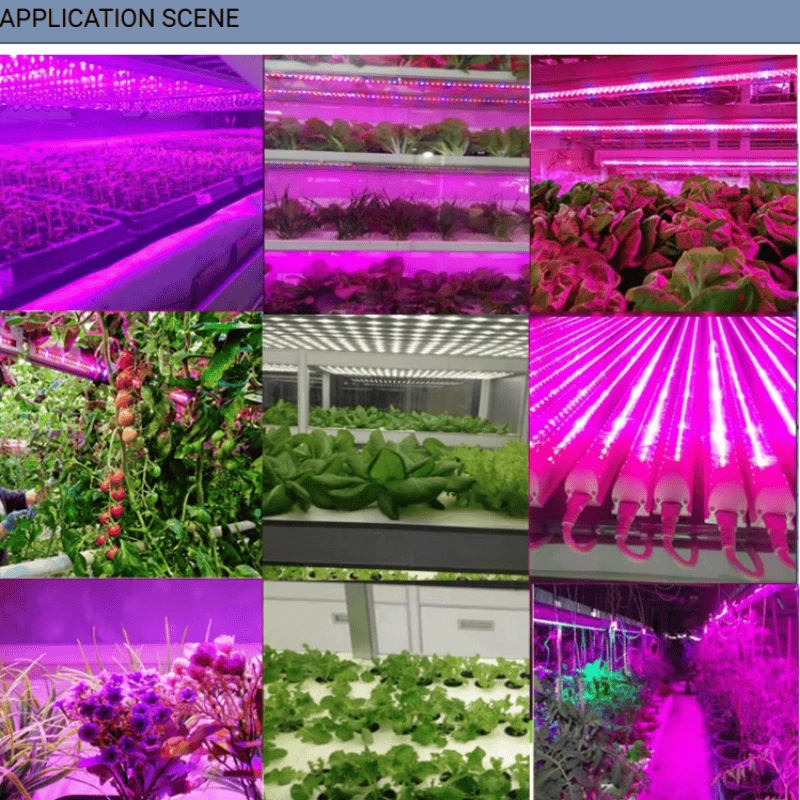
The integrated T8 tube addresses this constraint more directly than any alternative format. Its 1200 mm length matches standard rack widths; its 33 mm profile fits between shelves with minimal clearance; and its linear geometry distributes light along the full length of a row rather than concentrating it at a point source. In a greenhouse, the same format can be mounted under gutters or between crop rows for supplemental lighting without casting the broad shadows produced by large panels. The tube is not a universal fixture, but for the two largest segments of the 2026 market, it is the format that fits the physical infrastructure growers already have.
The "Best" Tube Is a Specification, Not a Brand
The market's rebound has produced a proliferation of tubes that look identical from the outside and differ substantially in performance. The buyer's task is to distinguish between them on the basis of measured photometric data, not wattage or price. The sections that follow establish the criteria that separate a 2026-competitive tube from a commodity fixture, and then apply those criteria to the vertical-farm and greenhouse use cases specifically.
The 2026 Benchmark Specification for a Best-in-Class Grow Tube
Photon Efficacy: 2.9 μmol/J as the Tube-Format Ceiling
Efficacy-μmol of PAR photons per joule of electricity-is the single most consequential number on a grow tube datasheet. The current tube-format benchmark is 2.9 μmol/J, achieved by lensed tubes that combine high-bin LED chips with efficient constant-current drivers. For comparison, a bare-diode tube in the same family may operate at 2.5 μmol/J, and older-generation designs sit at approximately 2.2 μmol/J.
The practical consequence is not marginal. A 2.9 μmol/J lensed tube consuming 32 W delivers 93 μmol/s of PPF; a 2.5 μmol/J bare tube consuming 36 W delivers 90 μmol/s. The higher-efficacy tube produces slightly more photons while drawing 4 W less power-and because its secondary lens redirects side-emitted photons downward, it delivers those photons where they matter. In a 1,000-tube installation operating 16 hours per day, the 2.9 μmol/J tube saves approximately 46,720 kWh per year relative to a 2.2 μmol/J baseline, translating to $4,672–$7,008 in electricity cost avoidance at commercial rates.
The Lens Effect: Why "PPFD" Without a Distance Is Meaningless
PPFD specifications must be read at the mounting distance the grower will actually use. At shelf distance (15–30 cm), secondary optics determine how much of the emitted flux reaches the canopy. Measured center-point data from a benchmark 2026 tube family illustrates the magnitude:
| Distance | Bare 36 W (2.5 μmol/J) | Lensed 32 W (2.7 μmol/J) | Lensed 32 W (2.9 μmol/J) |
|---|---|---|---|
| 0.15 m | 270 μmol·m⁻²·s⁻¹ | 365 μmol·m⁻²·s⁻¹ | 416 μmol·m⁻²·s⁻¹ |
| 0.20 m | 196 μmol·m⁻²·s⁻¹ | 275 μmol·m⁻²·s⁻¹ | 316 μmol·m⁻²·s⁻¹ |
| 0.30 m | 126 μmol·m⁻²·s⁻¹ | 185 μmol·m⁻²·s⁻¹ | 210 μmol·m⁻²·s⁻¹ |
Source: factory-measured center-point values.
The lensed 2.9 μmol/J tube delivers 35–55% more PPFD at the same distance than the bare tube, despite consuming 4 W less power. For a buyer, this means the correct comparison is not "what is the PPFD?" but "what PPFD is delivered at my shelf height, with the optics I intend to use? " A tube that quotes a high center-point PPFD without stating the distance is not providing actionable data.
Ingress Protection: IP66 Is the 2026 Working Standard
Both vertical farms and greenhouses are humid, washdown-prone environments. IP66-dust-tight and protected against powerful water jets-is the 2026 working standard for professional installations, not a premium upgrade. IP65 is the minimum defensible rating for dry indoor rooms, but a tube specified for a hydroponic rack or a greenhouse irrigation zone should carry IP66 and pair that rating with sealed, linkable connectors that preserve the ingress seal across the entire daisy-chained run. The economic logic is straightforward: an unprotected driver failure in a multi-tier rack requires fixture replacement and disrupts the crop cycle; an IP66 tube eliminates that failure mode from the operating schedule.
Thermal Architecture and Lifespan: L70 at 35,000–50,000 Hours
The aluminum housing of a professionally specified tube is a thermal component, not a cosmetic shell. A thick aluminum extrusion conducts junction heat to the tube surface for convective dissipation; a plastic housing allows junction temperature to rise, accelerating lumen depreciation and spectral shift. In a sealed indoor environment, poor thermal design also imposes a parasitic HVAC load that partially offsets the energy savings from LED conversion.
The 2026 benchmark lifespan for a commercial-grade tube is 35,000–50,000 hours to L70, with a three-to-five-year warranty as the standard signal of manufacturing confidence. At 16 hours of daily operation, a 35,000-hour rating corresponds to roughly six years of service before first replacement-eliminating the annual relamping cycle that fluorescent tubes impose.
Vertical Farming: Selecting the Best Tube for Shelf-Level Production
Matching PPFD to Crop and Rack Spacing
Vertical farms grow crops in stacked layers with fixed vertical clearance, typically 30–40 cm between shelf and fixture for leafy greens. At this distance, a lensed 2.9 μmol/J tube delivering 316 μmol·m⁻²·s⁻¹ at 0.20 m sits comfortably within the 200–400 μmol·m⁻²·s⁻¹ target range for lettuce, spinach, and arugula. For higher-light crops such as strawberries or herbs requiring 400–600 μmol·m⁻²·s⁻¹, the tube should be selected at a closer mounting distance or supplemented with a higher-output configuration; the tube format itself is capable of these intensities, but the spacing and tube count per shelf must be adjusted accordingly.
Uniformity and the Linear Advantage
Uniformity-expressed as U0 > 0.8 across the usable shelf area-is a primary selection criterion for vertical farms, because uneven light produces inconsistent growth and reduces pack-out rates. Linear tube fixtures have an inherent geometric advantage over point-source panels: when spaced at recommended intervals, their overlapping beams fill the shelf depth without the central hot spot and edge fall-off characteristic of discrete-bulb fixtures. A properly spaced T8 array delivers 220–280 μmol·m⁻²·s⁻¹ with acceptable uniformity across an 800 mm shelf depth at 0.25 m mounting height. The procurement question is therefore not "is this tube uniform?" but "what tube spacing produces U0 > 0.8 across my specific shelf width? "
Daisy-Chaining and Rack Integration
The integrated T8 format supports end-to-end connection of up to 10 tubes in series. In a multi-tier rack, this reduces the number of electrical drops required per shelf, lowering installation cost and simplifying cable management. The linkable architecture also allows the grower to convert one tier at a time-beginning with a seedling bench and expanding as cultivation capacity grows-without re-engineering the facility's electrical infrastructure.
Energy Density per Square Meter of Rack
At the rack level, the relevant energy metric is watts per square meter of growing area, not watts per tube. A 32 W tube spaced at the recommended density for leafy greens produces a power density of approximately 133 W/m² while delivering 300 μmol·m⁻²·s⁻¹ average PPFD at 0.30 m. A typical 10-layer lettuce vertical farm consumes 35–45 kWh/m²/day for lighting alone with legacy fixtures; a 2.9 μmol/J tube reduces this to 28–35 kWh/m²/day, a 20–25% reduction in the single largest recurring energy cost of the operation.
Greenhouses: Selecting the Best Tube for Supplemental Lighting
The Supplemental Lighting Role: Closing the DLI Deficit
Greenhouses rely on sunlight, but in winter and in high-latitude locations, the natural Daily Light Integral (DLI) falls below the crop's requirement. For lettuce and leafy greens, the target DLI is 14–18 mol·m⁻²·d⁻¹; for high-wire fruiting vegetables such as tomato and cucumber, the target is 25–30 mol·m⁻²·d⁻¹. When the greenhouse's transmitted sunlight delivers only 6.5 mol·m⁻²·d⁻¹ during the darkest months, supplemental lighting must close a deficit of 7.5–11.5 mol·m⁻²·d⁻¹ depending on the crop.
The required supplemental intensity follows directly: 60–100 μmol·m⁻²·s⁻¹ is common for moderate-DLI crops, while 150–200 μmol·m⁻²·s⁻¹ is common for high-DLI fruiting crops. A T8 tube is not a replacement for high-bay greenhouse top-lighting at two-meter mounting heights, but it is well suited to inter-row, under-gutter, and propagation-zone supplemental lighting, where the tube can be mounted close to the canopy and deliver its PPFD efficiently without the throw-distance losses of overhead fixtures.
Efficacy Under Greenhouse Conditions
The economic case for LED supplemental lighting in greenhouses rests on efficacy and on the ability to operate at lower intensity without a yield penalty. Modern LED fixtures for greenhouse applications operate in the 2.0–2.7 μmol/J range; a 2.9 μmol/J tube sits at the upper bound of this range and reduces the electricity cost of closing a given DLI deficit proportionally. For a greenhouse operator comparing a tube retrofit against a legacy HPS installation, the relevant calculation is not the tube's wattage but the kWh required to deliver the target supplemental DLI. A higher-efficacy tube reduces that figure directly.
IP66 and the Washdown Reality of Greenhouse Production
Greenhouse production involves irrigation, fertigation, and routine sanitation. Fixtures are exposed to spray, condensation, and in food-production environments, washdown protocols. IP66 is the appropriate specification for tubes mounted in these zones; IP65 is acceptable only in dry propagation rooms or overhead positions protected from direct spray. The tube's sealed construction and linkable waterproof connectors preserve the ingress protection across the full run, not merely at the fixture body-a distinction that matters when the entire lighting system is exposed to the same humid environment.
Procurement Framework: How to Specify the Best Tube for 2026
A Due-Diligence Sequence for Vertical Farm and Greenhouse Buyers
The following sequence reflects the criteria established in Sections 2 through 4. A tube that fails the first three items should be eliminated regardless of price.
First: Demand efficacy at or above 2.5 μmol/J, with 2.9 μmol/J preferred for new installations. Verify the figure by dividing the stated PPF (μmol/s) by the input wattage. A tube that claims high PPF at low efficacy is an inefficient fixture that will consume more electricity per delivered photon over its service life.
Second: Require distance-indexed PPFD data at your actual mounting height. For vertical farms, this means 0.15–0.30 m; for greenhouse supplemental zones, specify the intended mounting distance. Demand an average PPFD across the usable area, not a center-point maximum, and a uniformity statement (U0 > 0.8 for vertical farms).
Third: Confirm IP66 ingress protection and an aluminum thermal pathway. IP65 is acceptable only for dry, protected indoor positions. The housing should be aluminum extrusion, not a plastic shell, and the daisy-chain connectors should preserve the IP rating across the linked run.
Fourth: Verify lifespan to L70 at 35,000–50,000 hours and a warranty of three to five years. At 16 hours per day, a 35,000-hour rating corresponds to roughly six years of service; a shorter warranty signals either lower-grade components or insufficient confidence in the thermal design.
Fifth: Calculate five-year PPFD per dollar, not sticker price per tube. A higher-efficacy, lensed tube at a modest price premium delivers more usable photons per dollar of total energy expenditure over a five-year horizon. In the benchmark data, the 2.9 μmol/J lensed tube delivers 61% more usable PPFD per dollar over five years than an older 2.5 μmol/J bare design.
A Five-Year Total-Cost-of-Ownership Comparison
| Cost Category | Legacy Fluorescent T8 | Older LED Tube (2.2 μmol/J) | 2026 Benchmark Tube (2.9 μmol/J) |
|---|---|---|---|
| Purchase (per tube) | $8–$15 | $20–$30 | $30–$45 |
| Replacement cycle | 8–12 months | 5–6 years | 6–8 years |
| Electricity (5 yr, 16 h/day) | ~1,460 kWh | ~1,168 kWh | ~934 kWh |
| Energy cost (5 yr, $0.12/kWh) | ~$175 | ~$140 | ~$112 |
| Relamping labor (5 yr) | 5–6 events | 0–1 event | 0 events |
| HVAC load | High (radiant canopy heat) | Moderate | Low (aluminum conduction) |
Figures are indicative and vary by local electricity rates, tube count, and operating schedule.
The five-year arithmetic favors the 2024 benchmark tube on every line except initial purchase price. The electricity and maintenance savings repay the purchase premium within the first 12–18 months in a commercial vertical farm operating 16 hours per day, after which the savings accrue as operating margin.
Conclusion: The Best Tube Is the One That Meets the Specification
The 2024 LED grow tube market offers more choices than ever, and the differences between them are measurable before purchase. For vertical farms, the best tube is a 2.9 μmol/J lensed design delivering 300–316 μmol·m⁻²·s⁻¹ at 0.20 m with U0 > 0.8 across the shelf, IP66 sealed, and linkable up to 10 units per run. For greenhouse supplemental zones, the best tube is the same optical and thermal platform, specified at the intensity required to close the crop's DLI deficit at the intended mounting distance. In both environments, the tube's aluminum thermal pathway, 35,000–50,000-hour L70 rating, and three-to-five-year warranty are not premium extras; they are the baseline criteria that separate a productive asset from a recurring maintenance liability.
The market's rebound in 2026 has not changed the fundamental rule of horticultural lighting procurement: the grower who specifies by measured efficacy, distance-indexed PPFD, and verified ingress protection will outperform the grower who specifies by wattage or sticker price across every harvest cycle and every year of service. The integrated T8 tube is a mature format; the best 2026 examples are precisely engineered photon-delivery instruments. The specification sheet tells the difference.
How To Cooperate With Us?
Our firm prides itself on owning its own factory, guaranteeing complete control over the production process and the quality of our goods. We are not only agents; we are manufacturers committed to offering our clients the most competitive rates available. We invite consumers to evaluate our samples first, as we are assured that the quality and pricing of our items are self-evident. Our dedication to excellence and client satisfaction compels us to consistently perform at our best and provide superior quality products.
Our address
3rd Floor, 5th Building, Hebei Industrial Park, Hualian Community, Longhua District, Shenzhen, China





