

Introduction: Why Indoor Succulents Lose Their Color
The Anthocyanin Pathway as a Light-Responsive System
The coloration that growers prize in succulents is produced by anthocyanins, water-soluble pigments that accumulate in vacuoles and absorb green wavelengths, transmitting reds, purples, and blues to the human eye. In the plant's physiology, anthocyanins function as a photoprotective screen-they are synthesized in response to high light intensity, UV exposure, and cool temperatures, acting as a natural sunscreen that shields photosynthetic tissue from excess energy. A succulent that remains green under indoor lighting is not "relaxed"; it is receiving insufficient light signal to trigger the protective pigment pathway.
The practical consequence is that coloration is a dose-dependent and spectrum-dependent trait. It cannot be forced by any single wavelength in isolation, and it cannot be achieved by pushing light intensity to the point of photoinhibition. The grower's task is to deliver the spectral signal that the plant evolved to interpret as "bright, safe, and worth protecting."
The Monochromatic Red Fallacy
A persistent misconception holds that because red light drives photosynthesis, a red-dominant spectrum will maximize both growth and color. The experimental evidence does not support this simplification. Under monochromatic red light, Sedum rubrotinctum plantlets exhibited stem elongation rather than compact rosette formation, and the anthocyanin response was inferior to that achieved under mixed red-blue treatments. Red light alone supplies photosynthetic energy but fails to provide the blue-light signal that regulates morphology and, in combination with red, the pigment pathway. The result is a plant that may grow, but stretches pale and structurally weak-the opposite of the compact, intensely colored specimen the grower intended to produce.
The Spectral Formula for Coloration: What the Data Show
The 4:1 Red-to-Blue Ratio as an Empirical Optimum
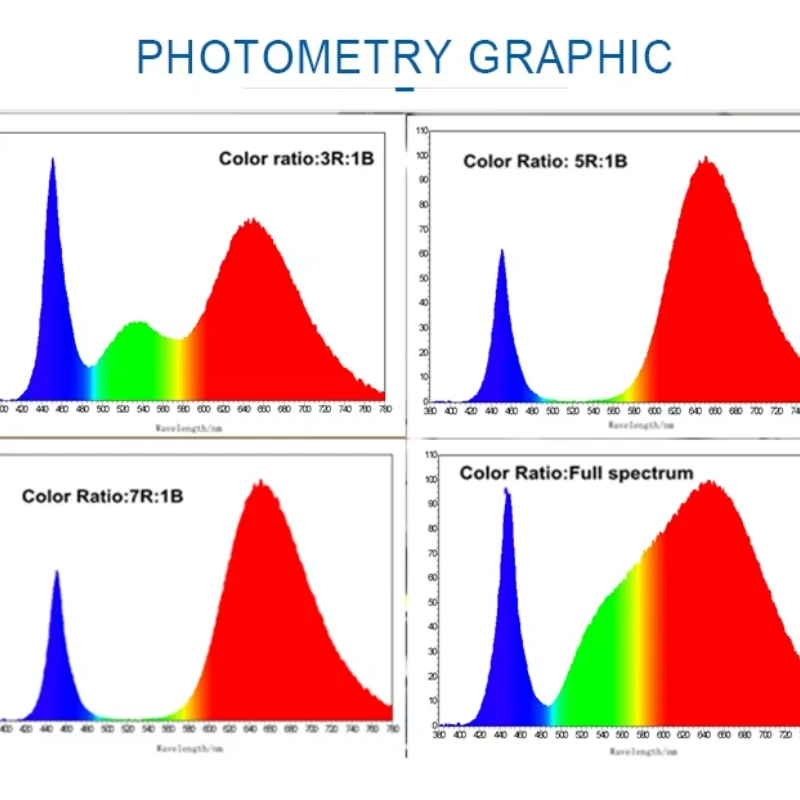
The most directly relevant evidence for succulent coloration comes from the 2024 Sedum study, which evaluated six light-quality treatments (R, 4R1B, 3R1B, 2R4B, B, and W) over 90 days. The 4R1B combination ranked first in a principal component analysis across growth and color parameters: it produced the greatest fresh biomass, the highest shoot/root fresh weight ratio, the largest stem diameter and crown width, and-critically for the present discussion-markedly increased anthocyanin content and leaf R/green chromaticity. The ranking was unambiguous: 4R1B > 2R4B > 3R1B > W > B > R.
The interpretation is straightforward. A red-dominant spectrum supplies the photon flux that drives photosynthesis and carbohydrate accumulation, providing the carbon skeleton for anthocyanin synthesis. The 20% blue component supplies the cryptochrome-mediated signal that maintains compact architecture and, in combination with red, potentiates the pigment response. Neither component alone reproduces the full effect; the ratio is the active variable.
Blue Light's Dual Role: Compactness and Pigment Priming
Blue light (≈400–500 nm) acts through cryptochrome photoreceptors to suppress gibberellic acid biosynthesis and inhibit cell elongation, producing shorter internodes and a more compact plant. In a succulent, compactness is not merely an aesthetic preference; it is the architectural precondition for the rosette form that displays coloration most effectively. A stretched, etiolated succulent distributes its pigment across a larger, paler surface area and loses the tight geometry that makes red margins and blushed tips visually striking.
Furthermore, full-spectrum emission with ample blue wavelengths triggers anthocyanin production, while UV acts as an enhancer rather than a strict necessity. This means the indoor grower does not require UV supplementation to achieve coloration; a blue-replete full-spectrum tube supplies the primary signal, and the red component supplies the energy and the phytochrome-mediated amplification.
Far-Red and the Limits of the Red-Boost Strategy
Far-red radiation (≈730 nm) is sometimes dismissed as irrelevant to coloration because it falls outside the conventional PAR waveband. In a full-spectrum context, however, a modest far-red component contributes to phytochrome signaling that influences leaf expansion and the overall light-acclimation state of the plant. The more important caution is against over-specifying red at the expense of blue and green. A spectrum weighted too heavily toward 660 nm may accelerate stem elongation and produce a plant that is large but pale-the precise failure mode documented under monochromatic red in the Sedum trial. The goal is not maximal red; it is the ratio that maximizes anthocyanin content per unit of healthy biomass.
From Spectrum to Fixture: Specifying a Coloration-Grade LED Tube
Beyond "Full Spectrum": Verifying the Blue Share
The term "full spectrum" on a product label does not guarantee a blue fraction sufficient for coloration and compactness. The grower should demand the measured spectral distribution graph and verify that the blue band (430–480 nm) carries a meaningful share of total photon flux. A practical benchmark, derived from seedling and succulent research, is a blue photon share of approximately 20–30% of total output for compact, color-responsive growth. A tube that shows a blue spike with negligible green and far-red, or a red-dominant curve with a token blue supplement, is not a coloration-grade fixture regardless of its marketing language.
Intensity and Duration: The Other Half of the Coloration Equation
Spectrum sets the signal; daily light integral (DLI) sets the magnitude. Succulents in active growth benefit from a DLI in the range of 10–20 mol·m⁻²·d⁻¹, achievable with a PPFD of 200–350 μmol·m⁻²·s⁻¹ under a 12–14 hour photoperiod at shelf distance. At closer mounting heights (15–30 cm), a lensed T8 tube in the 2.5–2.9 μmol/J efficacy class delivers this intensity without excessive power draw or canopy heat. The tube's linear geometry and even bead arrangement distribute the light across the rosette rather than concentrating it at a single point, producing uniform coloration across the plant rather than a sunburned center and pale edges.
Thermal and Ingress Considerations for Succulent Shelves
Succulent collections are frequently maintained on multi-tier shelving in humid rooms or converted cabinets. The tube's aluminum housing conducts junction heat away from the LED chips, maintaining spectral stability and preventing the localized heat load that can stress delicate rosettes at close mounting distances. IP65 or higher ingress protection ensures reliable operation in environments where misting or humidity control is routine. These are not secondary considerations; a fixture that runs hot or fails under humidity will not deliver the consistent spectral dose that coloration requires.
A Practical Protocol for Recovering Color
The Transition from Pale to Vibrant
The grower converting a pale, green succulent collection to LED tube lighting should expect a response timeline measured in weeks, not days. The first visible change is typically tightening of the rosette-reduced internode extension as blue-mediated cryptochrome signaling takes effect. Anthocyanin accumulation follows as the plant acclimates to the new light dose, with red margins and blushed tips appearing first on the most light-responsive cultivars ( Echeveria agavoides , Echeveria 'Perle von Nurnberg', and many Sedum hybrids).
A practical starting specification is a full-spectrum tube with approximately 20–25% blue, mounted at 20–30 cm above the canopy, operating 12–14 hours per day to deliver a DLI of 12–18 mol·m⁻²·d⁻¹. If coloration appears but compactness does not, the blue share should be increased; if the plant remains compact but pale, the photoperiod or PPFD should be raised within the range that avoids photoinhibition.
Avoiding the Common Failure Modes
Three failure modes account for most disappointing results. First, insufficient intensity: a tube mounted too high or operated for too few hours delivers a DLI below the threshold for anthocyanin induction, and the plant remains green regardless of spectrum. Second, excessive red relative to blue: the plant grows larger but stretches pale, losing the compact rosette form. Third, heat stress at the canopy: a poorly thermally managed fixture mounted at close distance can bleach or scorch pigment, producing discoloration that is damage, not coloration. A tube with an aluminum thermal pathway, verified blue share, and distance-indexed PPFD data addresses all three.
Table 1. Spectral and Operational Targets for Succulent Coloration
| Parameter | Target Range | Rationale |
|---|---|---|
| Red:Blue ratio | ≈4:1 (with 20–25% blue share) | Empirically optimal for anthocyanin and biomass in Sedum |
| PPFD at canopy | 200–350 μmol·m⁻²·s⁻¹ | Sufficient DLI without photoinhibition |
| Photoperiod | 12–14 h·d⁻¹ | DLI 12–18 mol·m⁻²·d⁻¹ |
| Mounting distance | 20–30 cm | Maximizes delivered PPFD and uniformity |
| Efficacy | ≥2.5 μmol/J | Energy-efficient photon delivery |
| Housing | Aluminum extrusion | Thermal stability, spectral consistency |
Conclusion: Color Is a Specification, Not an Accident
The pale succulent is not a plant that "needs more sun" in some undifferentiated sense. It is a plant that has not received the specific spectral and intensity signals that trigger anthocyanin synthesis while preserving the compact architecture that makes that coloration visible and valuable. The 2024 Sedum evidence is unambiguous: a red-dominant spectrum with a meaningful blue component-exemplified by the 4R1B ratio-simultaneously improves biomass, root development, stem diameter, and anthocyanin content. An integrated T8 LED grow tube specified to deliver that spectrum at 200–350 μmol·m⁻²·s⁻¹ over a 12–14 hour photoperiod, with an aluminum thermal pathway and IP-rated construction, converts that photobiological finding into a reliable cultural practice. The transition from pale to vibrant is not a matter of luck or of "pushing" the plant harder. It is a matter of specifying the right light and delivering it consistently, week after week, across the entire collection.
How To Cooperate With Us?
Our firm prides itself on owning its own factory, guaranteeing complete control over the production process and the quality of our goods. We are not only agents; we are manufacturers committed to offering our clients the most competitive rates available. We invite consumers to evaluate our samples first, as we are assured that the quality and pricing of our items are self-evident. Our dedication to excellence and client satisfaction compels us to consistently perform at our best and provide superior quality products.
Our address
3rd Floor, 5th Building, Hebei Industrial Park, Hualian Community, Longhua District, Shenzhen, China





