

The highbay light is designed for high ceilings. It is the main lighting equipment in industries, warehouses, and stadiums. Its major purpose is to illuminate a large area efficiently and uniformly for safety and efficiency. Optimizing the lighting strategy requires knowing its properties.
The highbay lights built for performance and longevity
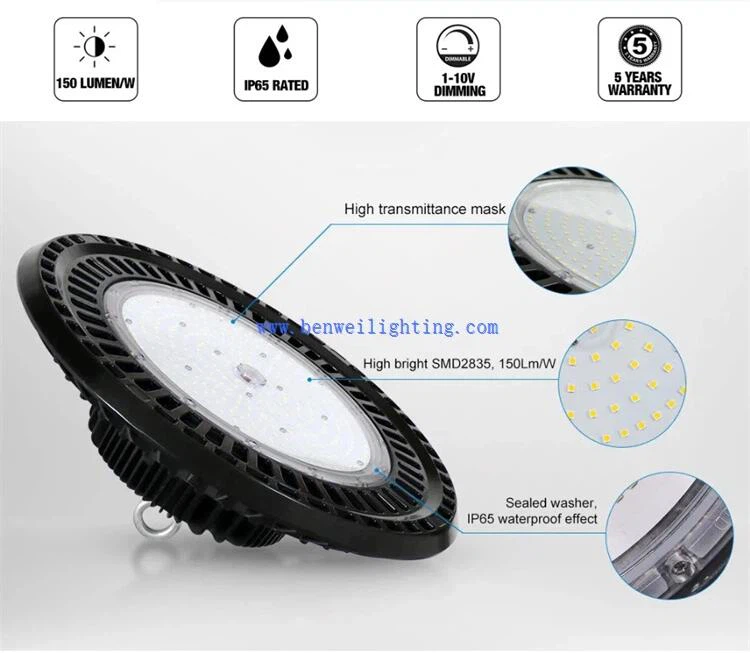
The core emits bright light from high-power LED modules. Lenses or reflectors manage light distribution to generate beam angles of 60 degrees, 90 degrees, or 120 degrees, reducing waste and enhancing ground lighting uniformity. Designing heat dissipation is critical. The LED has a long service life because its big aluminum heat sink or fin construction keeps it stable in high-temperature situations. The shell is constructed of die-cast aluminum or high-strength plastic, has IP65/IP66 high-level protection, resists dust and high-pressure water mist, and has a high IK impact resistance to prevent unintentional damage. Installation can be adjusted to different heights using chains, rods, or brackets.
The type of light source has changed
Formerly, high-pressure sodium and metal halide lamps were popular, but they had delayed startup, poor color rendering, high energy consumption, and limited lifespans. LED lights are becoming standard. They have many advantages: luminous efficacy is over 130 lumens/watt, energy consumption is half or lower than traditional light sources, instant startup is not needed, the color rendering index Ra is greater than 70 or 80, making object colors more accurately reproduced, and the service life is over 50,000 hours, reducing replacement and maintenance costs. The 150–500-watt power range suits diverse spaces.
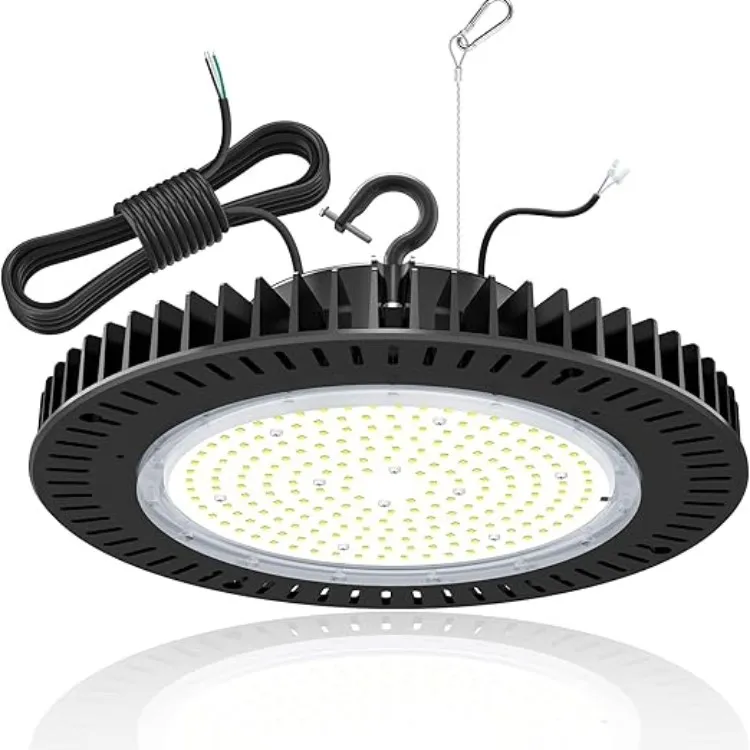
Choosing highbay light requires careful consideration of many elements
Basic space height and area determine lighting power and installation number. Different lighting and homogeneity standards are needed for storage aisles and precision sorting areas. For high ceilings and strong illumination, narrow beam deep illumination lamps are used; for general large-area uniform lighting, wide beam lights are used. In dusty, humid, corrosive, or collision-prone environments, items with high IP protection ratings (IP65/66) and IK impact resistance grades (IK08+) are needed. Long-term expenses depend on energy efficiency and lifespan, and LED's ultra-high luminous efficiency and ultra-long lifespan make it the best choice. Quality inspection areas should use lamps with a color rendering index (Ra) above 80 for precise color recognition. To respond to energy-saving scenarios, lamps with dimming functions or sophisticated control systems (grouping, sensing) are increasingly necessary.
Installation requires professional planning
Lamp installation height must be calculated based on power, light distribution angle, and goal ground illuminance. The average range is 8–15 meters. For instance, a 12-meter ceiling height may require a 300-watt lamp, but an 8-meter ceiling height may only need 150 watts. The installation procedure must assure structural load-bearing capacity safety. The suspension rod or direct installation is more stable, while the suspension chain is easier for fine height adjustment. Modern high ceiling lighting require little maintenance due to LEDs' dependability. To maximize heat dissipation and light transmission, the lamp body must be frequently cleaned of dust.
Summary
With its great light efficiency, extended lifespan, dependability, and energy savings, the LED highbay light is the best choice for large rooms. To achieve safe, efficient, and cost-effective long-term illumination, choose a high-ceiling lamp that matches space, environmental, and performance criteria.
For more details about our offerings, please contact us at bwzm18@ledbenweilighting.com.





