Overview of Luminous Attenuation Phenomenon for Conventional T8 Tube Lights
Application Value and Luminous Evaluation Standard of T8 Tube Lights
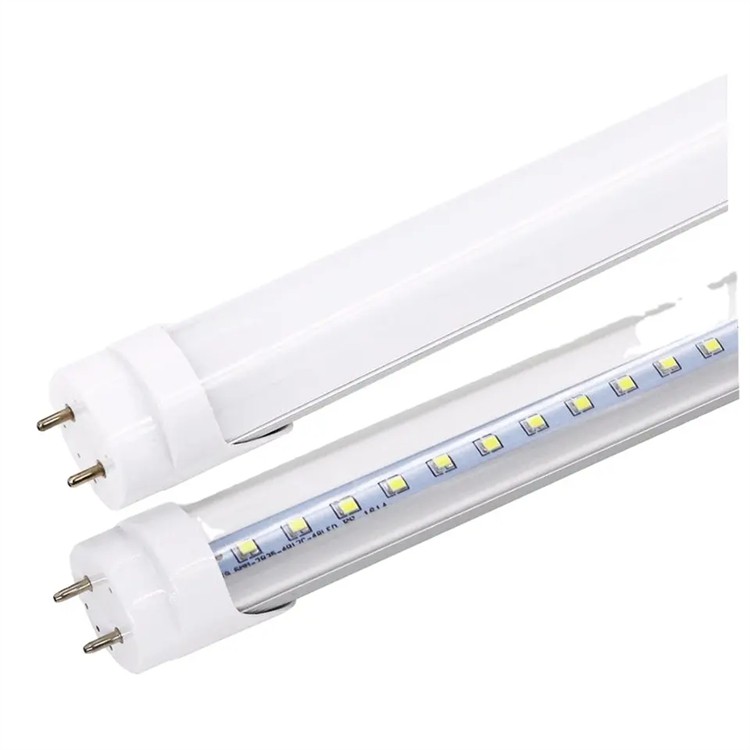
Standard T8 tube lights refer to 26mm-diameter linear luminous lighting fixtures compliant with IEC 60081 international linear lamp specification, which are mainstream general lighting fixtures deployed in residential rooms, commercial office areas, supermarket shopping spaces, warehouse logistics zones and public corridor environments. Characterized by uniform wide-angle illumination, affordable procurement cost and convenient modular installation, traditional fluorescent T8 tubes and retrofit T8 LED tubes dominate indoor basic lighting schemes. In professional lighting engineering, effective luminous brightness is quantified by lumen output and average on-site illuminance: qualified new T8 fluorescent tubes deliver 2800lm to 3200lm initial luminous flux, while premium original T8 LED tubes reach 3400lm to 4000lm initial lumen volume to meet daily indoor visual activity demands.
Definition and Inducements of T8 Tube Light Brightness Degradation
Luminous brightness attenuation means the irreversible or reversible decline of actual luminous flux and space illuminance generated by T8 tubes after long-term cyclic operation, classified into reversible external attenuation and irreversible internal component attenuation. Reversible brightness drop is mainly caused by external sheltering, environmental pollution and poor operating circuit stability, which can be eliminated via daily maintenance and partial accessory adjustment. Irreversible brightness reduction originates from internal lamp phosphor aging, chip light decay, circuit component aging and electrical parameter mismatch, which requires parts replacement or overall product upgrading. Long-term unaddressed brightness degradation will lower indoor illumination uniformity, reduce visual comfort, interfere with office and daily household activities, and destroy standardized indoor layered lighting effects.
Hazard of Insufficient Luminous Brightness for Indoor Scenarios
Continuous low-brightness operation of T8 tubes brings multiple hidden risks for indoor users and lighting systems. For personnel, long-term working and living in low-illuminance space accelerates eye strain, induces visual fatigue, and affects visual judgment efficiency for office document reading and fine manual work. For lighting hardware, long-term low-power unstable operation aggravates ballast load loss, increases circuit buzzing and light flickering probability, and shortens the overall service life of the whole lamp set. For indoor space aesthetics, uneven dim light weakens space layering, reduces indoor cleanliness perception, and fails to meet OSHA workplace minimum illuminance standards for commercial public spaces.
Feasible Professional Solutions to Boost T8 Tube Light Luminous Brightness
Regular Standardized Fixture Cleaning to Eliminate External Light Blockage
External light shielding contamination is the most prevalent, reversible and low-cost cause of T8 tube brightness fading. Long-term indoor floating dust, oil fume particles, fiber debris and moisture sediments gradually adhere to tube glass surface, frosted lens cover and lamp bracket inner reflective plate. These attachments form opaque barrier layers, reducing light transmittance by 15% to 25% and absorbing effective visible light radiated by luminous components, directly lowering actual indoor luminous brightness without internal tube failure.
Standard power-off cleaning operation specifications must be followed to avoid electrical damage and tube surface scratch damage. First, implement dual power-cut operation: turn off wall control switch and corresponding lighting branch circuit breaker, wait 60 seconds for circuit residual capacitance voltage release before touching lamp components. For daily light dust accumulation, adopt lint-free static soft dry cloth to wipe tube outer surface, reflector and light cover gently. For kitchen and office oil-stained fixtures, prepare diluted neutral mild detergent solution, moisten soft cloth for decontamination, and wipe dry to avoid water residue infiltration into lamp holder wiring ports.
Prohibited cleaning behaviors: never use rough scouring pads, metal brushes, corrosive acidic cleaning agents, alcohol high-concentration solvent to clean tubes. Such abrasive materials and harsh chemicals will scratch glass surface, damage internal phosphor coating of fluorescent tubes, corrode LED chip protective colloid, and cause permanent luminous dark spots and irreversible brightness loss. It is recommended to conduct full fixture cleaning every 2 to 3 months for high-dust indoor environments to maintain original light transmittance.
Timely Replacement of Aging, Decayed and Damaged T8 Tube Core Lamps
If standardized cleaning cannot restore nominal luminous brightness, internal luminous medium aging becomes the core cause of persistent dimming. Different tube types have fixed rated service life and light decay coefficient conforming to industry test standards. Traditional gas-filled fluorescent T8 tubes have an 8000-hour rated lifespan, with 30% luminous attenuation after one year of regular use; internal phosphor powder deteriorates, inert gas activity decreases, and tube wall blackening occurs at both ends, resulting in insufficient startup luminous power and weakened light output.
Retrofit low-quality T8 LED tubes suffer from rapid light decay caused by inferior encapsulated glue and unqualified drive chips, with more than 35% lumen drop within 2 years. Physical damage including tube cracking, pin oxidation, internal circuit breakage also leads to localized dim lighting and overall brightness insufficiency. Targeted replacement solution: remove old attenuated tubes and match high-standard original specification tubes for replacement. Select high-fluoride phosphor fluorescent tubes or high-CRI low-decay LED tubes with below 10% lumen depreciation within 50000 hours, which can instantly restore factory-rated initial brightness and stabilize long-term luminous performance. Users shall match tube length, pin model and voltage specification to avoid model mismatch causing startup failure.
Functional Upgrade of Aging and Mismatched Lamp Ballast Components
Ballast is the core power regulation accessory of T8 tube lighting loop, undertaking voltage stabilization, current limiting and startup excitation functions for tube operation. The operational performance of ballast directly determines output luminous power and luminous stability of T8 tubes. Two mainstream ballast types are equipped for traditional T8 lamp brackets: low-efficiency magnetic copper coil ballast and early-generation low-frequency electronic ballast.
Outdated magnetic ballasts have low current conversion efficiency, large inductive power loss and unstable output current, which cannot supply rated operating voltage for tubes, resulting in dim startup brightness and periodic light flickering. Aging conventional electronic ballasts have component capacitance attenuation, output current distortion and load mismatch, limiting maximum luminous flux release of qualified T8 tubes. Professional upgrade suggestion: replace old ballasts with high-frequency constant-current electronic ballasts. New upgraded ballasts feature 92% power conversion efficiency, precise current stabilization, low reactive power loss, which can increase effective luminous output by 18% to 22%, meanwhile lowering circuit power consumption and electromagnetic buzzing noise. Matching ballast upgrade is applicable for scenarios with intact tubes but persistent insufficient brightness.
Overall Retrofit: Full Replacement of Traditional T8 Tubes with Premium LED T8 Tubes
For long-term renovation of high-brightness demand spaces, overall upgrading to formal energy-saving LED T8 tubes is the most thorough long-term optimization scheme. Compared with conventional gas discharge fluorescent T8 tubes, industrial-grade LED T8 tubes adopt solid-state SMD luminous chips, with higher electro-optical conversion efficiency, optimized light distribution angle and no luminous power loss caused by gas excitation. Under the same power wattage, LED T8 tubes provide 30% to 40% higher effective illuminance than traditional fluorescent counterparts, delivering uniform glare-free bright light without local dark zones.
From comprehensive operational benefit perspective, LED T8 tubes contain zero mercury hazardous substances, conform to RoHS environmental protection standards, and cut overall lighting power consumption by 65% to 70%. Though LED tubes have higher one-time upfront procurement cost, its 50000-hour ultra-long service life reduces frequent tube replacement labor and material cost, bringing long-term electricity expense savings. Besides, mainstream modern LED T8 tubes support compatible ballast bypass installation, adaptive wide voltage startup, and anti-attenuation constant-current drive design, maintaining stable peak brightness for more than 10 years, which is the optimal solution for permanent brightness improvement of office and household fixed lighting systems.
Auxiliary Optimization Rules to Maintain Stable Long-Term Tube Brightness
Scientific Daily Power Use Management
Avoid frequent frequent startup and shutdown of T8 tube lights, as frequent switch action accelerates ballast loss and luminous medium aging; configure voltage stabilizer for areas with fluctuating grid voltage to prevent unstable input power leading to insufficient luminous brightness and accelerated light decay.
Reasonable Indoor Layout Matching
Dark matte wall surfaces absorb more visible light, so matching light-colored reflective wall decoration can improve space reflected brightness reasonably. Keep ventilation of lamp installation position to reduce oil fume and dust accumulation speed, extending effective brightness maintenance cycle of T8 tubes.
Regular Circuit Inspection Maintenance
Check lamp holder pin oxidation degree and wiring tightness every half year; polish oxidized metal pins to guarantee smooth conductive transmission. Loose wiring contact will cause voltage supply shortage, indirectly lowering actual luminous brightness of normal T8 tubes.
Conclusion
Gradual brightness reduction is a common comprehensive failure phenomenon of long-serviced T8 tube lights, triggered by external pollution shielding, tube luminous medium aging, ballast electrical performance degradation and backward light source technology. Corresponding classified professional solutions can effectively restore and upgrade luminous brightness: periodic standardized power-off fixture cleaning removes external light barriers to solve reversible brightness attenuation; replacement of aging failed tubes repairs internal luminous function instantly; upgraded high-efficiency electronic ballasts optimize circuit power supply efficiency to release maximum tube luminous flux; full retrofit to high-performance LED T8 tubes realizes permanent brightness improvement and energy-saving operation. To maintain stable long-term high brightness, users shall combine daily cleaning, circuit inspection and standardized power management. Combined with on-site budget, usage scenario and service life demand, selecting targeted improvement methods can optimize indoor lighting quality, meet occupational health illuminance standards, and maximize the service value of T8 indoor lighting fixtures.

How To Cooperate With Us?
Having its own factory gives our firm complete control over the production process and the quality of our goods, which we take great pride in. We are manufacturers, not only brokers, committed to offering our clients the lowest costs. We invite consumers to evaluate our samples first since we are certain that the cost and quality of our items are evident. Our dedication to excellence and client happiness motivates us to consistently provide superior products.
Our address3rd Floor, 5th Building, Hebei Industrial Park, Hualian Community, Longhua District, Shenzhen, China