

Introduction: The Thermal Challenge in Commercial LED Lighting
The Evolution of Commercial Illumination
The commercial lighting industry has undergone a profound transformation over the past decade, transitioning from energy-inefficient halogen and fluorescent sources to light-emitting diodes (LEDs). While the initial driving force behind this shift was energy savings, facility managers and lighting specifiers are now focusing on a more critical metric: fixture longevity and maintenance overhead. In large-scale commercial environments-such as retail chains, hospitality venues, and office complexes-the cost of replacing a failed fixture far exceeds the cost of the fixture itself.
The Misconception of "Infinite" LED Life
LEDs are often marketed with a blanket statement of having a "50,000-hour lifespan." However, this rating is highly conditional. Unlike traditional incandescent bulbs that emit heat as infrared radiation (making them hot to the touch), LEDs generate heat at the semiconductor junction level-a microscopic point within the chip itself. If this heat is not extracted efficiently, the LED's performance degrades rapidly. Therefore, the true lifespan of an LED downlight is not determined by the diode itself, but by the efficacy of its thermal management system.
Thesis Statement
This paper argues that the integration of die-casting aluminum radiators is the single most important engineering feature in extending the operational lifespan of commercial LED lighting. Through optimized geometry and superior thermal conductivity, die-cast aluminum prevents thermal runaway, preserves the integrity of high-CRI (Color Rendering Index ≥90) COB chips, and ultimately delivers a substantially lower total cost of ownership (TCO) for B2B clients.
The Physics of LED Degradation: Why Heat is the Enemy
To appreciate the value of a die-cast aluminum radiator, one must first understand the thermodynamic realities of LED technology.
Understanding Junction Temperature (Tj)
The Junction Temperature (Tj) is the temperature at the actual light-emitting semiconductor junction inside the LED package. For every 10°C increase in Tj above the optimal operating temperature, the expected lifespan of the LED is typically halved. In a high-wattage COB (Chip-on-Board) downlight, the concentrated light output generates intense localized heat. Without a highly conductive pathway to dissipate this heat, the Tj will spike within minutes of operation.
Thermal Runaway and Lumen Depreciation
When heat accumulates, it creates a vicious cycle known as thermal runaway. As the temperature rises, the LED's internal resistance decreases, causing more current to flow, which in turn generates even more heat. This rapid accumulation leads to lumen depreciation-the gradual fading of light output over time. In commercial lighting, a fixture that drops below 70% of its initial light output (L70) is considered end-of-life, regardless of whether the chip is still physically glowing.
Color Shift and the Destruction of High CRI
The product in question features a premium CRI≥90 COB chip. This high color rendering is achieved through a specific phosphor coating that mimics natural sunlight, providing flawless color fidelity. However, this phosphor layer is extremely sensitive to heat. Prolonged exposure to high junction temperatures causes the silicone encapsulant to yellow and the phosphor to degrade. The result is a visible color shift (usually toward a harsh blue or sickly green), which can ruin the aesthetic of a luxury hotel or a high-end retail store.
Die-Casting Aluminum: The Metallurgical Advantage
Why do we utilize die-casting aluminum for our heat sinks, and why is it superior to other manufacturing methods?
The Thermal Conductivity of Aluminum
Aluminum is the gold standard for LED thermal management. It possesses a thermal conductivity of approximately 170-200 W/m·K, which allows it to rapidly absorb heat away from the PCB substrate. Compared to steel or plastics, aluminum transfers heat at a massively accelerated rate, preventing the heat from ever reaching a critical threshold at the source.
Die-Casting vs. Extrusion: The Structural Superiority
While aluminum extrusions are common in the industry, die-casting offers distinct advantages for complex lighting fixtures. Die-casting involves injecting molten aluminum into a precision steel mold under high pressure.
Complex Geometry: Die-casting allows for the creation of intricate, three-dimensional fin arrays that cannot be achieved with extrusion.
Thickness Variation: We can engineer the base plate of the heat sink to be thick (for rapid heat spreading) while the outer fins are thinner (for efficient cooling and weight reduction).
Structural Integrity: The die-cast process produces a single, seamless piece of metal that is highly durable and resistant to vibration and structural deformation over time.
Designing for Convective Heat Transfer
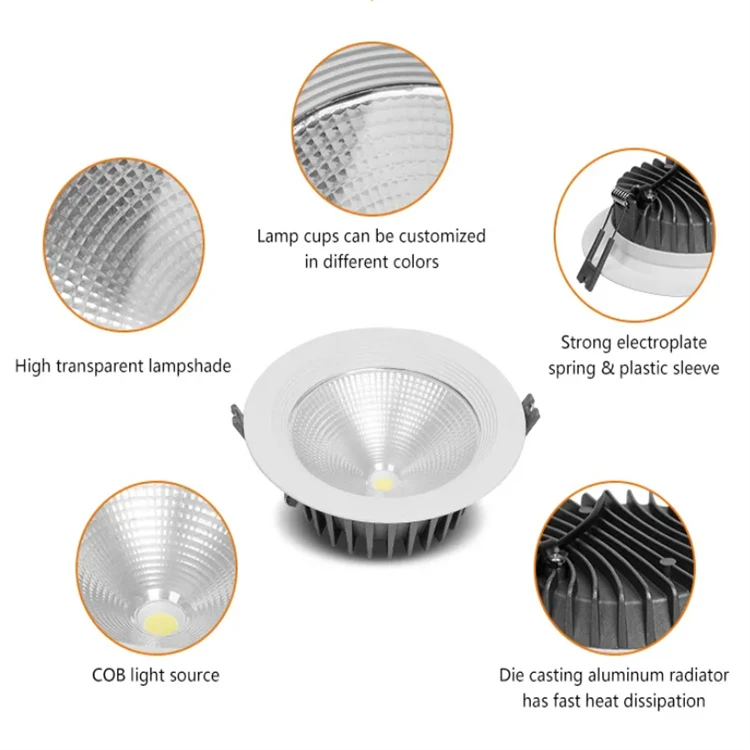
As illustrated in our product schematics, the radiator features a dense array of curved, vertical fins. This is not an arbitrary design; it is the result of computational fluid dynamics (CFD). The geometry maximizes the surface area exposed to the ambient air. As heat rises naturally (the chimney effect), the vertical orientation of the fins channels the airflow efficiently, ensuring continuous convective heat transfer without the need for noisy, active cooling fans.
How Our Die-Cast Radiator Extends Fixture Lifespan
The theoretical physics translate directly into practical longevity in our commercial downlight series.
Protecting the COB Light Source
Our high-performance downlights utilize COB (Chip-on-Board) technology, which concentrates multiple LED dies into a single, highly efficient light source. The die-cast aluminum radiator is specifically machined to sit flush against the thermal pad of the COB substrate. This direct thermal bridge ensures that the intense heat generated at the center of the chip is immediately wicked away and dispersed across the entire surface of the radiator.
Maintaining Photometric Stability (CRI≥90)
By keeping the junction temperature low, the die-cast heat sink preserves the chemical integrity of the COB chip. This guarantees that the CRI≥90 performance does not degrade over time. For a retail client, this means that the vibrant reds of a garment or the subtle golds of a painting will look identical in year five as they did on the day of installation.
Synergy with the Optical System
Thermal management also protects the optical components. The high-transparency lampshade and reflective cup are designed to withstand moderate temperatures. Excessive heat can cause the plastics to become brittle or yellow, reducing light transmission and altering the beam angle. The die-cast radiator acts as a thermal shield, ensuring the optical integrity of the luminaire remains pristine.
Ensuring Installation Integrity
The robust nature of the die-cast aluminum housing also provides a rigid structural base for the strong electroplate springs and plastic sleeves. Unlike thin stamped metal housings that can bend or warp under heat, the die-cast body maintains its shape, ensuring the heavy-duty springs maintain a secure grip on the ceiling for decades.
The Commercial ROI: Why Lifespan Equates to Profitability
For B2B buyers, specifiers, and facility managers, the technical superiority of the die-cast radiator translates into undeniable commercial value.
Drastically Reduced Maintenance Costs
In a commercial setting-such as a shopping mall or a hotel-the cost of replacing a single downlight involves the cost of the replacement unit, the labor cost of an electrician, the cost of scaffolding or a scissor lift, and the potential loss of revenue due to disruption. By maximizing the lifespan of the fixture through superior heat dissipation, you reduce maintenance cycles from every few years to once a decade or more.
Lower HVAC Loads
While not immediately obvious, inefficient LED fixtures contribute to the heat load of a building. A downlight that successfully dissipates heat into the ceiling plenum actually dumps that heat into the surrounding environment, forcing the HVAC system to work harder. Because our die-cast radiators are highly efficient at transferring heat, and because the LED chip runs cooler, the overall ambient heat contribution is minimized, leading to secondary energy savings in air conditioning.
Sustained Energy Efficiency
As LEDs degrade, their forward voltage can increase, leading to a drop in luminous efficacy (lumens per watt). By maintaining optimal thermal conditions, the fixture operates at peak efficiency for a much longer portion of its life, ensuring the energy savings calculated during the ROI phase are actually realized over the project's lifespan.
Factory Direct OEM/ODM: Scaling Thermal Excellence
We understand that different commercial projects have unique thermal demands. A high-ceiling hotel lobby requires a higher wattage fixture than a low-ceiling office space.
Customizing Heat Sink Geometry
Through our comprehensive OEM/ODM support, we work directly with lighting designers and distributors to tailor the thermal solution. We can modify the fin density, the thickness of the thermal mass, and the physical dimensions of the die-cast radiator to perfectly match the specific wattage and form factor required by your project.
Competitive Pricing, Uncompromised Quality
By managing the die-casting process entirely in-house, we eliminate intermediary markups. Our factory-direct model ensures that you are not paying a premium for high-end thermal management. We deliver a competitive price, good quality commercial downlight that is engineered to outlast and outperform generic market alternatives.
Conclusion: The Smart Choice for Long-Term Projects
The longevity of commercial lighting is a direct function of its thermal management. While standard fixtures rely on cheap, stamped metal or inadequate plastic housings that lead to premature failure, our downlights are built around the uncompromising physics of die-casting aluminum radiators.
By rapidly dissipating heat away from the COB light source, we prevent lumen depreciation, protect the CRI≥90 color fidelity, and guarantee structural integrity. For the modern B2B buyer, this translates into lower maintenance costs, satisfied clients, and a superior return on investment.
When planning your next commercial or residential project, choose a lighting partner that understands the physics of longevity. Choose our high-performance die-cast aluminum downlights.

How To Cooperate With Us?
We are happy to have total control over the manufacturing process and the calibre of our products since we have our own facilities. Since we are producers rather than just brokers, we are dedicated to providing our customers with the best pricing. Since we are certain that the price and quality of our products are clear, we invite customers to see our samples first. Our commitment to quality and customer satisfaction drives us to continuously provide top-notch goods.
Our address
3rd Floor, 5th Building, Hebei Industrial Park, Hualian Community, Longhua District, Shenzhen, China





