Track lighting is a versatile illumination solution that allows directional control of individual light heads along a continuous electrified track. Its adaptability makes it suitable for both residential and commercial interiors, from art galleries and retail displays to kitchens and living rooms. However, the wide variety of track types, head configurations, light sources, finishes, and control options often leads to decision complexity. This paper provides a systematic framework for selecting an optimal track lighting system based on user‑defined needs, spatial characteristics, style preferences, and budget constraints.
Pre‑Selection Functional Analysis
Assessment of Illumination Objectives
Before evaluating any product, define the primary lighting tasks:
Accent lighting – highlighting artwork, architectural features, or merchandise.
Task lighting – illuminating countertops, desks, or reading areas.
Ambient (general) lighting – providing base illumination for the entire room.
Combination – a mix of the above, often achieved with multiple heads aimed at different zones.
Spatial Parameters
Room dimensions – larger rooms require longer tracks or multiple parallel runs.
Ceiling height – lower ceilings (≤2.4 m) favour low‑profile tracks and narrow beam angles to avoid glare; higher ceilings (≥3 m) allow for higher wattage and wider beams.
Natural light availability – spaces with abundant daylight may use fewer heads or dimmer controls to adjust evening output.
Existing Decor and Desired Ambiance
Identify the target atmosphere: warm and cosy (low colour temperature, dimmable), crisp and energetic (high colour temperature, directable spots), or neutral. This directly influences bulb selection and finish choices.
Categorisation of Track Lighting Styles
Style Typologies
Track lighting is available in distinct aesthetic families:
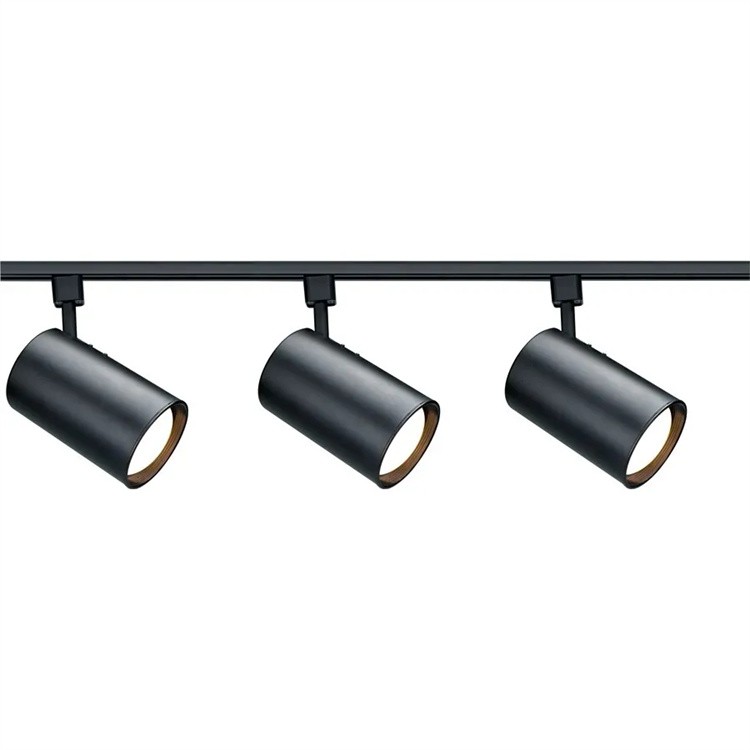
Modern / Minimalist – clean lines, monochrome finishes (black, white, silver), often with cylindrical or rectangular heads.
Industrial – exposed bulbs, metal cages, weathered steel or copper finishes.
Vintage / Rustic – decorative Edison‑style filaments, bronze or antique brass tracks.
Contemporary / Transitional – curved tracks, mixed materials (glass + metal), brushed nickel or chrome.
Matching Style to Interior Decor
For a cohesive interior, the track lighting finish and head shape should echo existing hardware (door handles, faucets) and furniture lines. A mismatch creates visual fragmentation. Use digital mood boards or manufacturer visualisation tools to test compatibility.
Track Type Selection: H‑Type vs. J‑Type
Technical Distinctions
Track systems are not universally interchangeable. The two dominant standards in North America are:
| Feature | H‑Type (Halo / H‑Style) | J‑Type (Juno / J‑Style) |
|---|---|---|
| Common application | Commercial (offices, retail, galleries) | Residential (homes, apartments) |
| Conductor spacing | Standardised across many brands | Slightly different conductor layout |
| Head compatibility | H‑type heads fit H‑tracks only | J‑type heads fit J‑tracks only |
| Availability | Widely available for high‑ceiling commercial spaces | More compact, often lower profile |
Selection Guidance
Choose H‑type if the space requires heavy‑duty fixtures, long continuous runs (>6 m), or integration with commercial dimming panels.
Choose J‑type for typical residential rooms (kitchens, living rooms, bedrooms) where lower voltage options (12V) and compact heads are preferred.
Note: A third L‑type (Lightolier) exists but is less common. Always verify track profile before purchasing heads.
Configuration of Lighting Heads
Determining the Number of Heads
The required number of heads is derived from the desired illuminance (lux) and the beam angle of each head. A practical rule:
For general ambient lighting: one head per 1.5–2 m of track length (using wide‑flood optics).
For accent lighting: one head per 0.6–1 m of track length (using narrow spot optics, 15°–25°).
More heads increase granularity of light direction but also raise energy consumption and upfront cost. For a 3 m track, 3–4 heads offer a good balance for residential use; 5–6 heads for commercial gallery walls.
Head Types and Adjustability
Fixed heads – economical, but limited aiming.
Pivoting / swivelling heads – 350° rotation + 90° tilt, standard for most applications.
Monorail / cable heads – for suspended systems, but not traditional track.
Specialty heads – gimbal rings, pinhole baffles, or lensed heads for severe glare control.
Energy Efficiency and Light Source Selection
Dominance of LED Technology
Incandescent and halogen track heads are obsolete for new installations due to low efficacy (15–20 lm/W) and high heat output. LED track heads offer:
Efficacy: 80–130 lm/W
Lifetime: 35,000–50,000 hours
Instant on, no warm‑up
Compatible with most dimmers (ELV or TRIAC, depending on driver)
Colour Temperature and Colour Rendering
Colour Temperature (CCT) : Choose 2700K–3000K for warm residential ambience; 3500K–4000K for neutral task lighting; 5000K for commercial or display applications (art, jewellery).
Colour Rendering Index (CRI) : For accurate colour discrimination (art, retail), specify CRI ≥90. For general living spaces, CRI ≥80 is acceptable.
Finishes and Material Quality
Common Finish Options
Brushed nickel – neutral, hides fingerprints, suits transitional to modern.
Chrome / polished nickel – reflective, high‑gloss, best for contemporary or glam styles.
Brass (polished or satin) – vintage or luxury decor.
Black / white / silver painted – minimalist or industrial.
Bronze / oil‑rubbed bronze – rustic or traditional.
Material Durability
Aluminium tracks with powder‑coated finishes resist corrosion. Plastic components in low‑cost tracks may become brittle under heat (even with LEDs). For kitchens or bathrooms, verify moisture resistance (not required for the track itself, but for heads: IP44 recommended near sinks).
Control and Dimming Integration
Benefits of Dimmer Functionality
Dimmable track lighting provides:
Scene setting (bright for cleaning, soft for movies).
Energy savings when run at reduced output.
Extended LED lifespan.
Dimmer Compatibility
Not all LED track heads work with standard (TRIAC) dimmers. Check that:
The track head specifies "dimmable".
The dimmer is listed as compatible (e.g., Lutron, Leviton, or manufacturer‑recommended).
For mains voltage (120V) track heads, use forward‑phase (TRIAC) or universal dimmers. For low‑voltage (12V) systems with magnetic transformers, use reverse‑phase (ELV) dimmers.
Install a dimmer on the wall switch controlling the track. Multi‑zone dimming (separate controls for different track segments) adds flexibility but requires a more complex electrical setup.
Budgeting for Installation and Ancillary Costs
Component Costs
Track rails (per linear metre): $15–$40.
Connectors (straight, L‑shaped, T‑shaped, flexible): $5–$20 each.
Heads per unit: $20–$150 depending on LED quality and finish.
Power feed / canopy (end or middle feed): $10–$30.
Professional Installation
If no existing electrical junction box is positioned for the track, an electrician must install a new box, run wiring, and potentially add a dimmer switch. Labour typically ranges $100–$300 per hour, with 1–3 hours for a simple replacement, 4–8 hours for new construction. DIY installation is possible for replacing an existing track of the same type, but new wiring requires licensed electricians in most jurisdictions.
Total Budget Estimate
| Configuration | Low‑end (basic LED, 3 heads) | High‑end (designer LED, dimmer, 6 heads) |
|---|---|---|
| Material cost | $80–150 | $300–600 |
| Installation (electrician) | $100–200 | $200–400 |
| Total | $180–350 | $500–1000 |
Conclusion
Selecting the best track lighting is a structured decision process that balances functional requirements (room size, lighting tasks, ceiling height) with aesthetic preferences (style, finish, colour temperature) and technical constraints (track type, dimmer compatibility, energy efficiency). By sequentially:
Assessing illumination objectives and spatial parameters,
Matching style to interior decor,
Choosing H‑type or J‑type track based on application,
Determining the number and type of heads for desired lux levels,
Prioritising LED sources with appropriate CCT and CRI,
Selecting finishes that harmonise with hardware,
Ensuring dimmer functionality with verified compatibility, and
Accounting for installation costs in the budget,
users can confidently specify a track lighting system that delivers both visual performance and aesthetic coherence. Always test one head and track segment before full purchase to confirm physical fit and light quality.

How To Cooperate With Us?
Our firm prides itself on owning its own factory, guaranteeing complete control over the production process and the quality of our goods. We are not only agents; we are manufacturers committed to offering our clients the most competitive rates available. We invite consumers to evaluate our samples first, as we are assured that the quality and pricing of our items are self-evident. Our dedication to excellence and client satisfaction compels us to consistently perform at our best and provide superior quality products.
Our address
3rd Floor, 5th Building, Hebei Industrial Park, Hualian Community, Longhua District, Shenzhen, China