

A client once asked: "Should I buy a fixed 5600K light, or one with adjustable color temperature?" While this might seem like a simple technical choice, picking the wrong one can be costly-either you end up with insufficient brightness, resulting in dull, "grayish" footage, or you pay for features you'll never actually use. This article cuts through the fluff, breaking down the differences between these two types of lights-covering brightness, color rendering, usage scenarios, and cost-to help you make the right purchasing decision.
Understanding the Structural Differences
A 5600K "daylight" light uses a single type of LED chip, all emitting the same white light-mimicking the quality of midday sunlight.
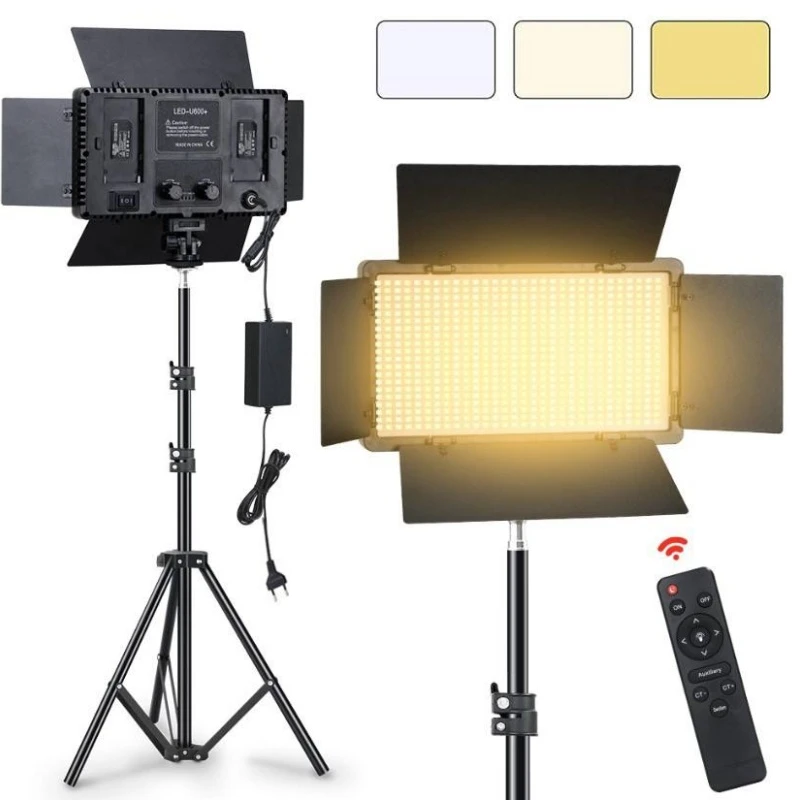
A bi-color (adjustable color temperature) light, by contrast, features both warm-white (typically 3200K) and cool-white (typically 5600K) LED chips on the same panel. By adjusting the brightness ratio between these two sets of chips, you can achieve any color temperature between 3200K and 5600K.
Here's the crucial point: because a bi-color light must split its space between two types of chips, each type only occupies about half the available area on the panel. Almost all subsequent differences stem from this fundamental design choice.
Brightness and Efficiency: Which Performs Better?
At the same power rating, a fixed 5600K light is generally brighter. The reason is straightforward: every single LED chip on the panel is dedicated to producing 5600K light, with none of the space "diverted" to other types.
In a bi-color light, when set to 5600K, only the cool-white chips are fully active, while the warm-white chips remain off. Consequently, the maximum output is often noticeably lower than that of a fixed-daylight light of the same wattage. When set to an intermediate color temperature, both sets of chips contribute, which can lead to fluctuations in overall brightness.
If you are shooting in a large space-or using modifiers like softboxes or reflectors, which inevitably absorb a significant amount of light-having extra brightness "headroom" is essential. In such scenarios, a fixed-daylight light holds a clear advantage.
Color Rendering: CRI vs. TLCI
For color-sensitive photography-such as product, apparel, or food photography-color rendering indices are critical benchmarks.
Single-color-temperature lights feature a relatively simple spectrum, making it easier to achieve CRI and TLCI ratings of 95 or higher. High-quality, consistent products also ensure greater uniformity across individual units.
Bi-color lights rely on a blend of LED chips with different spectra. This can sometimes lead to a slight green or magenta shift in the mid-range of the color temperature scale, along with minor fluctuations in color rendering values. While well-engineered bi-color lights can minimize these issues, they demand higher-quality LED chips and more sophisticated dimming algorithms-which is precisely where the biggest differences between manufacturers lie.
Therefore, don't just look at a stated "CRI 95+" rating. Ask for clarification: At which color temperature was this value measured? Does it hold true across the entire adjustable range?
Color Temperature Flexibility: The True Value of Bi-Color Lights
The primary advantage of bi-color lights is their ability to adapt to various lighting environments without the need to swap out fixtures or apply color gels. Common scenarios include:
Mixed-lighting environments: When a space contains tungsten bulbs, warm-toned pendant lights, or natural light from a window, you can adjust your fill light to match the ambient conditions.
Creating atmosphere: In portraiture, interviews, or food photography, warmer tones can lend a softer, more inviting feel to the image.
Versatility: For small studios with limited budgets or gear, a single bi-color light can effectively do the work of two separate units.
Conversely, if your shooting environment is entirely controlled-for instance, a dedicated product photography setup with a black backdrop, using only studio lighting at a constant 5600K-the adjustable color temperature feature will likely go unused.
Price and Long-Term Costs
Because bi-color lights require a higher number of LED chips and more complex driver circuitry, they generally cost more than daylight-only (fixed-color-temperature) lights of the same power output. For distributors or studios purchasing in bulk, this price difference can become significant. However, you must also consider the cost of use: if you use a daylight-balanced (5600K) light and need a warmer tone, you will have to purchase additional color-correction gels (such as CTO filters). These filters reduce light output by approximately one stop and tend to fade or warp over time. From this perspective, for users who frequently need to adjust color temperature, a bi-color light is actually more convenient.
How to choose based on your needs
There is no absolute "best" choice; it depends on your specific application:
E-commerce product photography and white-background shots: Prioritize 5600K daylight-balanced lights. They offer fixed color temperature, consistent color rendering, and high brightness, ensuring color uniformity across large batches of product images.
Live streaming and short-video production: Bi-color lights are more suitable. They allow for fine-tuning of the scene and skin tones, and are essential when blending with existing ambient lighting or overhead lights in a studio setup.
Portrait, wedding, and interview photography: Bi-color lights offer greater flexibility, allowing you to quickly adapt to the ambient light at any location.
Studio rentals and educational institutions: A combination of both is recommended-use daylight-balanced lights as key lights for maximum brightness, and bi-color lights as fill or accent lights to set the mood.
Distributors and retailers: Consider stocking a mix of both. Daylight-balanced lights often drive higher sales volume, while bi-color lights can offer better profit margins; the exact ratio should be tailored to your specific customer base.
Summary
5600K daylight-balanced lights excel in brightness, color consistency, and affordability-ideal for fixed environments where efficiency and uniformity are paramount. Bi-color lights excel in versatility, making them perfect for dynamic lighting environments where a single light needs to serve multiple purposes; the trade-offs are slightly lower brightness and a higher cost.
A simple rule of thumb: if your shooting environment rarely changes, choose a daylight-balanced light; if you frequently encounter varying ambient lighting conditions, choose a bi-color light. If you are still unsure, consider purchasing one of each for a side-by-side test before committing to a bulk order.
Need advice on selecting equipment or a price quote?
If you are currently choosing studio lighting for your workspace, live-streaming setup, or retail store-or if you would like to learn about wholesale pricing or OEM customization options for daylight-balanced and bi-color lights-please feel free to contact us directly. Please let us know your intended use case, budget, and approximate purchase quantity; our team will recommend suitable models and provide samples along with a detailed quotation.
Our address
No. 5-3 Niujiao Road, Yanchuan Community, Yanluo Subdistrict, Bao'an District, Shenzhen
bwzm18@ledbenweilighting.com






