Anyone with experience in warehouse or logistics operations knows that the loading dock component most frequently overlooked is the lighting. When a truck backs into a bay, its interior is often pitch-black; forklift operators are forced to navigate by feel, relying on flashlights to check labels, verify quantities, or inspect for damaged goods. A well-positioned loading dock light can save a great deal of trouble.
However, the market offers three main types of dock lights: "gooseneck" (fixed-neck) lights, flexible-arm lights, and fixed-mount lights. Many buyers struggle to distinguish between them, only to discover-after purchase-that the angle is wrong, the light fails to reach the back of the trailer, or the mechanism loosens after just six months of use. This article examines these three types from a practical, operational perspective to help you make the right choice.
Defining the Three Types of Loading Dock Lights
To make a meaningful comparison, we must first clarify the concepts.
"Gooseneck" (or fixed-neck) lights feature a lamp head attached to a curved, rigid neck that extends from the mounting point. The lamp head allows for minor angle adjustments, much like a standard desk lamp.
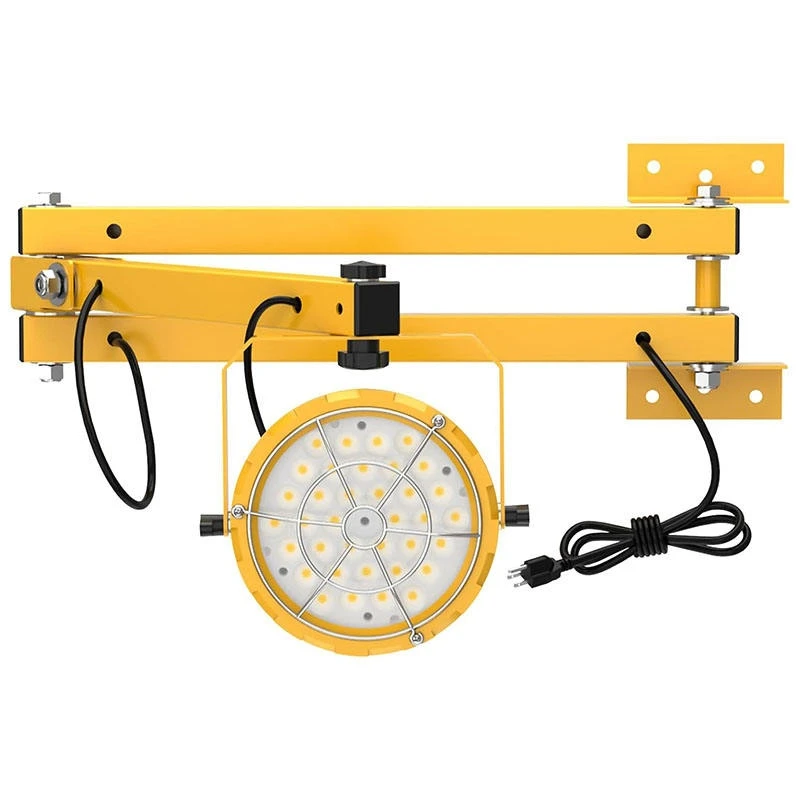
Flexible-arm lights typically incorporate multiple joints or a bendable arm, allowing the lamp head to move extensively-up, down, left, or right-and enabling the entire unit to be retracted or extended. Some models even feature a telescopic design.
Fixed-mount lights are attached directly to a wall, the edge of the loading dock, or the ceiling. Their angle is set during installation and generally remains static thereafter.
In short, the fundamental difference lies in the range of motion of the lamp head.
Illumination Range: Matching Light Reach to Trailer Depth
The primary purpose of a loading dock light is to project illumination into the trailer. For shorter trailers, covering the area from the doorway to the middle is sufficient; however, with 13-meter (or longer) semi-trailers, the rear section often ends up in darkness.
Because fixed-mount lights have a static position and angle, their illumination range is limited, making them better suited for lighting the operational area near the edge of the loading dock itself. "Gooseneck" (flexible-neck) lights allow the lamp head to extend outward, shortening the distance to the interior of the trailer and providing deeper illumination. Flexible-arm lights can reach directly into the center of a trailer, making them the best choice for deep-bodied trucks.
When making your selection, first measure the length of the vehicles that most frequently arrive at your facility, then decide whether it is worth increasing your budget to achieve greater illumination depth.
Adjustability: Adaptability to Different Vehicle Types
If your loading dock consistently handles the same type of vehicle-for instance, a regular fleet of two or three specific trucks-you can simply set the angle of the light once, and it will likely remain suitable for ongoing use; in this case, high adjustability is less critical.
However, if you receive a wide variety of vehicles-such as box trucks, shipping containers, low-bed trailers, or stake-side trucks-where trailer heights and cargo stacking configurations vary constantly, the ability to flexibly adjust the lamp head becomes essential. Flexible-arm lights excel here; workers can easily reposition them by hand, even a dozen times a day, with minimal effort. Gooseneck lights offer some adjustability, but within a limited range. Fixed-mount lights generally lack this capability entirely.
Installation Location and Space Constraints
This factor is frequently overlooked. Even the best light is useless if it cannot be installed properly or if it creates an obstruction.
Fixed-mount lights occupy the least space; they do not extend outward, so there is no risk of them being struck by forklifts or cargo. Gooseneck lights require clearance for the neck to extend; when mounting them at the edge of a loading dock, ensure they do not interfere with the operation of dock levelers or dock seals. Flexible-arm lights have the greatest reach, which necessitates sufficient surrounding clearance. If the dock opening is too narrow or there is overhead equipment, verify beforehand that the arm can swing freely.
Before placing an order, it is highly recommended to photograph and measure the width and height of the dock opening, as well as any nearby obstacles, and share this information with the supplier for verification. This is far more efficient than having to redo the installation later.
Durability and Routine Maintenance
Loading docks are demanding environments-impacts from vehicles, exposure to the elements, temperature fluctuations, and frequent physical handling are all common occurrences.
Generally, a simpler design means fewer potential points of failure. Fixed-mount lights have no moving parts and require virtually no maintenance; their lifespan is primarily determined by the durability of the fixture itself. For "gooseneck" (flexible-neck) lights, the quality of materials and workmanship at the bends and connection points is critical-inferior necks may sag or loosen over time. Lights with articulated (flexible-arm) designs feature multiple joints, each of which is a potential point of wear. If operators tend to pull or tug on them forcefully, these joints may loosen, and internal wiring could come under strain; therefore, it is worth inquiring about the joint-fastening mechanism and the internal cable routing design.
Procurement Costs and Long-term Investment
In terms of price, fixed-mount lights are generally the most affordable, followed by gooseneck models, with articulated-arm lights being the most expensive-a hierarchy that largely reflects their structural complexity.
However, relying solely on the unit price can be misleading. A cheap light that fails to illuminate the interior of a trailer forces workers to use handheld flashlights for supplemental lighting, or slows down loading and unloading operations due to poor visibility. Conversely, purchasing a high-end, feature-rich articulated-arm light for a simple loading dock may result in unnecessary expenditure on capabilities that go unused.
When calculating costs, consider both the "actual daily usage requirements" and the "inconvenience involved in replacing a unit" should it fail.
Selection Guide for Various Scenarios
• Standardized vehicle types, shallow trailers, and limited budgets: Fixed-mount lights are sufficient, cost-effective, and hassle-free.
• A need for some adjustability, with medium-depth trailers: Gooseneck lights offer a well-balanced solution.
• Diverse vehicle types, deep trailers, and high-frequency loading/unloading: Articulated-arm lights provide the greatest value.
• Large numbers of loading docks: You can allocate equipment based on the function of each dock-using articulated-arm or gooseneck lights for primary, high-traffic docks, and fixed-mount lights for auxiliary docks-to optimize your overall budget.
These are general guidelines; the best choice for your specific warehouse will depend on the conditions on-site.
Conclusion
None of the three types of loading dock lights is inherently "better" or "worse"; the differences stem primarily from the degree of adjustability in the lamp head. Fixed-mount lights are simple, durable, and cost-effective, though they offer limited reach and adjustability. "Neck-style" (articulated arm) lights strike a balance between cost and flexibility. Flexible-arm lights provide the greatest range of motion and the deepest reach into trailers, but they require more installation space and more frequent maintenance.
When making your choice, simply consider these four factors: the types of vehicles serviced, the depth of the trailers, the available space at the loading dock, and your budget and maintenance capabilities. Once you have clarity on these points, the right solution usually becomes clear.
If you are still unsure which type best suits your loading dock, feel free to share your dock dimensions, the types of vehicles you typically service, and your operational environment with us. Our engineers can provide professional selection advice-free of charge-along with detailed specifications and price quotes. You may also leave a message to request product samples or documentation, and we will get back to you promptly.
Our address
No. 5-3 Niujiao Road, Yanchuan Community, Yanluo Subdistrict, Bao'an District, Shenzhen
bwzm18@ledbenweilighting.com