When selecting UV blacklight floodlights, many customers ask about wattage first, followed by the beam angle. However, based on our experience, when clients complain that a light is "not bright enough" or "doesn't cover the whole area," it is almost always because the wrong beam angle was chosen-not because the wattage was insufficient.
There is no such thing as an inherently "better" or "worse" beam angle; it simply comes down to what is most suitable for your specific space. In this guide, we will explain the underlying principles and various application scenarios to help you make the right choice from the start.
What does the beam angle actually affect?
The beam angle refers to the conical spread of light emitted by a fixture-typically defined in the industry as the angle at which the light intensity drops to half of its peak (center) value. For a given wattage, whether the light is "spread out" or "concentrated" directly determines two factors: coverage area and irradiation intensity.
These two factors exist in a trade-off relationship. A wider beam angle covers a larger area, but the UV irradiance per square meter is lower. A narrower beam angle results in a smaller, more concentrated spot, which provides higher intensity at the center and can project light over a greater distance. Since UV-reactive effects (such as those from fluorescent paints or inks) are highly sensitive to irradiance, this trade-off is even more significant for blacklights than it is for standard lighting.
Advantages and limitations of wide-beam blacklights
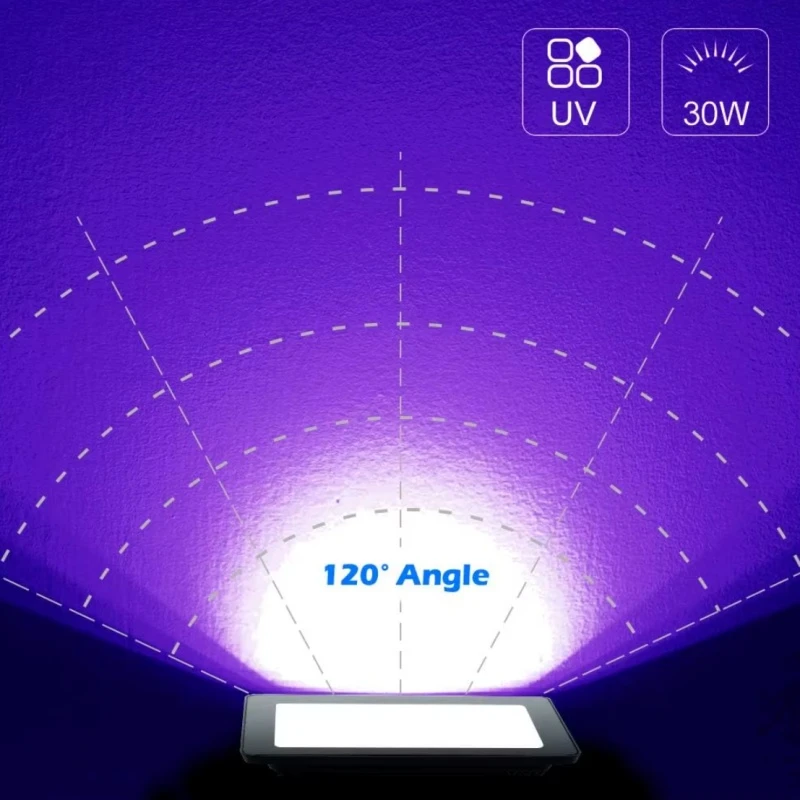
Common wide-beam specifications typically range from 90° to 120°. Pros:
• A single light can cover a large area with a smooth transition of light, minimizing the risk of distinct bright spots or dark corners.
• Highly effective for close-range installation-ideal for low ceilings, narrow corridors, or small exhibition spaces.
• Requires fewer fixtures for a given area, resulting in lower costs for wiring and installation.
Cons:
• Irradiance is spread out; the fluorescent effect weakens significantly as the distance increases.
• Light tends to scatter, making it less precise for applications where the goal is to illuminate only a specific object.
Pros and Cons of Narrow-Beam Blacklight Fixtures
Narrow-beam fixtures typically have a beam angle between 15° and 60°; some models even allow for adjustment by swapping out lenses.
Pros:
• Concentrated light output with high central irradiance, resulting in more vivid fluorescent colors and stronger contrast.
• Long-range reach, making them suitable for setups where lights are mounted high or the target is at a distance.
• Allows for precise targeting of specific objects or walls, reducing wasted light.
Cons:
• Small beam spot size; covering a large area requires multiple fixtures.
• If not positioned carefully, the overlap between lights can create visible, alternating bands of light and shadow.
• At close range, the center may be overly bright, while the edges drop off into darkness abruptly.
Matching Installation Distance with Beam Angle
Rather than relying on guesswork, try calculating it. The diameter of the light spot is approximately: 2 × installation distance × tan(beam angle ÷ 2).
For example, with an installation distance of 5 meters:
• 30° narrow beam: spot diameter is approximately 2.7 meters.
• 60° medium beam: spot diameter is approximately 5.8 meters.
• 120° wide beam: theoretically reaches about 17 meters, but the light intensity at the edges is so weak that the effective, usable area is much smaller.
Therefore, don't assume that a 120° beam angle-as stated on a spec sheet-means a single fixture can fully illuminate an entire large hall. The effective range is typically more conservative than the theoretical value; it is best to allow for some margin during planning, ensuring that the light beams from adjacent fixtures overlap slightly.
Choosing for Common Application Scenarios
• Stages, performances, parties, and nightclubs: Light fixtures are often positioned at a distance, yet must cover the entire stage. A common approach is to use medium or narrow-beam lights, supplemented by a few wide-beam fixtures for fill lighting.
• Fluorescent murals and themed exhibitions: For large wall surfaces requiring uniform illumination, wide-beam lights are the most convenient choice. If you wish to highlight a specific piece, add narrow-beam lights for focused accent lighting.
• Outdoor building facades and landscape decor: Due to the long distances involved, narrow-beam lights are necessary to ensure the light retains sufficient intensity upon reaching the target.
• Close-range inspection and viewing of fluorescent markings: For small targets at close range, narrow-beam lights make fluorescent traces appear more distinct.
• Small indoor spaces (bars, escape rooms, gaming areas): With lower ceilings, wide-beam lights are generally sufficient.
In complex environments, relying on a single type of light or beam angle may not be enough; a mixed configuration is often more practical.
Other Parameters to Consider Beyond Beam Angle
Once the beam angle is selected, several other factors will influence the final result:
• Wavelength: 365nm provides stronger and purer fluorescence excitation, while 395nm is more budget-friendly but contains a higher proportion of visible light. Choose based on your specific requirements and budget.
• Power and Light Intensity: For a given beam angle, power determines the "base brightness"-these two factors should be evaluated together.
• Ingress Protection (IP) Rating: For outdoor or damp environments, an IP65 rating or higher is recommended.
• Heat Dissipation Design: In scenarios involving long-term operation, poor heat dissipation will accelerate light degradation (lumen depreciation).
• Custom Beam Angle Options: For large-scale projects, customizing lens angles to suit the specific site is often more cost-effective than using standard, off-the-shelf models.
Summary
Wide-beam lights excel in providing broad coverage, soft light, and ease of installation, making them ideal for uniform illumination over large areas at close range. Narrow-beam lights excel in concentrating light, reaching long distances, and highlighting specific details, making them suitable for long-range applications or focusing on precise targets. The actual answer depends on three factors: the mounting height of the light, the size of the area to be illuminated, and the required light intensity.
First, determine the mounting distance and use the formula above to estimate the size of the illuminated spot. Then, decide whether a wide-angle, narrow-angle, or a combination of beam angles is best-following this process will help ensure you make the right choice.
Still unsure which beam angle is best for your project? Feel free to send us your site dimensions, mounting height, and application details; our engineers will provide a tailored selection recommendation at no cost. We also offer OEM/ODM services, allowing for customization of beam angles, wavelengths, and power ratings. Simply reach out to us if you need samples or a price quote.
Our address
No. 5-3 Niujiao Road, Yanchuan Community, Yanluo Subdistrict, Bao'an District, Shenzhen
bwzm18@ledbenweilighting.com