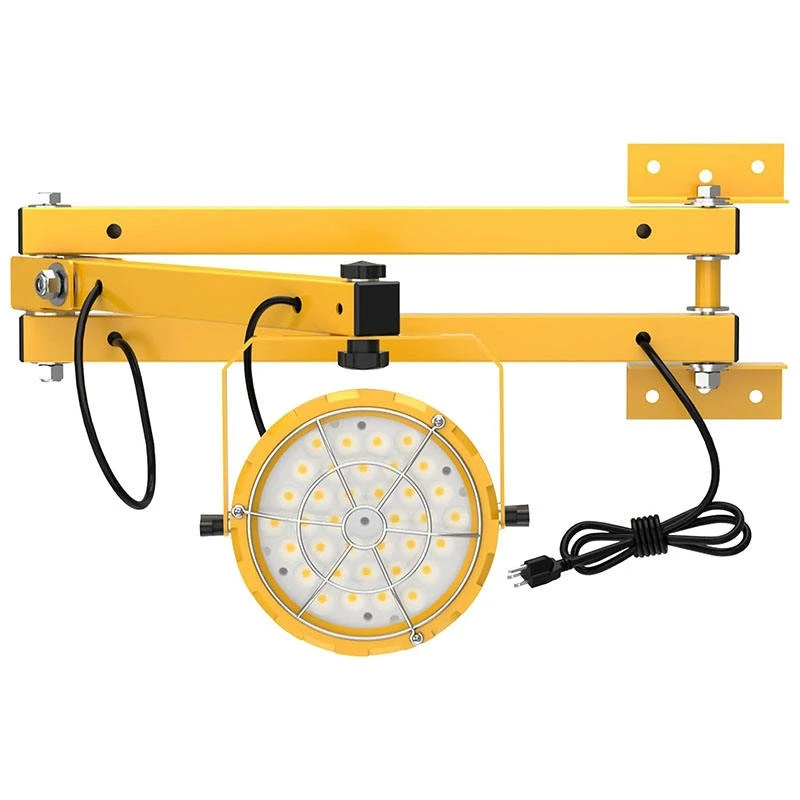
When selecting equipment for warehouses or logistics loading docks, procurement professionals often face a common dilemma: should they choose a wall-mounted bracket or a dock-leveler support structure? Making the wrong choice can lead to costly installation rework, reduced loading/unloading efficiency, or even serious safety hazards. This article skips the abstract theory and focuses on the critical decision-making factors, helping you clarify your approach.
Understand the fundamental purpose of each type
Wall-mounted brackets are secured directly to a wall or column, relying on the wall structure for support. They feature a compact design with a small footprint, making them ideal for securing light-to-medium-duty equipment or auxiliary components.
Dock-leveler support structures are specifically engineered for dock levelers. Typically integrated with a loading dock pit or foundation, they must withstand the repetitive impact of forklifts, cargo, and vehicles, requiring a higher degree of load-bearing capacity and stability.
In short: the former relies on the wall for support, while the latter is designed for floor-based, heavy-duty load-bearing. Grasping this distinction provides a clear direction for your selection.
Evaluate the installation environment: Wall and dock structure
The first step in the selection process is an on-site assessment-don't just look at the spec sheets.
Wall material: Load-bearing capacity varies significantly between concrete walls, brick walls, and light-steel structures. If the wall lacks sufficient strength, a wall-mounted bracket could actually become a safety risk.
Dock structure: If the loading dock already has a pre-existing pit, or if it is a new construction project where the foundation can be designed accordingly, installing a dock-leveler support structure will be much more straightforward.
Retrofitting vs. new construction: In warehouse renovations, modifying walls or floors can be far more costly and complex than anticipated; wall-mounted solutions are often easier to implement. For new projects, the foundation can be built to the specific requirements of the dock leveler from the start.
Assess load requirements: Capacity and frequency of use
This is the factor most frequently underestimated.
Load capacity must be calculated based on the actual maximum operating conditions-accounting for the weight of the forklift, the weight of the cargo, and dynamic impact forces-rather than simply looking at the nominal weight of the cargo alone. The load-bearing capacity of wall-mounted supports is limited by the wall structure and the anchoring method; they are generally suitable for scenarios involving lighter loads and minimal impact.
Frequency of use is equally critical. A loading dock handling dozens of truckloads daily has vastly different requirements for structural fatigue life compared to one used only a few times a week. In high-frequency, heavy-load operating environments, it is better to opt for structures specifically designed for repetitive stress-such as those used for dock levelers (loading bridges).
Consider Spatial Layout: Dock Dimensions and Operational Flow
The advantage of wall-mounted supports is that they do not occupy floor space-a highly practical feature for warehouses with limited dock width or tight turning radii for forklifts.
Dock leveler supports require dedicated space for the equipment itself and its foundation; however, this investment yields more stable vehicle docking and a smoother workflow for loading and unloading. If your facility handles a diverse range of trucks with significant variations in bed height, supports designed for dock levelers offer superior adaptability to these height differences.
Before finalizing your selection, it is advisable to sketch a simple floor plan of the loading dock, marking forklift travel paths and vehicle parking positions-this often makes potential issues immediately apparent.
Consider Installation and Maintenance Costs
Look beyond the initial purchase price and evaluate the total cost of ownership:
Wall-mounted supports: Offer quick installation, fewer procedural steps, and convenient ongoing inspection, typically resulting in a lower initial investment.
Dock leveler supports: May require civil engineering work, foundation pouring, and system commissioning. While the upfront investment is higher, they offer a longer service life and lower repair frequency in heavy-duty applications.
Regarding maintenance, regardless of the type, it is recommended to regularly inspect anchor bolts, weld seams, and anti-corrosion coatings.
This is especially important in outdoor or humid environments, where rust can gradually compromise structural integrity.
Consider Safety and Compliance Requirements
Because these supports are critical to the safety of personnel and cargo, decisions should not be based on intuition alone.
Verify that the product comes with relevant load-testing reports and material certifications.
Check the safety standards required by the target market-this is particularly important for export projects and should be confirmed well in advance. On-site installation must strictly adhere to established standards; the type, spacing, and embedment depth of anchor bolts must not be altered arbitrarily.
A mounting system that complies with standards and is installed according to proper specifications is far more reliable than one that merely boasts impressive technical parameters on paper.
Summary
To distill the points above, consider the following approach:
For scenarios with solid walls, light loads, limited space, and a constrained budget → prioritize wall-mounted brackets.
For scenarios involving heavy loads, frequent operations, a diverse range of vehicle types, and a need for long-term stability → prioritize dock-leveler-style mounting systems.
For cases falling between these two categories → first evaluate the actual operating conditions and the load-bearing capacity of the wall, then determine whether an upgraded solution is required.
There is no single "best" option-only the one that is most appropriate for the specific site. By carefully considering the environment, load, space, cost, and safety, the right solution will generally become clear.