

Anyone who has worked on sports field lighting projects has likely heard this complaint: "The lights are bright enough, but as soon as a fly ball goes up, I lose sight of it." Baseball is different from many other sports. The ball can soar dozens of meters into the air, requiring outfielders to look upward-directly into the night sky-to track it. Meanwhile, the batter must lock eyes on a small ball, only a few centimeters in diameter, the instant it leaves the pitcher's hand. If a light source enters the player's field of vision, the ball can "disappear" for a fraction of a second-a lapse long enough to cause an error or even an injury.
Therefore, the quality of stadium floodlighting cannot be judged solely by wattage or illuminance levels; glare control is the true differentiator. Let's walk through the process-from pole placement to final installation and inspection-of how to get this right.
Why baseball fields are exceptionally sensitive to glare
• Unique lines of sight: When outfielders track high-flying balls, they look upward against the backdrop of the dark night sky. If a light fixture enters their field of vision, the extreme contrast between light and dark overwhelms the eye's ability to adapt.
• Small, fast-moving targets: A baseball is small and travels at high speed, leaving players very little time to locate it.
• The batter's perspective: The batter faces the entire pitching direction; lights positioned behind the pitcher or in the outfield can all become sources of interference.
Consequently, the design philosophy for baseball field lighting is: first ensure the ball remains visible, then address the overall brightness.
Pole placement: Avoiding critical lines of sight
The positioning of light poles largely determines the potential for glare; once the layout is set, subsequent adjustments to the fixtures can rarely fully compensate for fundamental flaws in the initial configuration.
• Avoid the axis directly in front of the batter and behind the pitcher: Lights placed along this line have the most direct impact on the batter.
• Avoid positions directly in the line of sight of outfielders facing home plate: Outfielders often look back toward home plate while tracking the ball; ideally, light poles should not be positioned within this specific angle.
• A common practice is to position light poles outside the field boundaries, allowing light to enter the playing area from the sides or at an angle, rather than shining directly toward the players.
• The number and height of the poles should be considered in tandem: taller poles allow the light beams to be directed more sharply downward, reducing the likelihood of light shining directly into players' eyes.
Aiming Angles: Avoid Directing Beams into the Sky
With the same set of lighting fixtures, different aiming points can lead to vastly different experiences for players.
• Aim Downward: Light beams should be directed onto the playing surface rather than sweeping across the sky. Otherwise, stray light may illuminate the background of a high-flying ball, making it harder to see.
• Zone-Based Aiming: Establish specific aiming points for the infield and outfield. The infield requires higher brightness, while the primary goal in the outfield is to ensure the ball remains visible.
• Allow for Fine-Tuning: Use mounting brackets with angle scales, which enable minor on-site adjustments without requiring the entire system to be reinstalled.
Optical Design and Light-Shielding Accessories
Optical design represents the "core" technical capability of a fixture to control glare.
• Precision Light Distribution: Utilize lenses or reflectors to focus light onto the target area, minimizing light spill to the sides or upward.
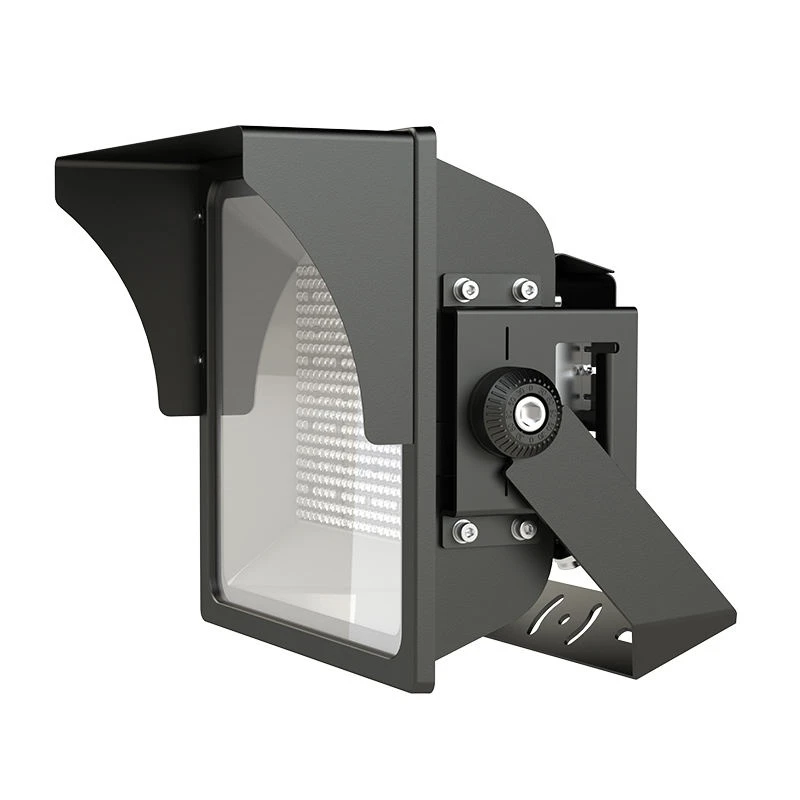
• Light Shields (Visors/Baffles): Installed on the upper edge of a fixture, these block light directed upward-a feature particularly beneficial for outfielders.
• Louvers or Anti-Glare Structures: These reduce the intensity of glare when viewing the fixtures from the side, ensuring that players are not blinded if they happen to glance toward the light poles.
• Luminance Distribution of the Light Source: Using multiple LEDs paired with diffusing lenses creates a softer light output compared to a single, ultra-bright point source, preventing the formation of harsh, intense "hot spots."
Color Temperature, Uniformity, and Vertical Illuminance
These factors are directly related to the ability to "see the ball clearly," yet they are often treated as secondary parameters.
• Color Temperature: Sports facilities typically use a neutral-to-cool white light, which makes a white ball easier to distinguish against the backdrop of grass or dirt. Specific values can be selected based on the facility's classification and whether it requires provisions for broadcasting.
• Illuminance Uniformity: If there is too great a contrast between light and dark areas on the field, players' eyes may struggle to readjust when shifting their gaze from a bright zone to a dark one-potentially causing them to lose sight of the ball at a critical moment.
• Vertical Illuminance: As a ball travels through the air, its sides are illuminated; therefore, in addition to horizontal illuminance on the ground, vertical illuminance must also be ensured.
Flicker-Free Operation and Dimming: Often-Overlooked Details
• Low-Flicker Drivers: While flicker may not be perceptible to the naked eye, it can cause a fast-moving ball to appear as if it has a "trail" or moves in a staccato, discontinuous fashion-an effect that becomes particularly noticeable in slow-motion broadcast replays.
• Multi-Level Dimming: Since brightness requirements vary between training sessions, amateur games, and official matches, dimming capabilities allow for the optimal light level in any given scenario, while also helping to reduce overall glare.
Conclusion
To ensure floodlights are sufficiently bright without hindering batters or outfielders as they track the ball, consider these key points:
1. Position light poles to avoid obstructing critical lines of sight, thereby minimizing direct glare at the source.
2. Lower the aiming angles of the fixtures to prevent light beams from being directed too high into the sky.
3. Select luminaires with precise light distribution, equipped with visors or anti-glare shielding.
4. Balance color temperature, uniformity, and vertical illuminance to ensure the ball remains clearly visible.
5. Choose products that are flicker-free and dimmable.
There is no "one-size-fits-all" solution for glare control; because every field differs in terms of dimensions, pole infrastructure, and intended level of play, the best approach is one that is carefully refined through attention to these specific details.
If you are planning a lighting project for a baseball field, softball field, or other sports facility, please get in touch. Simply provide us with the field dimensions, existing pole infrastructure, and the intended use (training, competition, or broadcasting), and our engineers will develop a tailored lighting design and cost proposal-helping you resolve potential glare issues during the design phase.
Our address
No. 5-3 Niujiao Road, Yanchuan Community, Yanluo Subdistrict, Bao'an District, Shenzhen
bwzm18@ledbenweilighting.com






