

For a broad range of lighting applications, LED strip lights are popular and adaptable. However, knowing how far a strip can be powered from one end without encountering problems like voltage loss is essential for organizing longer installations. A number of variables, including voltage, power usage, and wire configuration, affect how long an LED strip can be powered from one end.
While 24V LED strips may reach up to 10 meters, 12V LED strips can often go up to 5 meters. 48V LED strips provide a 50-meter power range for extended runs. High-voltage strips, such as 110V or 240V AC strips, are perfect for big commercial or outdoor installations since they can reach up to 100 meters. Let's examine how voltage impacts LED strip length and how to extend your LED strips' operating distance.
Ⅰ. Understanding Maximum Run Length and Voltage Drop
The farthest distance an LED strip can be powered from one end without encountering a voltage drop is known as its maximum run length. When electricity passes through the strip and runs against resistance, it loses voltage, which is known as a voltage drop. The LEDs at the distant end fade or flicker as a consequence. The strip is more vulnerable to voltage loss at lower voltages, especially in 12V strips. Longer runs are possible with higher voltage strips, such as 24V and 48V, since they demand less current, which lowers resistance.
Ⅱ. How Does LED Strip Length Affect Power?
An LED strip's maximum run length is mostly determined by its power. The length of the strip and its wattage per meter determine how much electricity an LED strip installation will use overall.
LED strips typically have wattage ratings between 4.8W/m and 14.4W/m, which indicate how much energy the strip uses over a meter. The strip needs more power at higher wattages, which affects how long you can operate it before experiencing a voltage drop.
A 10-meter LED strip with a 4.8W/m rating, for instance, will use 48W of electricity (4.8W x 10m = 48W). The overall power need increases to 96W when the length is increased to 20 meters.
Selecting the appropriate power source is also crucial. Enough wattage must be supplied by the power source to support the strip's whole length. To prevent overloading and guarantee steady functioning, it is usually advised to use a power supply that is 20–30% larger than the entire amount of power needed.
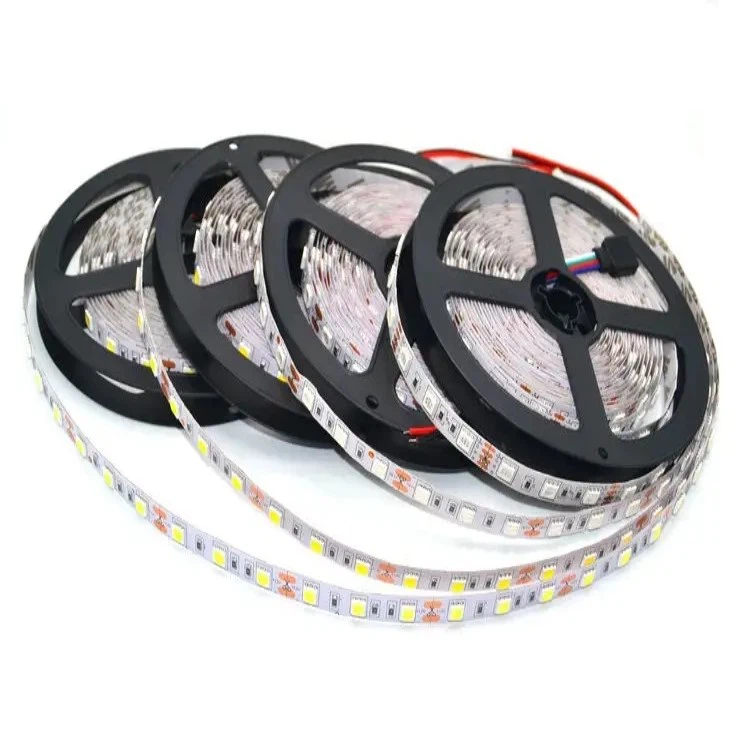
Ⅲ. What is an LED strip with constant current?
LED strips with constant current are designed to keep the current constant across the strip, guaranteeing that the brightness is constant over the whole length. In conventional constant voltage strips, the power source keeps the voltage constant (for example, 12V or 24V), but the current varies, which may cause fading and voltage loss over extended runs.
Drivers are used in constant current LED strips to control the current passing through the LEDs. This removes the possibility of voltage drop and guarantees that, regardless of the strip's length, the LEDs will always get the precise amount of power they need.
Ⅳ. Why Can LED Strips With Constant Current Be Longer?
Because constant current LED strips control the current flowing along the full length of the strip, they can operate for longer periods of time than typical constant voltage strips. By doing this, the effects of voltage drop are lessened or eliminated, enabling the LEDs to remain light even while traveling great distances.
Longer runs may be powered by constant current strips for the following reasons:
1. Existing Law
No matter how far away an LED is from the power supply, the constant current driver makes sure it always gets the same amount of current. This stops the strip from fading at the far end, which happens often with constant voltage strips.
2. Diminished Drop in Voltage
The voltage drop that normally happens when the power passes through the strip is reduced since the current is controlled. As a result, a single power source may power significantly longer strips.
3. Extended Maximum Length of Run
Run lengths of 30 to 50 meters or more may be accomplished with constant current strips without the need for extra power supply or uneven brightness. Because of this, they are perfect for huge projects that need continuous, lengthy streams of light.
Ⅴ. Ultra-Length LED Strip: What is it?
For applications that need lengthy, continuous illumination lines without any discernible fading, ultra-length LED strips are made. Long-distance brightness maintenance is aided by these strips' constant current drivers and average 48V use. Ultra-length strips do not need numerous power supply or connectors since they can operate for at least 50 meters from a single power source.
Large commercial projects, outdoor lighting, and industrial settings that need continuous, long-lasting lighting runs with consistent brightness from beginning to end are the perfect applications for ultra-length LED strips.

Ⅵ. Benefits of Using Ultra-Length LED Strip Lights
1. Constant Illumination:
Due to continuous current regulation, ultra-length LED strips avoid the fading that usually happens with regular strips and maintain uniform brightness across extended distances.
2. Less Need for a Power Supply:
These strips make installation easier and save costs by enabling longer lines with fewer power supply.
3. Perfect for Big Projects:
Ideal for outdoor, commercial, or industrial settings requiring extended, continuous illumination runs.
4. Durability and Efficiency:
High-voltage, ultra-length LED strips are designed to withstand higher currents and are intended for extended usage in challenging conditions.
Ⅶ. How to Increase the Running Length of LED Strips
Here are a few methods to increase the running length of LED strips without sacrificing brightness if your project calls for them to be used for longer than the typical maximum run lengths:
1. Employ Strips with Higher Voltage
Longer runs are possible with 24V and 48V LED strips than with 12V ones, as was previously mentioned. By raising the voltage, you minimize resistance and voltage loss by lowering the current. High-voltage AC strips (110V or 240V) may extend up to 100 meters from one end for very long lines.
2. Strength on Both Ends
By powering the LED strip from both ends, voltage drop is minimized since less energy must travel. By using this technique, the strip's two ends are guaranteed to get enough voltage to keep their brightness constant.
3. Make Use of Thick Wires
Switching to thicker wire (lower AWG) lowers resistance and helps minimize voltage drop if you're experiencing it because of lengthy cable lengths. It is advised to use 16 AWG or 14 AWG wire for longer lengths in order to manage the current load.
4. Make Use of Parallel Wiring
You may divide a lengthy LED strip into smaller pieces and power each one separately rather of running it all at once. This method avoids voltage loss during extended runs and lessens the strain on each power source.
5. Make Use of a Bigger Power Source
Make sure your power source can provide enough watts to run the whole length of the strip. Adding a 20–30% cushion to accommodate for power loss during longer runs is a smart idea. For instance, choose a power supply with a minimum 240W rating if your overall power needs are 200W.
6. Make use of LED strips with constant current
Longer lengths without voltage drop are made possible by constant current LED strips, which control the current flowing across the strip. Installations requiring constant brightness over a considerable distance are best suited for these strips.
Shenzhen Benwei Lighting Technology Co., Ltd was established in 2010. It is a national high-tech enterprise integrating design, R&D, production and sales of indoor and outdoor lighting products and also can do OEM, ODM. We also providing professional lighting solutions and other integrated services. BENWEl insists on the philosophy "quality first" to work with its customers, our clients covers Europe, America, Asia, Australia,South Africa and other countries, has occupied a leading position in the lighting market and won the trust of clients.
For product details, please contact us by email: bwzm6@ledbenweilighting.com





