

Basic Overview of Modular LED Stadium Flood Light Service Life
Definition of LED Lighting Service Life Industry Standards
Unlike traditional lighting equipment such as metal halide lamps and halogen lamps that fail suddenly with complete light extinction, the service life of LED lighting products is defined by the lumen maintenance rate in the international industry standard (IESNA LM-80 and TM-21). The industry universally recognizes that the effective service life of LED lamps refers to the cumulative working hours when the luminous flux decays to 70% of the initial luminous flux (L70 standard). For high-power outdoor professional lighting represented by modular LED stadium flood lights, the L70 lifespan is the core benchmark to measure product durability, rather than the simple physical service life of the lamp body.
Traditional outdoor lighting lamps usually have a service life of only 8,000 to 15,000 hours, with rapid light attenuation after 1 year of continuous use, resulting in dim illumination and frequent replacement. In contrast, modular LED stadium flood lights adopt upgraded chip packaging technology, modular heat dissipation structure, and industrial-grade protective design, which fundamentally improves the service life limit of high-power lighting equipment. It is the key technical advantage that makes it replace traditional lighting products in large outdoor engineering projects.
Standard Service Life Parameters of Modular LED Stadium Flood Lights
High-quality modular LED stadium flood lights configured with 3030/3535 high-purity LED chips and double gold wire packaging technology have passed strict LM-80 aging tests. The rated L70 service life reaches 50,000 hours under standard laboratory working conditions (ambient temperature 25℃, rated voltage, and full-load operation). Converted into actual application time, if calculated by 8 hours of daily lighting for stadium venues, the theoretical continuous service life can reach more than 17 years; if calculated by 12 hours of daily working hours for construction yards and port terminals, the service life can still stably exceed 11 years.
In addition to the L70 standard, the product also has excellent L80 and L90 lumen maintenance performance. After 30,000 hours of operation, the luminous flux can still maintain more than 80% of the initial value; after 10,000 hours of operation, the light attenuation is less than 10%. This ultra-low light attenuation characteristic ensures that the lamp can maintain professional-level lighting brightness and uniformity for a long time in the whole life cycle, avoiding the problem of insufficient illumination in the later stage of traditional lamps.
Differences Between Modular Structure and Integrated Lamp Service Life
The modular split design is the key reason why this series of stadium flood lights has a longer effective service life than traditional integrated LED flood lights. The integrated high-power lamp has an integrated light source and heat dissipation structure. Once local chips are damaged or the heat dissipation system is aging, the whole lamp will be scrapped, and the actual usable life is far lower than the rated life. However, the modular LED stadium flood light adopts an independent split structure for each light module, heat dissipation system, and drive power supply.
When a single module has individual chip aging or minor failure, users only need to replace the faulty single module instead of the whole lamp. The main body, heat dissipation structure, and power supply of the lamp can continue to work stably. This structural advantage greatly improves the actual effective service life of the equipment. In actual engineering applications, the comprehensive service life of modular lamps is 30% to 50% longer than that of integrated lamps of the same power, and the long-term use stability is significantly improved.
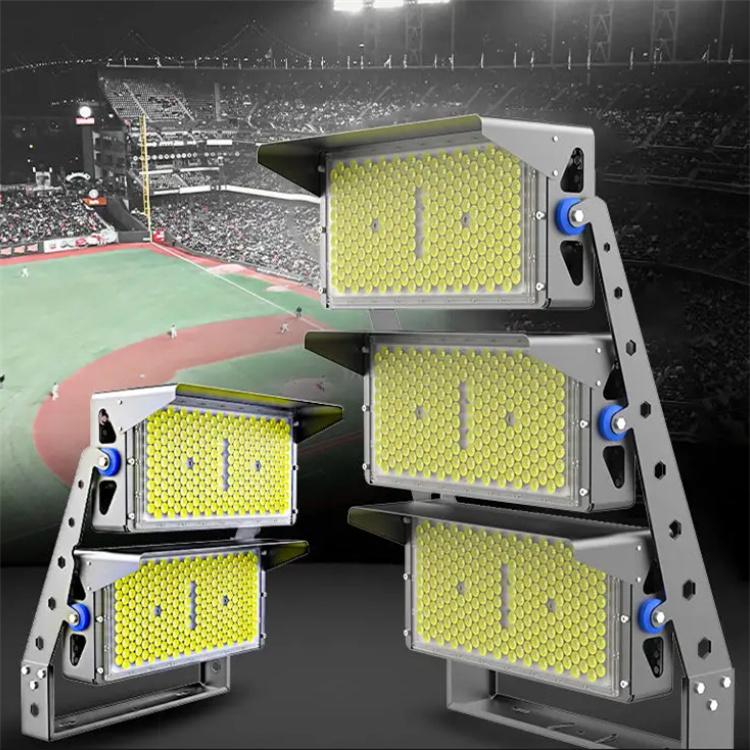
Core Factors Affecting the Service Life of Modular LED Stadium Flood Lights
Internal Structural and Material Factors
The LED chip is the core light-emitting component of the flood light, and its quality and packaging technology directly determine the upper limit of product service life. This modular stadium flood light adopts high-grade 3030/3535 LED chips with ultra-thick double gold wire packaging. Compared with ordinary single copper wire packaging chips on the market, double gold wire packaging has stronger electrical conductivity, better pressure resistance, and effectively avoids wire breakage and chip burnout caused by current impact.
At the same time, the chip is equipped with high-temperature resistant phosphor glue and anti-aging packaging resin, which can resist high-temperature oxidation during long-term high-power operation, prevent phosphor failure and light color deviation, and ensure stable light output for a long time. Inferior chips are prone to rapid aging, light decay acceleration, and dead lights after 5,000 to 10,000 hours of use, while high-quality industrial-grade chips can maintain stable performance for more than 50,000 hours.
2. Heat Dissipation System Performance
Temperature is the biggest killer of LED lamp service life. More than 70% of LED light attenuation and equipment failure are caused by excessive junction temperature and poor heat dissipation. This modular flood light adopts an innovative spiral air convection heat dissipation structure and honeycomb heat dissipation groove design. The die-cast aluminum alloy heat dissipation shell has ultra-high thermal conductivity, which can quickly export the heat generated by the chip during operation to the air.
The independent heat dissipation cavity of each modular lamp realizes one-module-one heat dissipation system, avoiding heat superposition caused by centralized light emission of high-power lamps. The optimized air convection design forms an automatic air circulation channel, which accelerates heat exchange with the external environment, effectively controls the LED junction temperature below 75℃ during long-term full-load operation, and greatly slows down the aging speed of chips and electronic components. Compared with ordinary lamps with passive heat dissipation, this structure reduces the light attenuation rate by more than 40% and doubles the service life of the whole machine.
The drive power supply is the heart of the LED lamp, and its stability determines the long-term working state of the light source. The modular stadium flood light is equipped with an industrial-grade constant-current isolated drive power supply, with a power factor higher than 0.95 and ultra-low harmonic distortion. It has multiple built-in protection functions including overvoltage protection, overcurrent protection, surge lightning protection, short-circuit protection, and high-temperature protection.
In complex outdoor power supply environments with unstable voltage and frequent voltage fluctuations, the drive power supply can always output stable current and voltage, avoid lamp flicker and chip burnout caused by current impact, and ensure continuous and stable operation of the lamp. Inferior non-isolated power supplies are prone to component aging and failure after long-term operation, leading to lamp damage, while high-quality industrial power supplies have a service life of more than 60,000 hours, which matches the life of LED chips perfectly.
External Environmental and Application Factors
Modular LED stadium flood lights are widely used in open-air outdoor environments, and extreme temperature and humidity will affect the service life of the equipment. Long-term high-temperature environments (summer high temperature above 40℃) will increase the operating load of the heat dissipation system, slightly increase the chip junction temperature, and accelerate light attenuation. Long-term high-humidity and rainy environments may cause moisture erosion of internal components if the product has poor sealing performance.
This product adopts IP66 full-sealed protection structure, with integrated rubber sealing ring and waterproof glue filling process inside the lamp body, which can effectively isolate moisture, rainwater, and water vapor. It can work stably in the environment of -40℃ to +60℃, and the service life attenuation caused by environmental temperature and humidity is controlled within 5%, which is far lower than that of ordinary outdoor lighting products.
For coastal ports, seaside stadiums, and chemical industrial park lighting scenarios, the air contains a large amount of salt fog and corrosive gases, which will corrode the lamp shell and internal electronic components of ordinary lamps, resulting in shell rust, circuit aging, and shortened service life. The modular stadium flood light adopts high-purity die-cast aluminum alloy shell with anti-oxidation and anti-corrosion electrostatic spraying treatment on the surface.
The whole lamp body has the characteristics of anti-rust, anti-corrosion, and anti-aging, which can resist long-term salt fog erosion and ultraviolet radiation. It avoids shell aging, fading, and structural damage caused by long-term outdoor sun exposure and wind and rain erosion, ensuring that the heat dissipation structure and sealing performance remain intact in the whole life cycle, and the service life is not affected by harsh corrosive environments.
Long-term full-load continuous operation and frequent switch will affect the service life of LED lamps. In stadium night games, construction site all-weather operation and other scenarios, the lamp needs to work continuously for a long time; while frequent instantaneous current impact will be generated when the lamp is switched on and off frequently, which will cause fatigue aging of chips and power components.
The industrial-grade configuration of modular flood lights adapts to long-term full-load operation. After continuous 24-hour aging tests, the light attenuation and component aging rate are extremely low. At the same time, the soft start technology is adopted to avoid instantaneous high current impact during startup, which can effectively adapt to frequent switch operation, reduce operating loss, and ensure stable service life in high-frequency working scenarios.
Light Attenuation Law and Life Loss Control Mechanism
Light Attenuation Characteristics in Different Life Cycles
In the initial working stage of 0 to 10,000 hours, the modular LED stadium flood light has extremely low light attenuation. After professional aging treatment before leaving the factory, the product eliminates the initial aging loss of components. The luminous flux attenuation within 10,000 hours is less than 10%, the light color is uniform, and the brightness is stable. There is no flicker, dark area, or color deviation, which can maintain the best professional lighting effect and fully meet the lighting standards of international sports venues and large engineering projects.
In the mid-term operation stage of 10,000 to 30,000 hours, the lamp enters a stable aging period. With the slow aging of individual chip phosphors and internal electronic components, the luminous flux is attenuated to 80%–90% of the initial value. The attenuation rate is uniform and stable without sudden light decay. The lighting performance still fully meets the daily use standards of stadiums, terminals, and construction sites, and there is no need for equipment replacement and maintenance in this stage.
In the late stage of 30,000 to 50,000 hours, the product continues to work stably, and the luminous flux remains above 70% of the initial value, reaching the L70 service life standard. Compared with the sharp performance decline of traditional lamps in the later stage, the modular flood light has gentle attenuation and stable performance. Even at the end of the rated service life, it can still maintain basic lighting functions, which can meet the low-standard lighting needs of auxiliary venues, and the actual usable life is longer than the rated life.
Modular Design Life Loss Reduction Advantage
The biggest advantage of modular structure in life loss control isindependent operation and independent loss of each module. The lamp body is composed of multiple independent light-emitting modules, each module is equipped with an independent heat dissipation unit and a separate power supply circuit, and there is no mutual interference between modules. When individual modules have slight aging and loss, it will not affect the normal operation of other modules.
In contrast, the integrated flood light has overall linkage loss. Local chip aging will cause overall circuit load imbalance, accelerate the aging of the whole lamp, and lead to overall failure in advance. The modular design realizes decentralized loss, effectively delays the overall aging speed of the equipment, and maximizes the extension of the comprehensive service life of the lamp. At the same time, the detachable modular structure supports partial replacement and maintenance, which fundamentally solves the problem of overall scrapping caused by local loss of traditional lamps.
Intelligent Loss Control of Industrial Protection Design
The IP66 industrial-grade protection system of the product is an important guarantee to control life loss. The fully sealed structure isolates dust, rainwater, sand, and foreign matter from entering the lamp body, avoids circuit short circuit, component corrosion, and heat dissipation blockage caused by external impurities, and eliminates abnormal life loss caused by environmental factors. The tempered anti-yellowing lens will not age and fog after long-term ultraviolet radiation, ensuring stable light transmittance and no additional brightness loss.
In addition, the built-in intelligent temperature control system can automatically sense the internal temperature of the lamp. When the temperature is too high due to extreme high temperature or long-term full-load operation, it will appropriately adjust the operating power to reduce the chip heat generation, protect the core components from high-temperature damage, and realize intelligent control of life loss, ensuring that the product always operates within the safe life range.
Scientific Maintenance Strategies to Prolong Service Life
Regular Cleaning and Heat Dissipation Maintenance
Long-term outdoor operation will lead to dust, fallen leaves, and sediment accumulation on the surface of the lamp body and heat dissipation groove, which will block the heat dissipation channel, reduce the heat dissipation efficiency, increase the chip junction temperature, and accelerate light attenuation and component aging. It is recommended to clean the lamp shell and honeycomb heat dissipation groove every 3 to 6 months according to the use environment, wipe off surface dust and dirt with a dry soft cloth, and keep the heat dissipation channel unobstructed.
For coastal and dusty construction site environments with severe environmental pollution, the cleaning cycle can be appropriately shortened to ensure the best heat dissipation effect. Good heat dissipation maintenance can reduce the long-term operating temperature of the lamp by 5℃–10℃, effectively delay the aging speed of core components, and prolong the overall service life of the product by more than 15%.
Regular Inspection of Power Supply and Circuit System
The stability of the power supply circuit directly affects the service life of the lamp. It is necessary to regularly check the power line interface, waterproof wiring terminal, and drive power supply state of the flood light every year to ensure that the wiring is firm, there is no aging, peeling, and water seepage of the line, and no poor contact. For the lighting system with long-term operation, regular voltage and current detection should be carried out to ensure that the lamp works within the rated power range and avoid overload operation.
At the same time, it is necessary to check the lightning protection and surge protection device of the lighting system regularly. Outdoor high-altitude lamps are vulnerable to lightning strike impact. Good lightning protection measures can avoid instantaneous high-voltage impact damage to the power supply and chips, eliminate sudden failure loss, and ensure long-term stable operation of the equipment.
Timely Replacement of Aging Modules and Accessories
Benefiting from the modular detachable design, users do not need to replace the whole lamp after long-term use. In the later stage of product use, if individual modules have obvious light attenuation, dim brightness, or minor faults, the faulty modules can be replaced in a targeted manner. The replacement operation is simple and fast, no professional construction equipment is needed, and the maintenance cost is extremely low.
Timely replacement of aging modules can avoid the problem of unbalanced load of the whole lamp caused by partial aging, ensure the overall working stability of the lighting system, and maximize the service life of the main body and remaining modules of the lamp. This targeted maintenance mode is the core advantage of modular LED stadium flood lights different from traditional integrated lamps in life cycle management.
Conclusion
Modular LED stadium flood lights, relying on high-quality chip packaging technology, innovative modular heat dissipation structure, industrial-grade protection performance, and stable drive system, have a rated L70 service life of up to 50,000 hours, which is 3–5 times that of traditional outdoor lighting products. Its unique modular split structure realizes independent operation and loss control of a single module, avoids overall scrapping caused by local failure, and greatly improves the actual effective service life and long-term application value of the product.
The service life of the product is affected by internal core quality and external application environment. High-temperature heat dissipation, environmental corrosion, and overload operation are the main factors leading to light attenuation and life loss. Through standardized production and industrial-grade configuration, this product effectively controls the life loss rate, and maintains ultra-low light attenuation and stable performance in the whole life cycle. Combined with scientific daily maintenance and modular replacement maintenance, the comprehensive service life of the equipment can be further extended, bringing ultra-long-term stable lighting services and ultra-low operating maintenance costs for global outdoor large-scale lighting projects.
In the field of modern outdoor professional lighting, long service life and low attenuation have become the core competitiveness of lighting equipment. Modular LED stadium flood lights perfectly meet the long-term operation and low-cost maintenance needs of stadiums, ports, construction sites, and other scenarios, and are the most cost-effective and durable long-term lighting solution for large outdoor engineering projects.

How To Cooperate With Us?
We are happy that we have total control over the manufacturing process and the quality of our products since we have our own facilities. Since we are producers rather than just brokers, we are dedicated to providing our customers with the best pricing. Since we are certain that the price and quality of our products are transparent, we advise customers to examine our samples first. Our commitment to quality and customer satisfaction drives us to continuously provide top-notch goods.
Our address
3rd Floor, 5th Building, Hebei Industrial Park, Hualian Community, Longhua District, Shenzhen, China





