Stadium lighting systems serve as the core infrastructure supporting modern professional and amateur sports events, enabling high-standard sports competitions, outdoor training, large-scale public performances and spectator viewing activities under low-light and night environmental conditions. Different from conventional civilian and commercial lighting, stadium lighting requires ultra-high luminous intensity, uniform illumination distribution, stable light output and professional color rendering performance to meet the visual needs of athletes' high-speed movement, real-time referee judgment and high-definition television broadcasting. The power grade, luminous efficiency and overall performance of stadium lights directly determine the lighting quality of sports venues. To clarify the professional power attributes of stadium lighting systems, this paper systematically analyzes the standard power specifications of mainstream stadium lights, multi-dimensional influencing factors of lighting power configuration, luminous performance advantages of different light sources, and the overall energy consumption level of venue lighting systems, providing scientific theoretical support for stadium lighting design, equipment selection and operation management.
Standard Power Specification Classification of Stadium Lights
The power configuration of stadium lights is not fixed, which is formulated strictly according to international sports lighting standards, venue scale, competition grade and sports event types. The power grade difference directly determines the luminous coverage area, illumination intensity and professional application scenario of the lighting system. At present, the power of mainstream commercial and professional stadium lighting fixtures is concentrated in the high-power interval, forming a standardized power matching system for different sports events.
Basic Power Range of Conventional Stadium Lighting Fixtures
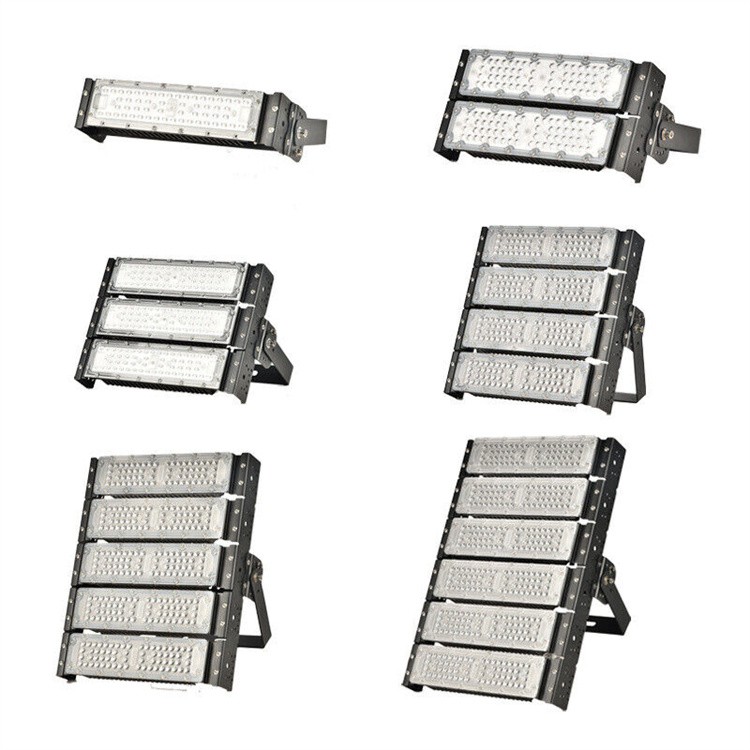
Ordinary amateur and community stadiums are equipped with medium-power lighting fixtures, while professional competition-level stadiums uniformly adopt high-power industrial-grade lamps. The rated power of a single mainstream stadium light fixture ranges from 1000W to 2000W, which is far higher than the power of traditional civilian lighting fixtures. Among them, 1000W lamps are mostly used for small-scale training venues and amateur competition venues, with moderate illumination and coverage; 1500W lamps are the mainstream standard for conventional professional sports venues, meeting the basic lighting needs of formal competitions; 2000W ultra-high-power fixtures are applied to large-scale professional stadiums undertaking high-level competitions and live TV broadcasting tasks.
Event-Based Power Matching Standards
Different sports have distinct visual environment requirements due to differences in field area, athlete movement speed, ball movement trajectory and viewing distance, thus forming differentiated power configuration standards. Baseball venues require precise and uniform ground illumination to capture the high-speed trajectory of baseballs and the subtle movements of players. The minimum matching power of single lamp for standard baseball stadium lighting is 1500W to ensure no shadow dead zones and uniform light distribution on the field. Football venues feature large field area, long viewing distance and wide activity range of players, requiring higher overall luminous flux and coverage. The single lamp power of professional football stadiums can reach 2000W, which meets the dual needs of on-site viewing and high-definition live broadcast.
Intuitive Luminous Power Comparison Analysis
The ultra-high power of stadium lights can be intuitively quantified through the comparison with civilian lighting fixtures. A single 1500W professional stadium light has luminous flux equivalent to 120 units of standard 60W civilian incandescent bulbs. According to the average household lighting configuration of 20 civilian bulbs, the luminous capacity of only one 1500W stadium light exceeds the total luminous power of six ordinary families. For a large-scale stadium with 80,000 spectator seats, the overall lighting system is equivalent to 9,600 standard 60W civilian bulbs in terms of luminous efficiency, forming an ultra-high-brightness lighting environment that completely covers the entire field and spectator area.
Core Influencing Factors of Stadium Lighting Power Configuration
The final power scheme of stadium lighting system is a comprehensive result of multi-dimensional factor superposition. In addition to event types, venue spatial parameters, environmental conditions and usage scenarios will also affect the selection of lamp power and overall layout, forming a scientific and standardized power configuration system.
Venue Spatial Dimension Parameters
The width and area of the stadium are the basic factors determining the overall power demand. Large-area venues require more lighting fixtures and higher single-lamp power to eliminate illumination dead zones and realize full-field uniform lighting. The height of light poles is a key structural factor affecting lighting efficiency and power matching. Properly increasing the installation height of light poles can expand the single-lamp luminous coverage area, optimize the overall light distribution uniformity, and reduce local glare and shadow interference. However, excessive pole height will lead to luminous flux attenuation, which requires matching higher-power lamps to compensate for light loss and ensure the standard illumination of the field.
Quantity and Layout of Light Poles
The number of light poles and spatial layout density jointly restrict the power configuration of a single lamp. Venues with dense light pole layout can disperse the lighting pressure, and the single lamp power can be appropriately reduced on the premise of meeting the total illumination standard. For venues with sparse light pole layout and wide spacing, it is necessary to configure high-power single lamps to ensure overlapping coverage of light beams and avoid insufficient local illumination. Reasonable layout and power matching can balance lighting effect, energy consumption and construction cost, which is the core link of stadium lighting system design.
Environmental and Usage Scenario Factors
Diurnal conditions and weather changes also put forward differentiated requirements for lighting power. Daytime supplementary lighting only needs to make up for local light insufficiency, with low power demand; night full-scene lighting requires maximum power output to meet independent lighting needs. In bad weather such as cloudy days, fog and haze, the light transmittance of the atmosphere decreases, and the luminous flux attenuation is serious, which requires the lighting system to maintain higher power operation to ensure stable field visibility. In addition, large-scale events with live broadcast and high-definition shooting requirements need higher illumination standards, corresponding to higher overall power configuration of the lighting system.
Performance Comparison of Different Types of Stadium Light Sources
With the iterative upgrading of lighting technology, the mainstream light sources of stadiums have completed the transformation from traditional gas discharge lamps to modern LED solid-state light sources. Different light source types have significant differences in power utilization efficiency, luminous performance, stability and maintenance cost, which directly affect the actual power output effect of stadium lighting systems.
Deficiencies of Traditional Stadium Light Sources
Early stadiums widely adopted incandescent bulbs and halogen bulbs as lighting sources. Although these traditional light sources have simple structure and low initial cost, they have obvious defects in power utilization efficiency. Traditional bulbs rely on thermal radiation for luminescence, with extremely low electro-optical conversion efficiency. Most of the electric energy is converted into heat energy loss, and the effective luminous flux output is low. In addition, traditional light sources have short service life, severe light attenuation, high failure rate and frequent replacement demand, resulting in high long-term operation and maintenance costs, which can no longer meet the high-efficiency and high-stability lighting needs of modern professional stadiums.
Performance Advantages of Modern LED Stadium Lights
Current professional stadiums all adopt high-power LED stadium lights as the mainstream lighting solution. LED lights have revolutionary advantages in power performance and comprehensive efficiency. Firstly, they have ultra-high electro-optical conversion efficiency, which can convert most electric energy into effective visible light, with low heat loss and higher effective luminous power under the same rated power. Secondly, LED lights have higher brightness and better light uniformity, which can effectively eliminate glare and shadow, and significantly improve the field lighting quality. Thirdly, LED light sources have stable performance, extremely low lumen attenuation rate and ultra-long service life, which greatly reduce the frequency of equipment maintenance and replacement. In addition, LED lights support stepless power adjustment and intelligent switching, which can flexibly match the power demand of different scenarios and realize refined energy-saving control.
Energy Consumption Level and Operational Cost Analysis of Stadium Lights
The ultra-high power configuration of stadium lighting systems brings huge energy consumption scale, which is an important part of stadium daily operation cost. The energy consumption level of stadium lights is far higher than that of conventional civilian and commercial lighting, with significant scale characteristics.
Single Lamp Energy Consumption Comparison
The energy consumption of a single high-power stadium lamp is extremely impressive. Statistical data shows that the power consumption of one single professional stadium light operating for one hour exceeds the average monthly household electricity consumption of ordinary residents. Compared with civilian lighting equipment, the energy consumption gap is tens or even hundreds of times, which fully reflects the ultra-high power operation characteristics of stadium lighting fixtures.
Overall System Energy Consumption Scale
A complete stadium lighting system is composed of dozens or even hundreds of high-power lamps. Under full-load operation during events, the total power consumption of the entire lighting system is extremely huge, and the annual cumulative power consumption of long-term operation and standby can reach millions of kilowatt-hours. Although the LED lighting technology adopted by modern stadiums greatly reduces unit energy consumption compared with traditional light sources, the overall energy consumption scale is still far higher than that of ordinary public lighting facilities due to the ultra-high power and large-scale layout of the system.
Comprehensive Value Evaluation of High-Power Lighting
Although stadium lighting systems have high energy consumption, their practical application value is irreplaceable. Ultra-high-power lighting ensures the clarity and uniformity of the sports field environment, guarantees the fairness and smooth progress of sports competitions, and provides high-quality viewing experience for spectators. At the same time, high-standard lighting systems support high-definition live broadcast of events, expand the communication influence of sports events, and create higher economic and social value for stadium operation. The high energy consumption cost is completely matched with its professional functional value and commercial value.
Conclusion
Stadium lights are typical ultra-high-power professional lighting equipment, with single lamp power ranging from 1000W to 2000W. The specific power configuration is comprehensively determined by sports event type, stadium spatial scale, light pole layout and environmental conditions. Compared with traditional incandescent and halogen light sources, modern LED stadium lights realize efficient output of luminous power with lower energy loss, with better lighting performance and lower maintenance cost, and have become the mainstream choice of current stadium construction and renovation. The ultra-high power and large-scale layout of stadium lighting systems lead to huge overall energy consumption, but they provide core guarantee for professional sports competitions, spectator viewing and event live broadcast. With the continuous development of energy-saving lighting technology and intelligent control system, stadium lighting will gradually realize the balance of high-power professional output, low energy consumption and low loss, and further improve the operational efficiency and comprehensive value of modern sports venues.

How To Cooperate With Us?
Having its own factory gives our firm complete control over the production process and the quality of our goods, which we take great pride in. We are manufacturers, not only brokers, committed to offering our clients the lowest costs. We invite consumers to evaluate our samples first since we are certain that the cost and quality of our items are evident. Our dedication to excellence and client happiness motivates us to consistently provide superior products.
Our address
3rd Floor, 5th Building, Hebei Industrial Park, Hualian Community, Longhua District, Shenzhen, China