

Outdoor lighting systems are essential infrastructure for modern sports venues, commercial zones, residential communities, and public activity spaces. Among various professional lighting fixtures, flood lights are the most widely applied large-area outdoor lighting equipment, occupying a core position in the field of industrial and commercial outdoor illumination. In daily engineering applications and academic discussions, many users lack systematic understanding of the inherent naming logic of flood lights. Different from spotlight, downlight and other directional lighting fixtures with narrow beam angles, flood lights have unique optical diffusion characteristics and regional lighting attributes. This paper systematically explores the etymological origin of the term "flood light", analyzes its core optical working principles and characteristic advantages, sorts out diversified application scenarios, and summarizes the technical evolution process of flood light products, so as to clarify the professional attributes and application value of flood lights from a theoretical perspective.
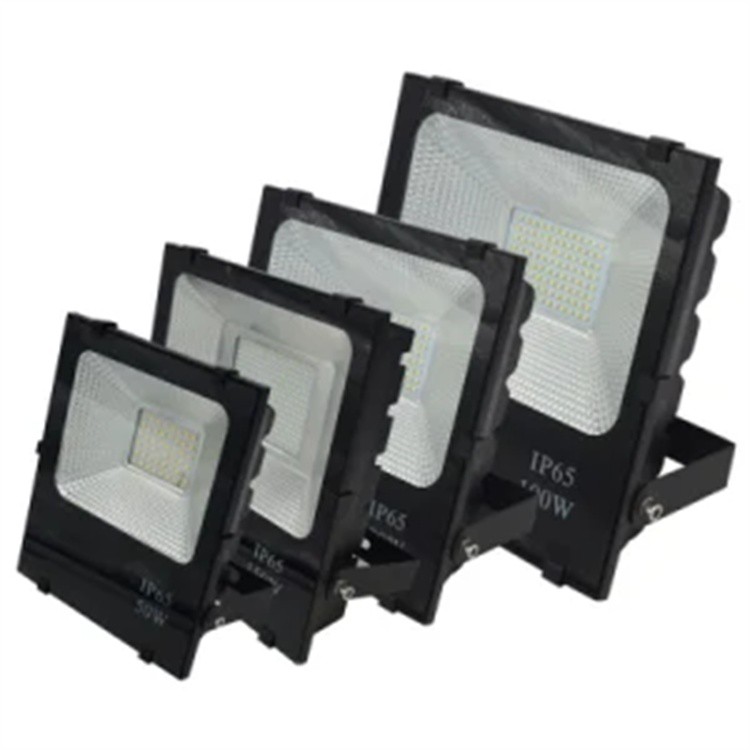
The Naming Origin and Core Definition of Flood Lights
The naming of flood lights is not a random industry convention, but a professional definition summarized based on their luminous form, beam diffusion law and lighting coverage characteristics, which forms a sharp contrast with traditional directional lighting fixtures. The core connotation of the term originates from the morphological simulation of natural flood diffusion, reflecting the most essential optical feature of this type of lighting equipment.
Etymological Logic of "Flood" Naming
The word "flood" originally refers to the natural phenomenon that river water overflows the bank and spreads outward in an all-round, unrestricted and large-area manner, featuring wide coverage, uniform diffusion and no fixed directional restriction. Combined with the luminous characteristics of lighting fixtures, early lighting researchers named this wide-angle diffused lighting product "flood light". Different from spotlights that converge light beams into a narrow and concentrated strip, flood lights simulate the diffusion trajectory of flood water, realizing omnidirectional and large-scale light coverage. The vivid naming method accurately summarizes the core working state of the product, and has gradually become a unified professional term in the global lighting industry.
Professional Optical Definition of Flood Lights
From the perspective of optical engineering, flood lights are defined as high-luminance surface light sources with ultra-wide beam angles. Its core technical feature is to break the directional constraint of traditional lighting fixtures, adjust the light emission angle through professional optical lenses and reflector structures, and realize uniform diffusion of light in a large spatial range. When the flood light works, the light radiates outward in a divergent manner, covering a large ground and spatial area with a single fixture, which is completely consistent with the spatial diffusion form of flood overflow, and this is the fundamental professional reason for its naming.
Comparative Analysis with Traditional Narrow-Beam Lights
Traditional lighting fixtures such as spotlights and track lights adopt focused optical design, with a beam angle generally controlled within 15° to 30°. Their core function is to focus light on a fixed target area for key lighting and accent lighting. In contrast, the beam angle of standard flood lights can reach 90° to 120°, and even ultra-wide-angle products can achieve 150° omnidirectional diffusion. While ensuring high overall brightness, it avoids local light concentration and glare problems, realizing full-coverage uniform lighting. This essential difference in optical diffusion characteristics fundamentally distinguishes flood lights from traditional lighting products, and also verifies the rationality of its naming logic.
Core Performance Characteristics of Modern Flood Lights
With the continuous iteration of lighting technology, flood lights have formed standardized and professional performance systems in terms of luminous efficiency, structural design and environmental adaptability. The unique performance advantages derived from its flood-type luminous characteristics make it irreplaceable in large-area outdoor lighting scenarios.
High Luminance and Large-Area Uniform Coverage
Flood lights are equipped with high-power light sources and high-precision optical diffusion structures, which can output stable and high luminous flux. Different from the uneven light distribution of traditional lamps, the optimized reflector and lens design of flood lights can eliminate central bright spots and peripheral dark areas, realizing uniform illumination within the coverage range. A single flood light can independently complete the basic lighting of large-area spaces, which greatly reduces the number of required fixtures in venue lighting projects and improves the overall lighting efficiency.
Excellent Environmental Adaptability and Stability
Most flood lights are designed for outdoor open-air scenarios, with professional dust-proof, waterproof and corrosion-resistant structural configurations. The sealed lamp body structure can resist the erosion of rainwater, dust, high temperature and low temperature, and maintain stable working performance in complex outdoor environments such as strong wind, heavy rain and ultraviolet exposure. Compared with indoor lighting fixtures, flood lights have higher operational stability and longer outdoor service life, which meets the long-term continuous lighting needs of public spaces and commercial venues.
Flexible and Diversified Installation and Application Forms
Modern flood light products support multiple installation methods such as vertical pole installation, wall mounting and ground placement, and can flexibly adjust the lighting angle and coverage range according to venue demands. The diversified installation forms, combined with its ultra-wide beam characteristics, enable flood lights to adapt to various complex spatial scenarios, realizing targeted large-area lighting for different sizes and shapes of venues.
Diversified Application Scenarios of Flood Lights
Relying on the core advantages of wide coverage, high brightness and strong stability, flood lights have expanded from single sports venue lighting to multiple fields such as commercial lighting, public security lighting and stage auxiliary lighting, becoming a universal professional lighting product for outdoor and large-space scenarios.
Outdoor Sports Venue Lighting
Sports venues are the most typical application scenarios of flood lights. Large outdoor venues such as football fields, basketball courts, tennis courts and track and field fields require full-field uniform high-brightness lighting to meet the needs of athletes' high-speed sports vision, referee judgment and audience viewing. The ultra-wide beam angle of flood lights can cover the entire sports field without lighting dead zones, and the stable high luminance ensures the smooth progress of night competitions and daily training, which is the standard configuration of modern sports venue lighting systems.
Public and Commercial Outdoor Lighting
In the field of public infrastructure, flood lights are widely used in parking lots, urban squares, community playgrounds, park roads and other scenarios, providing basic lighting for public activities. In commercial scenarios, they are applied to shopping mall facades, outdoor exhibition areas, enterprise factory areas and logistics yards, realizing large-area high-efficiency lighting. At the same time, flood lights also undertake important safety lighting functions, improving the brightness of outdoor public spaces, reducing hidden dangers of night safety accidents, and realizing the integration of lighting and safety protection.
Stage and Performance Auxiliary Lighting
In cultural and entertainment scenarios such as concerts, theatrical performances and dance shows, flood lights serve as core auxiliary stage lighting equipment. Different from spotlights that focus on highlighting characters and key areas, flood lights provide overall background lighting for the stage. The ultra-wide beam can cover the entire stage space, improving the overall brightness and hierarchical sense of the stage environment, creating a uniform and soft lighting atmosphere, and providing good visual conditions for performers' performances and audience viewing.
Technical Evolution and Performance Upgrade of Flood Lights
The flood light industry has experienced multiple rounds of technical iterations from traditional light sources to modern semiconductor light sources. The update of core technology has comprehensively improved the energy efficiency, durability and environmental protection of flood lights, realizing the upgrade from functional lighting to high-efficiency and low-consumption professional lighting.
Deficiencies of Traditional Light Source Flood Lights
Early flood lights mostly adopted halogen lamps, metal halide lamps and other traditional light sources. Although they can realize wide-angle flood lighting, they have prominent technical defects such as high energy consumption, serious heat generation, short service life and fast light attenuation. Traditional light sources have low electro-optical conversion efficiency, most of the electric energy is converted into heat energy loss, resulting in high operational energy consumption and easy aging and damage of equipment, which leads to high maintenance cost and poor comprehensive benefit in long-term use.
Technical Advantages of Modern LED Flood Lights
In recent years, LED flood lights have completely replaced traditional products and become the mainstream of the market. Relying on advanced semiconductor lighting technology, LED flood lights have achieved comprehensive breakthroughs in performance. Firstly, the electro-optical conversion efficiency is greatly improved, with lower power consumption and higher luminous flux output, realizing significant energy-saving effects. Secondly, the solid-state packaging structure features low heat generation, strong impact resistance and stable performance, effectively extending the service life of the product. In addition, LED flood lights have the advantages of fast startup, no stroboscopic, adjustable brightness and environmental protection without mercury, which meet the modern green lighting and intelligent lighting development needs.
Future Development Trend of Flood Light Technology
With the continuous development of intelligent lighting technology, modern flood lights are evolving towards intelligence, refinement and high efficiency. Intelligent dimming, human body induction, light sensation automatic control and other functions are gradually popularized in flood light products, which can realize automatic adjustment of lighting state according to environmental changes and usage demands, further reducing energy consumption. At the same time, the optimization of optical design and material technology will further improve the uniformity of light distribution and environmental adaptability of flood lights, expanding their application scope in more professional fields.
Conclusion
The naming of flood lights originates from their core optical characteristic of large-area diffuse lighting, which vividly simulates the uniform and wide-range diffusion form of flood water overflowing. Different from narrow-beam focused lighting fixtures such as spotlights, flood lights take ultra-wide beam angle, high uniform luminance and large-area coverage as their core technical attributes. After long-term technical evolution, flood lights have developed from traditional high-energy-consumption light source products to high-efficiency, low-loss and long-life LED intelligent lighting equipment. They are widely used in sports venues, public infrastructure, commercial spaces and stage performance scenarios, with irreplaceable practical value. Driven by green energy-saving policies and intelligent lighting technology innovation, flood lights will continue to maintain their dominant position in the field of outdoor large-area lighting and realize more diversified and refined professional applications in the future.

How To Cooperate With Us?
Having its own factory gives our firm complete control over the production process and the quality of our goods, which we take great pride in. We are manufacturers, not only brokers, committed to offering our clients the lowest costs. We invite consumers to evaluate our samples first since we are certain that the cost and quality of our items are evident. Our dedication to excellence and client happiness motivates us to consistently provide superior products.
Our address
3rd Floor, 5th Building, Hebei Industrial Park, Hualian Community, Longhua District, Shenzhen, China





