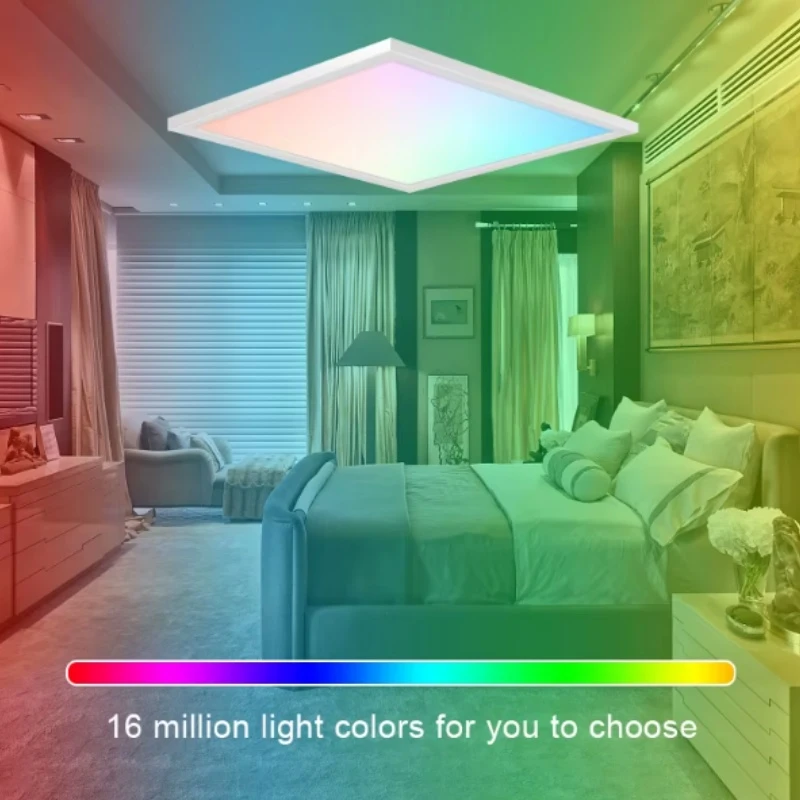
A dimmable RGB panel can change the entire mood of a room in seconds - from a bright, focused white for work, to a soft warm glow for relaxing, to a full-color scene for movie nights or parties. But not every RGB panel on the market is built the same way, and picking the wrong one usually shows up later: flickering at low brightness, colors that don't match what you saw in the product photo, or a remote that stops pairing after a firmware update.
If you're sourcing or specifying an RGB panel for a bedroom, living room, studio, or gaming setup, here's what actually matters when comparing options.
Define the Lighting Purpose of the Room
Before comparing specs, it helps to know what the panel is actually replacing. A bedroom panel used mainly for ambient color at night has very different requirements from a living room panel that also needs to serve as the main light source. If the panel needs to double as functional lighting (reading, working, general illumination), brightness output and CCT range matter more than color richness alone. If it's purely for atmosphere - behind a TV, along a wall, in a gaming corner - color saturation and smooth dimming curves become the priority. Deciding this first narrows down everything else on this list.
Check the Dimming Technology and Compatibility
Not all "dimmable" panels dim the same way. Common types include:
PWM (Pulse Width Modulation) - smooth dimming, but cheaper drivers can cause visible flicker at low brightness, especially on camera.
0-10V dimming - common in wired installations, needs a compatible dimmer or driver.
TRIAC dimming - works with standard wall dimmers already installed in many homes.
RF/Wireless dimming - controlled via remote or app, no extra wiring needed, easiest for retrofits.
The dimming range also matters. A panel that only dims down to 10% will still feel too bright for a dark room; look for panels that can go lower without color shift or flicker at the low end.
Evaluate CRI and Color Accuracy
CRI (Color Rendering Index) tells you how naturally the light renders colors compared to natural daylight. For an RGB panel used for general lighting, a CRI of 90+ is worth looking for - anything below 80 tends to make skin tones and fabrics look slightly off, even when the light itself looks "white." For the RGB color modes specifically, check the color gamut the panel can reproduce. Panels using higher-quality LED chips generally hold truer reds and deep colors, while cheaper chipsets tend to wash out at high saturation.
Compare RGB-Only vs RGB+CCT Panels
This is one of the most overlooked decisions. A pure RGB panel can only mix red, green, and blue - it can produce a wide range of colors, but its "white" is usually not a clean, neutral white. An RGB+CCT panel adds dedicated white LEDs (often warm white and cool white channels), letting the panel produce a proper tunable white light in addition to full-color modes. If the panel will ever be used as everyday lighting - not just colored accents - RGB+CCT is almost always the better choice.
Consider Panel Size and Mounting Options
Panel dimensions should match both the room size and the mounting method:
Flush/recessed panels sit into the ceiling and suit rooms with standard ceiling depth.
Surface-mounted panels attach directly to the ceiling or wall, easier for retrofits without ceiling work.
Suspended panels hang from cables, often used in higher ceilings or open-plan spaces.
Larger panels distribute light more evenly and reduce glare, but they also draw more power and need more structural support. For a bedroom or small room, a mid-size panel (around 600x600mm or smaller) is usually enough; larger living areas may need multiple panels or a bigger single unit.
Look at Control Options
Control method affects daily convenience more than most buyers expect:
Physical remote - simple, no app needed, but limited to preset scenes.
App control (Bluetooth/Wi-Fi) - allows scheduling, color mixing, and scene saving from a phone.
Smart home integration - works with voice assistants and existing smart lighting systems.
Wall switch / panel controller - good for shared spaces where a phone app isn't practical for every user.
If the panel will be used by multiple people in the household, a wall-mounted controller or app with shared access tends to work better than a remote that's easy to lose.
Verify Certifications and Build Quality
Since this is a fixture that stays powered for long periods, certification and driver quality shouldn't be an afterthought. Look for relevant safety certifications (such as CE, RoHS, or UL depending on the target market), a driver rated for the panel's actual wattage, and a stated lifespan (commonly 30,000–50,000 hours for quality LED panels). Aluminum frames generally dissipate heat better than plastic housings, which affects both LED lifespan and long-term color consistency.
Summary
Choosing the right dimmable RGB panel comes down to matching the panel's technical profile to how the room will actually be used. Start with the room's purpose, then check dimming compatibility, CRI, and whether RGB+CCT is needed for proper white light. From there, panel size, control method, and certifications determine how well the fixture fits into daily use - not just how it looks in the specs. Getting these details right up front avoids the common complaints buyers run into later, like flicker at low dimming, mismatched color temperature, or a control system that doesn't fit the space.
Still not sure which panel spec fits your project or room layout? Send us your room dimensions and intended use, and our team can recommend the right configuration - or send a quote for a custom order.
Our address
No. 5-3 Niujiao Road, Yanchuan Community, Yanluo Subdistrict, Bao'an District, Shenzhen
bwzm18@ledbenweilighting.com