In communicating with many clients during the selection process, we've found that "frame material" is often overlooked-many people only care about parameters like LED chips, drivers, and luminous efficacy, rarely considering why the vast majority of LED panel lights on the market unanimously choose aluminum alloy frames. This isn't a coincidence, but rather a result of the material's properties matching product requirements. This article will discuss the problems that aluminum alloy frames actually solve from a practical application perspective.
Lightweight and High-Strength, Reducing Installation and Transportation Costs
Aluminum's density is only about one-third that of steel, but through alloying and structural design, it still maintains sufficient strength to support the entire light body. For engineering projects, this characteristic is very practical-workers don't need to add extra reinforcement to the ceiling lights when suspending them, and the weight of the entire container can be reduced during long-distance transportation, naturally lowering logistics costs. We previously handled a bulk export order where the client specifically mentioned that for the same specifications, aluminum frames were significantly lighter per box than iron frames, directly saving on sea freight costs.
Excellent heat dissipation directly impacts lamp lifespan
LED chips generate heat during operation. If this heat accumulates inside the lamp body, the chip's degradation rate will significantly accelerate, leading to premature brightness decay and color shift. Aluminum alloy has a much higher thermal conductivity than plastic and most other metals. The frame can quickly conduct and dissipate the heat generated by the LED chips into the air, essentially providing an "invisible heat sink" for the entire lamp. This is why many flat panel lights have heat dissipation ribs or textured structures in their frames to further expand the heat dissipation area.
Strong corrosion resistance, adaptable to various installation environments
Aluminum alloy surfaces naturally form a dense oxide film in the air. This film effectively prevents moisture and oxygen from further corroding the internal metal. Combined with post-treatment processes such as anodizing and spraying, the frame's weather resistance is further enhanced. Whether in dry indoor environments like offices and shopping malls, or humid environments like kitchens and bathrooms, aluminum frames can remain rust-free and oxidation-free for extended periods, which is crucial for lighting products requiring long-term stable operation.
High Processing Precision and Better Frame Fit
Aluminum profiles are suitable for extrusion molding, allowing for custom mold making according to the specific dimensions and shape of the lamp. The edges and corners are finished more precisely, and tolerances are easier to control within a smaller range. This means a tighter fit between the frame and other components of the lamp body-such as the light guide plate, reflector, and driver compartment-reducing the likelihood of gaps, light leakage, or loose parts. For customers who value aesthetics, the neat frame lines also make the entire lamp look more refined and have a stronger industrial design feel.
Safety Advantages from Conductivity
Aluminum alloys inherently possess good conductivity, which is significant in lamp grounding design. The metal frame can serve as part of the grounding path, complementing the lamp's insulation and grounding design to reduce the risk of leakage, especially in humid or crowded public places where this safety redundancy is essential. Compared to plastic frames, metal naturally has an advantage in this regard.
Recyclable and in line with environmental trends
Aluminum is a metal that can be repeatedly recycled with minimal performance loss during the recycling process. This aligns with the current trend in the lighting industry towards low-carbon and sustainable development. Many overseas customers, especially buyers in the European market, proactively inquire about the recyclability and environmental certification of materials during the inquiry stage, giving aluminum alloy frames a natural advantage in this regard.
Simple comparison with other common frame materials
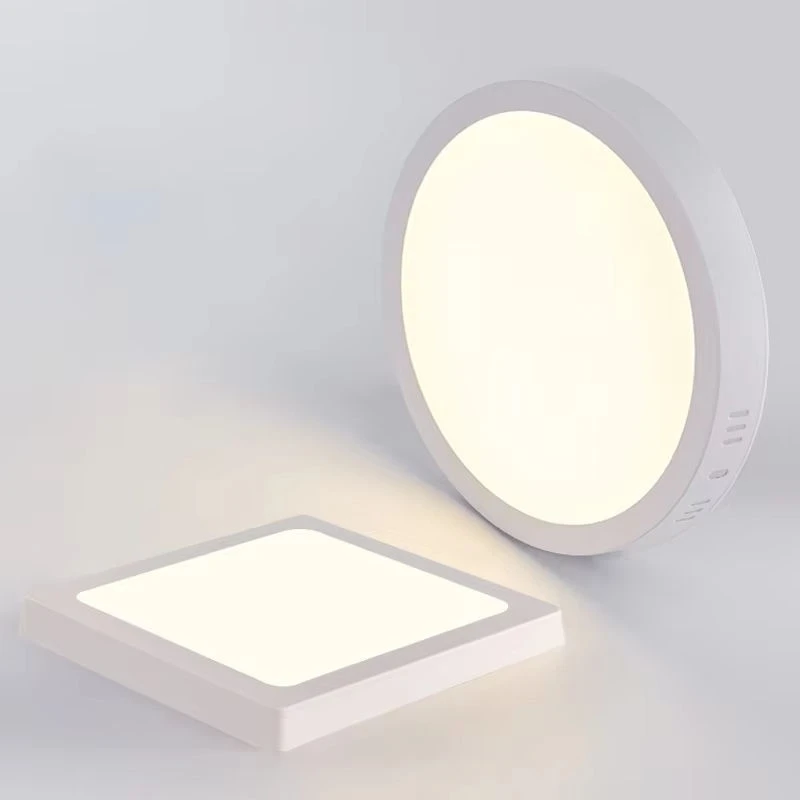
Besides aluminum alloy, plastic and iron frames are also available on the market. Plastic is lighter and cheaper, but has poor thermal conductivity and is prone to yellowing and brittleness over time. Iron frames are strong enough, but heavy, prone to rust, and have higher maintenance costs. Considering weight, heat dissipation, durability, and processing precision, aluminum alloy frames remain the most cost-effective choice for flat panel lights.
Conclusion
From heat dissipation, strength, corrosion resistance to processing precision and environmental attributes, aluminum alloy frames almost cover the core material requirements for LED flat panel lights. This is why it has become the mainstream choice in the industry-not because of a single outstanding advantage, but because of its well-balanced performance in all aspects, meeting the long-term usage needs of different application scenarios.
If you are selecting a panel light for your project, or have specific questions about frame materials, heat dissipation structures, or custom sizes, please feel free to contact our team. We can provide suitable product solutions and detailed technical parameters based on your actual application scenario. We look forward to receiving your inquiry.
Our address
No. 5-3 Niujiao Road, Yanchuan Community, Yanluo Subdistrict, Bao'an District, Shenzhen
bwzm18@ledbenweilighting.com