

Introduction: The Procurement Minefield in Industrial Lighting
The False Economy of the "Lowest Bidder"
In the procurement of industrial high-bay lighting, the initial purchase price is often the dominant deciding factor. However, this metric fails to account for the operational realities of a factory floor. A lighting system is a long-term infrastructure investment. When a facility opts for the lowest-cost fixture, they are rarely purchasing a "budget version" of a premium product; they are purchasing a fundamentally different, lower-quality engineering architecture.
The financial consequences of this false economy are severe. Replacing a failed high-bay luminaire mounted at 10 to 15 meters requires specialized access equipment (scissor lifts), certified electricians, and the disruption of adjacent production lines. Industry data consistently shows that the labor and downtime costs of replacing a single high-bay fixture can exceed the original purchase price by 3 to 5 times.
The Two Deadly Traps: Low Brightness and Poor Cooling
When facility managers attempt to cut costs, they inevitably fall into one of two engineering traps engineered by budget manufacturers.
The first is the "Low Brightness" trap. To prevent cheap LED chips from burning out prematurely, manufacturers deliberately under-drive them-a practice known as "power derating." A fixture labeled "150W" might only consume 100W, delivering a fraction of the expected light output. This forces the facility to install more fixtures than originally planned, or accept dangerously dim and uneven lighting.
The second is the "Poor Cooling" trap. Heat is the absolute enemy of LED technology. To save money, budget fixtures frequently utilize stamped steel or engineering plastics for their housings. These materials have terrible thermal conductivity, trapping heat inside the fixture. This causes rapid lumen depreciation (the fixture gets dimmer every year) and guarantees premature failure of the internal driver.
Redefining the Selection Criteria
To escape these traps, the selection process must shift from a "price-per-unit" mindset to a "performance-per-lifetime" evaluation. A truly premium UFO High Bay Light must satisfy three non-negotiable criteria: True Full-Wattage Brightness, an Unyielding Thermal Architecture, and a Tier-1 Power Supply. This article analyzes how this specific UFO High Bay Light achieves all three, establishing it as the benchmark for industrial reliability.
Trap 1 - Low Brightness: The Deception of Power Derating
The Mechanics of Power Derating
Power derating is a widespread industry shortcut. LED chips are highly sensitive to electrical current. When driven at their maximum rated current, they produce optimal lumens but generate significant heat. To use cheaper, lower-grade chips without them immediately failing, manufacturers adjust the internal driver to supply less current.
The fixture might be marketed as a high-wattage unit, but in reality, it is operating at 60% to 70% capacity. This creates a deceptive situation where the luminaire technically "works" and might even last a few years, but it entirely fails to deliver the Luminous Flux (lumens) and Illuminance (lux) required for safe industrial operations.
The Impact of Poor Optical Design on Worker Safety
Low brightness is not just an inconvenience; it is a safety hazard. Factories, warehouses, and assembly lines require precise, high-CRI (Color Rendering Index) illumination. If a facility is lit by derated fixtures, workers suffer from eye strain, fatigue, and reduced alertness. In environments where heavy machinery operates, shadows and dark zones created by poorly distributed light can lead to catastrophic accidents. Furthermore, cheap fixtures often exhibit high flicker rates, which can cause stroboscopic effects, making rotating machinery appear stationary.
The Solution: True Full-Wattage Brightness and Circular Array
This UFO High Bay Light categorically rejects the practice of power derating. It is engineered for True Full-Wattage Brightness. If the fixture is rated at 150W or 200W, it draws that exact wattage and drives the high-efficiency LED chips at their optimal, full-capacity current.
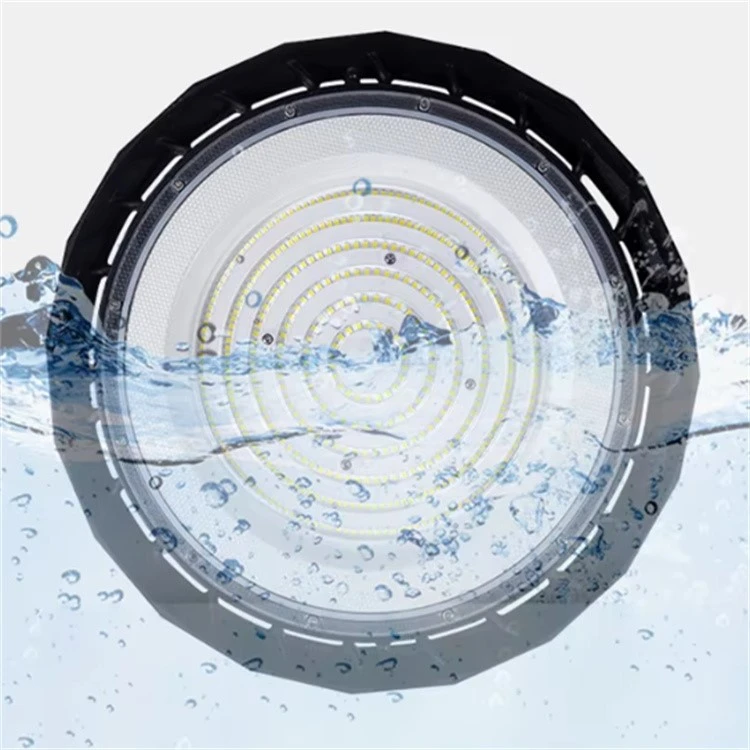
This is made possible by the Circular LED Chip Array. By spreading the LED chips across multiple concentric rings rather than clustering them in the center, the heat load is distributed evenly. This layout, combined with the high-transmittance PC lens, produces a massive, uniform surface of light. It delivers the full advertised lumen output, ensuring that aisles are brightly lit, shadows are eliminated, and the Uniformity Ratio (U0) meets stringent EN 12464-1 industrial standards.
Trap 2 - Poor Cooling: The Silent Killer of LED Fixtures
The Physics of Lumen Depreciation and Thermal Runaway
The lifespan of an LED is dictated by its junction temperature (Tj). The "10-degree rule" in LED engineering states that for every 10°C increase in operating temperature, the lifespan of the chip is halved. When a fixture suffers from poor cooling, the heat cannot escape. The LED junction temperature rises, causing the phosphor layer to degrade and the silicone encapsulant to yellow. This results in lumen depreciation-the gradual fading of the light output.
More critically, the trapped heat attacks the driver. The electrolytic capacitors inside the driver are highly temperature-sensitive. A poorly cooled fixture will see its driver fail long before the LED chips themselves reach the end of their rated life.
The Inadequacy of Stamped Steel and Plastic Housings
Many budget high bays use stamped steel or plastic.
Plastic is an insulator (thermal conductivity ~0.2 W/m·K). It acts as a thermal blanket, cooking the internal components.
Stamped Steel (thermal conductivity ~45 W/m·K) is heavy, prone to rust, and conducts heat at a fraction of the rate required for high-wattage LEDs.
Furthermore, these housings are often assembled from multiple pieces, introducing thermal interfaces (air gaps between the LED board and the heat sink) that act as severe bottlenecks to heat flow.
The Solution: Integrated Die-Cast Aluminum and Air Convection
This UFO High Bay Light utilizes an Integrated Die-Cast Aluminum housing. Aluminum alloy (ADC12) boasts a thermal conductivity of approximately 96 to 120 W/m·K-more than double that of steel. Crucially, the "integrated" aspect means the LED mounting base, the central body, and the exterior fins are molded as a single, monolithic piece. There are no bolted-on heat sinks and no thermal paste interfaces. Heat flows seamlessly from the LEDs to the external environment.
To maximize heat rejection, the housing features a Hollow Radial Fin Architecture. This design leverages natural Air Convection Cooling. As the fixture heats up, the air inside the hollow central cavity warms and rises (the Chimney Effect). As the hot air escapes the top, it draws cooler ambient air inward across the deep radial fins. This self-sustaining, passive airflow provides massive heat dissipation without the need for vulnerable fans that would suck in dust and grease.
The Power Core: Why the Philips Driver is the Ultimate Safeguard
The 65% Failure Rate Rule
Industry after-sales data reveals a stark reality: approximately 65% of all LED luminaire failures are driver-related. The LED chip is a passive semiconductor; the driver is an active power electronics system containing components that degrade under electrical and thermal stress. If a manufacturer cuts costs by using a generic driver, the entire fixture is compromised, regardless of how good the LEDs are.
Surge Immunity and Electrical Stability
Industrial electrical grids are notoriously "dirty." Voltage spikes caused by heavy machinery switching on or off, or by lightning strikes, can travel through the facility's wiring. Budget drivers, often rated for less than 1 kV of surge protection, are instantly destroyed or suffer latent damage that causes flickering months later.
This UFO High Bay Light is powered by a Genuine Philips Drive Power Supply (Xitanium platform). Philips drivers are engineered for extreme industrial environments, featuring built-in surge protection rated at 4 kV to 6 kV. They boast a Power Factor (PF) of ≥ 0.95 and a Total Harmonic Distortion (THD) of < 20%, ensuring maximum energy efficiency and protecting the facility's electrical infrastructure.
Programmable Thermal Derating
A premium Philips driver does not just provide clean power; it actively protects the fixture. It features programmable thermal derating (DTL). If the ambient temperature becomes dangerously high, the driver intelligently reduces the output current rather than allowing the system to burn out. This graceful degradation ensures the lights stay on, guaranteeing safety and operational continuity even under extreme thermal stress.
A Comprehensive Procurement Framework: Evaluating the UFO High Bay
To avoid the traps of low brightness and poor cooling, procurement officers must look beyond the marketing brochures. Here is a three-step framework to evaluate high-bay lighting:
Step 1: Scrutinizing the Photometric and Electrical Data
Verify True Wattage: Demand LM-79 test reports. Check that the actual input power (Watts) closely matches the labeled wattage. If a "150W" fixture only draws 100W, it is derated.
Check Luminous Efficacy: Ensure the fixture delivers at least 130-140 lumens per watt (lm/W).
Driver Authenticity: Ask for the specific model number of the driver. A true premium fixture will proudly display its Philips branding and documentation.
Step 2: Inspecting the Thermal Architecture
Material Check: Confirm the housing is die-cast aluminum, not stamped steel or plastic. It should feel solid and rigid.
Structural Integrity: Look for a single-piece molding without bolted heat sink plates. Check the exterior for deep, radial fins and a hollow central chimney to facilitate natural convection.
Sealing: Ensure the fixture has a high IP rating (e.g., IP65 or IP67) with high-grade silicone gaskets to prevent moisture ingress, which can cause short circuits.
Step 3: Calculating the Total Cost of Ownership (TCO)
The purchase price is only the beginning. Calculate the TCO over a 10-year horizon:
Energy Costs: High efficacy (lm/W) and a high Power Factor (PF) reduce electricity bills.
Maintenance Labor: A premium fixture with a >100,000-hour MTBF driver eliminates the cost of lift rental and electrician labor.
Productivity & Safety: High-quality, flicker-free, full-wattage lighting improves worker morale, reduces errors, and minimizes workplace accidents.
Conclusion: Escaping the Trap with Hardcore Engineering
The industrial lighting market presents a clear choice. Buyers can fall victim to the "Low Brightness & Poor Cooling" trap by purchasing derated fixtures built with inadequate materials and generic drivers. These fixtures represent a false economy, offering short-term savings that are quickly erased by poor illumination, frequent maintenance, and premature failure.
Alternatively, buyers can invest in a luminaire engineered for absolute reliability. This UFO High Bay Light stands as the definitive solution. By guaranteeing True Full-Wattage Brightness through a circular LED array, ensuring Efficient Heat Dissipation via an integrated die-cast aluminum body and natural air convection, and securing the electrical core with a Genuine Philips Driver, this fixture redefines what factory lighting should be.
When choosing high-bay lighting, the goal is not to find the cheapest fixture on the invoice. The goal is to find the fixture that will keep the factory safe, bright, and operational for the next decade. This UFO High Bay Light is built precisely for that purpose.
How To Cooperate With Us?
We are happy to have total control over the manufacturing process and the calibre of our products since we have our own facilities. Since we are producers rather than just brokers, we are dedicated to providing our customers with the best pricing. Since we are certain that the price and quality of our products are clear, we invite customers to see our samples first. Our commitment to quality and customer satisfaction drives us to continuously provide top-notch goods.
Our address
3rd Floor, 5th Building, Hebei Industrial Park, Hualian Community, Longhua District, Shenzhen, China





