

Introduction: The Core Pain Point of Traditional LED Flood Light Selection
Misjudgment in Traditional Lighting Product Selection
For a long time, most buyers and engineering practitioners have formed a single selection logic for LED flood lights, taking nominal power, initial lumen value, and low unit price as the core purchasing basis. This simplistic selection method ignores the key indicators that determine the long‑term use value of lamps, leading to widespread "short service life and severe lumen decay" problems in practical applications. Many flood lights with high initial brightness will experience obvious dimming within 6 to 12 months of use, with a lumen decay rate exceeding 30%, and even lamp bead burnout and power failure in severe cases, which cannot meet the long‑term continuous lighting needs of warehouses, factories, stadiums, parking lots, and outdoor engineering scenes.
The Industrial Value of Low Lumen Decay and Ultra‑Long Service Life
In commercial and industrial lighting projects, the comprehensive cost of lamps includes not only the initial procurement cost but also the later maintenance cost, replacement labor cost, and energy consumption loss caused by light attenuation. LED flood lights with low lumen decay can maintain stable luminous flux output for a long time, avoiding the problem of insufficient lighting brightness caused by rapid dimming and ensuring the consistency and standardization of project lighting effects. Ultra‑long service life can greatly reduce the frequency of lamp replacement and equipment failure maintenance, effectively reduce the overall operating cost of the project, and improve the safety and stability of long‑term lighting operation. Therefore, mastering the selection logic of low lumen decay and long‑life LED flood lights is the key to optimizing lighting project quality and maximizing user economic benefits.
Professional Definition of Lumen Decay and LED Service Life Industry Standards
What is LED Lumen Decay?
Lumen decay, also known as light attenuation, refers to the irreversible phenomenon that the luminous flux output of LED lamps gradually decreases with the extension of service time. Different from the sudden burnout of traditional halogen lamps and fluorescent lamps, LED light failure is a slow aging process. The core cause of lumen decay is the aging and damage of LED chip luminous crystals, packaging materials, and driving components under the combined action of high temperature, current fluctuation, and environmental corrosion. The lower the lumen decay rate, the stronger the long‑term stability of the lamp, and the longer the effective service cycle of maintaining high‑quality lighting effects.
Industry Authoritative Lifespan Evaluation Standard (L70/L80 Standard)
The international lighting industry uniformly adopts the L70 and L80 lumen maintenance standards to define the effective service life of LED lamps, abandoning the inaccurate judgment standard of "complete burnout". Among them, the L70 standard means that after a certain number of hours of operation, the lamp can still maintain 70% of the initial luminous flux; the L80 standard means maintaining 80% of the initial brightness. At present, the mainstream high‑quality commercial LED flood lights on the market take 50,000 hours L70 lifespan as the core quality standard, while inferior products often fail to reach 20,000 hours of stable operation, with a rapid decay of brightness below 70% of the initial value. It is worth noting that the real service life of LED flood lights depends not on the nominal parameters of the factory, but on the comprehensive performance of chips, drivers, heat dissipation, and protection structures.
Core Factors Affecting LED Flood Light Lumen Decay and Service Life
LED Chip Quality: The Fundamental Determinant of Light Attenuation Speed
The LED chip is the core luminous component of the flood light, and its material quality, packaging process, and luminous efficiency directly determine the basic lumen decay rate of the lamp. Inferior low‑cost chips have uneven crystal quality, poor current tolerance, and serious luminous heat generation. Under long‑term electrified operation, the luminous area is prone to aging and blackening, resulting in rapid light attenuation. High‑quality professional lamp beads adopt high‑purity semiconductor crystal materials and precise packaging technology, with uniform current conduction, low thermal resistance, and stable luminous performance.
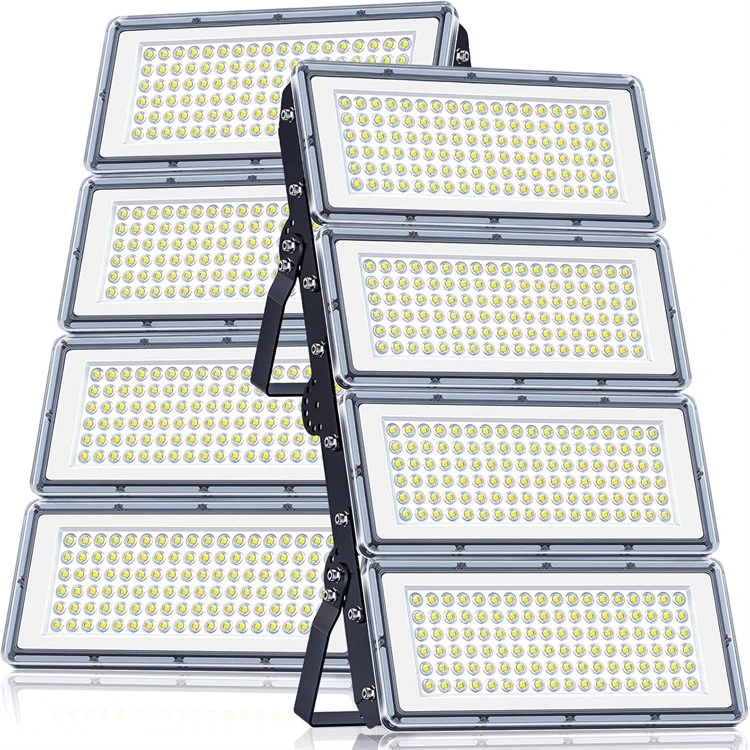
The high‑performance commercial LED flood light recommended in this article is equipped with 432pcs premium SDM2835 high‑efficiency LED chips, which is a mature and stable industrial‑grade light source solution. Compared with ordinary low‑cost lamp beads, SDM2835 chips have ultra‑high luminous efficiency, realizing 1W power output corresponding to 3W brightness of traditional halogen lamps, reducing 80% of energy consumption. More importantly, the chip has excellent anti‑aging performance, with an ultra‑low natural lumen decay rate, which can effectively delay the brightness attenuation process in long‑term operation and lay a solid foundation for the ultra‑long service life of the lamp.
Driving Power Performance: The Core Guarantee of Long‑Term Stable Operation
The LED driver is equivalent to the "power brain" of the flood light. More than 60% of LED lamp failure and accelerated light attenuation problems are caused by inferior driving power. Ordinary low‑configuration drivers have unstable current and voltage output, poor anti‑interference ability, and are unable to cope with grid voltage fluctuations. Instant current surges will cause continuous impact damage to LED chips, resulting in accelerated chip aging and rapid lumen decay. In addition, inferior drivers have high power conversion loss, serious heat generation, and are prone to short circuit and overload failure, directly shortening the service life of lamps.
This high‑quality flood light adopts an upgraded constant‑current stable drive solution, which solves the common defects of traditional drivers in one fell swoop. Firstly, the constant‑current drive technology realizes precise and constant voltage and current output, eliminates the impact of grid voltage fluctuation on the lamp beads, and ensures that the LED chips work in a stable electrical environment for a long time. Secondly, the built‑in multi‑level protection circuit supports overload protection, short‑circuit protection, and overheating protection, which can automatically cut off the power to protect the chip when abnormal current and temperature occur, avoiding permanent damage to the light source. In addition, the drive has extremely low power conversion loss, reduces invalid energy waste and heat generation, fundamentally reduces the electrical aging rate of the lamp beads, and greatly extends the effective service life of the whole machine.
Thermal Management System: The Key to Suppressing Lumen Decay
Industry data shows that high temperature accumulation is the biggest killer of LED flood light aging. The junction temperature of LED chips is positively correlated with the lumen decay speed. For every 10℃ increase in the long‑term operating temperature of the chip, the light attenuation rate will increase exponentially, and the service life will be shortened by more than 30%. Most inferior flood lights on the market adopt simple thin‑wall shell or non‑heat‑dissipation structural design, with small heat dissipation area and poor heat conduction efficiency. A large amount of heat generated by the operation of chips and drivers cannot be discharged in time, resulting in long‑term high‑temperature operation of the lamp, rapid aging of internal components, and serious light attenuation.
This product is equipped with anoptimized large‑area fin‑type aluminum heat sink, which is professionally designed for long‑term high‑load operation. The thickened high‑purity aluminum heat conduction material has ultra‑high thermal conductivity, which can quickly conduct the heat generated by the chip and driver to the surface of the heat sink. The fin‑type structure forms a 360° unobstructed air convection channel, relying on natural air circulation to efficiently dissipate heat, avoid internal heat accumulation, and keep the chip junction temperature within the safe and stable working range for a long time. The excellent thermal management system effectively suppresses thermal aging of the light source, slows down the lumen decay speed in all‑weather operation, and realizes long‑term stable brightness output of the lamp.
Environmental Protection Grade and Structural Durability: Anti‑Aging Barrier for Long‑Term Use
Most outdoor and industrial LED flood lights need to cope with harsh environments such as rain, snow, humidity, dust, and temperature changes. Poor sealing and low protection grade will lead to moisture and dust entering the lamp interior, corroding lamp beads, driving circuits, and welding points, resulting in increased failure rate and accelerated light attenuation. Ordinary flood lights mostly adopt IP65 or lower protection grade, which can only meet simple dust and water splash prevention, and will fail in humid and rainy environments for a long time.
This high‑performance flood light reaches the industrial‑grade IP67 waterproof and dustproof protection standard, which is the core high‑end configuration for long‑term outdoor and industrial use. The integrated reinforced sealing structure and high‑elasticity waterproof rubber ring realize full sealing and isolation inside the lamp body. It is completely dust‑tight to prevent dust particles from accumulating on the chip and affecting luminous efficiency; it can resist temporary water immersion and long‑term rain erosion, and can operate stably in high humidity, heavy rain, snow, fog and other harsh environments. At the same time, the whole lamp adopts anti‑aging and anti‑oxidation metal shell materials, which can resist external impact and environmental corrosion, avoid structural damage and internal component aging caused by environmental factors, and ensure that the lamp maintains ultra‑low lumen decay and stable performance in years of outdoor operation.
Professional Selection Standards for Low Lumen Decay & Long‑Life LED Flood Lights
Check Core Light Source Parameters to Avoid False High Brightness
When purchasing long‑life LED flood lights, users should not only look at the nominal power and initial lumen value, but also focus on the chip model, luminous efficiency, and natural light attenuation parameters. It is necessary to select industrial‑grade high‑quality lamp beads such as SDM2835, with luminous efficiency higher than 150lm/W, which can realize high brightness output under low power consumption. Low power and high efficiency mean lower operating heat generation, which is inherently conducive to reducing lumen decay and extending service life. Avoid choosing inferior high‑power low‑efficiency lamp beads, which generate serious heat and age rapidly despite high initial brightness, and will have severe light attenuation after short‑term use.
Verify Driving Configuration to Ensure Long‑Term Electrical Stability
Stable constant‑current drive is a necessary condition for low lumen decay of flood lights. Professional selection should prioritize products with independent constant‑current drive, high power factor (PF≥0.95), and low harmonic distortion. It is necessary to confirm that the driver has complete overvoltage, overcurrent, overheating, and short‑circuit protection functions, which can effectively resist grid fluctuation and abnormal power supply interference. Inferior non‑constant‑current drivers and drivers without protection functions are the main causes of rapid light attenuation and lamp damage, and must be avoided in long‑term lighting projects.
Focus on Heat Dissipation Structure Design to Control Operating Temperature
Excellent heat dissipation performance is the core physical guarantee for suppressing lumen decay. High‑quality long‑life flood lights must adopt thickened aluminum fin heat dissipation structure, with large heat dissipation area and smooth air convection channel. Users can simply judge the heat dissipation quality by observing the thickness of the heat sink, the density of the fins, and the overall volume. Thin‑wall thin‑sheet heat dissipation shells have poor heat dissipation effect and cannot support long‑term high‑load operation, and are not suitable for engineering and long‑term commercial use.
Confirm Protection Grade and Structural Durability for Harsh Environment Adaptation
For outdoor, factory, warehouse and other complex environment scenarios, the protection grade must reach IP67 or above to ensure dust‑proof, waterproof and moisture‑proof capabilities. At the same time, the lamp body structure should have adjustable brackets and high‑strength metal shell design, which not only facilitates flexible installation and angle adjustment, but also resists external impact, aging and oxidation, ensures the structural integrity of the lamp in long‑term use, and avoids performance degradation caused by structural damage.
Product Advantages Verification: Ultra‑Low Decay & 50,000H Ultra‑Long Lifespan Performance
Ultra‑Low Lumen Decay Performance Advantage
Benefiting from the high‑quality SDM2835 chip, stable constant‑current drive, and efficient fin‑type heat dissipation system, this commercial LED flood light achieves an industry‑leading ultra‑low lumen decay level. Under standard continuous operating conditions, the lumen decay rate is less than 8% after 10,000 hours of operation, and the luminous flux can still maintain more than 70% of the initial value after 50,000 hours of long‑term use, fully meeting the international L70 high‑standard lifespan certification. Compared with ordinary flood lights with a decay rate of more than 30% in one year, this product realizes long‑term stable brightness output, no obvious dimming in daily use, and consistent lighting effects throughout the service cycle.
50,000 Hours Ultra‑Long Service Life & Low Loss Operation
The comprehensive optimization of chip, drive, heat dissipation and protection structure makes the effective service life of the product reach 50,000 hours, which is 3‑5 times that of ordinary LED flood lights and 10 times that of traditional halogen lamps. In terms of energy loss, the product has ultra‑low power conversion loss and high luminous efficiency, which can save 80% of electricity cost compared with traditional lighting equipment. Long‑term low‑loss operation avoids frequent energy waste caused by low efficiency, and ultra‑long service life greatly reduces the frequency of lamp replacement, maintenance labor cost, and project downtime loss, bringing extremely high cost‑performance and long‑term return on investment for users.
All‑Scenario Stable Adaptability
With IP67 industrial protection grade, 180° rotatable adjustable bracket, and ultra‑stable long‑term operating performance, this low‑decay long‑life flood light is widely applicable to warehouses, industrial workshops, large parking lots, sports stadiums, building exterior wall lighting, yard landscape lighting, construction sites and other commercial and industrial scenarios. Whether it is long‑term continuous indoor lighting or all‑weather outdoor harsh environment operation, it can maintain ultra‑low lumen decay and stable performance, realizing one‑time installation and multi‑year worry‑free use.
Conclusion: High‑Value Lighting Selection Creates Long‑Term Economic Benefits
In the field of commercial and industrial LED flood light selection, abandoning the single price and power judgment standard and taking low lumen decay and ultra‑long service life as the core selection basis is the key to optimizing lighting project quality and reducing comprehensive operating costs. The lumen decay speed and service life of LED flood lights are determined by the comprehensive performance of core chips, driving systems, thermal management, and environmental protection structures. High‑quality industrial‑grade flood lights represented by SDM2835 chip constant‑current drive flood lights can effectively suppress light attenuation, extend the service cycle, and reduce energy loss and maintenance costs through multi‑dimensional technical optimization.
For engineering purchasers and commercial users, choosing low‑decay and long‑life LED flood lights is not only a choice of lighting equipment, but also a long‑term cost‑effective investment. This high‑performance IP67 waterproof LED flood light perfectly solves the common pain points of rapid light attenuation, short service life, unstable operation and high maintenance cost of traditional lamps. With ultra‑low lumen decay, 50,000‑hour ultra‑long service life, low energy loss, and strong environmental adaptability, it provides stable, efficient and worry‑free professional lighting solutions for all commercial and industrial scenarios, and maximizes the long‑term economic value of lighting projects.

How To Cooperate With Us?
Since we have our own facilities, we are pleased to have complete control over the production process and the quality of our goods. We are committed to giving our clients the finest prices since we are manufacturers rather than just brokers. We encourage buyers to see our samples first since we are certain that the cost and calibre of our items are transparent. Our dedication to excellence and client happiness motivates us to consistently provide superior products.
Our address
3rd Floor, 5th Building, Hebei Industrial Park, Hualian Community, Longhua District, Shenzhen, China





