

Introduction: The Overlooked Core Indicator of Stadium Lighting Quality
Common Misunderstandings in Stadium Light Procurement
In the field of commercial stadium lighting engineering, most purchasers form a single judgment standard: the higher the power and initial lumen brightness, the better the lighting quality. This one-sided cognition leads many projects to choose low-cost high-power inferior LED stadium lights, which have dazzling initial lighting effects but rapidly decay in brightness within 1–3 years of operation. After a period of use, the venue suffers from insufficient overall illumination, uneven local light and dark areas, and failed broadcast lighting standards. In order to meet the normal use of the venue, operators have to increase the number of lamps, replace equipment frequently, or bear the risk of substandard venue lighting. These hidden costs far exceed the initial savings in equipment procurement. The root cause of all problems lies in ignoring the lumen depreciation performance of lamps, which is the key indicator that determines the full-life-cycle value of stadium lighting.
The Essential Demand for Low-Decay Lighting in Stadium Scenarios
Stadiums, sports courts, large outdoor plazas, and industrial sports venues have ultra-high requirements for lighting stability. Professional sports events, high-definition live broadcasts, and daily public sports activities all require the venue to maintainstable and standard illumination for more than ten years. The lighting system cannot have obvious brightness attenuation, glare deviation, and light color distortion. Ordinary low-quality LED lights have severe lumen depreciation, which will directly lead to the decline of venue grade, failure to meet event hosting standards, and shortened equipment service life. Therefore, understanding lumen depreciation and selecting low-decay professional stadium lights is the core premise to ensure the long-term stable operation of venue lighting systems and reduce comprehensive operating costs.
Professional Definition and Industry Evaluation Standards of Lumen Depreciation
What Is Lumen Depreciation?
Lumen depreciation is a professional optical term referring to the gradual and irreversible attenuation of the effective luminous flux output of LED lighting fixtures under long-term continuous working conditions. Different from sudden lamp bead burnout, circuit failure, and lamp damage, lumen depreciation is a natural aging performance degradation of light source devices. For all LED lighting products, lumen depreciation is an unavoidable physical phenomenon, but the decay rate varies greatly with product quality and technical configuration. Low-quality lamps have fast decay speed and large attenuation range, while high-quality professional stadium lights can control the decay rate within the industry's optimal standard range through optimized technology and structural design.
In short, lumen depreciation means that the lamp will become dimmer and dimmer with the increase of service time. The initial brightness of the lamp cannot represent the long-term use effect. Only the lamps with slow lumen depreciation and stable long-term luminous performance are truly high-value professional stadium lighting equipment.
Core Industry Standards: LM-80 and TM-21 Evaluation System
The global lighting industry uniformly adopts the LM-80 and TM-21 standard system formulated by the Illuminating Engineering Society of North America (IESNA) to evaluate LED lumen depreciation and service life, which is the authoritative basis for judging product quality. LM-80 is the detection standard for LED light source lumen maintenance, which tests the luminous flux attenuation data of lamp beads under different temperature and time conditions. TM-21 is the data prediction standard, which predicts the long-term lumen decay trend and effective service life of lamps according to LM-80 test results.
The industry universally recognizes the L70 life standard, that is, when the luminous flux of the lamp decays to 70% of the initial brightness, it is regarded as the end of the effective service life of the product. For professional commercial stadium lights, the L70 lifespan and decay rate are the core indicators to distinguish high-end professional products from ordinary civilian lamps. Inferior stadium lights often decay to below 70% of initial brightness within 20,000 hours, while high-quality professional stadium lights can maintain ultra-low decay for a long time.
Classification of Lumen Depreciation Levels for Stadium Lights
Combined with the actual application scenarios of stadiums, the lumen depreciation performance of LED stadium lights can be divided into three levels. The first level is inferior low-end products, with a lumen decay rate of more than 40% within 30,000 hours, serious brightness attenuation after 2–3 years of use, and completely unable to meet professional lighting standards. The second level is medium civilian products, with a decay rate of 30%–40% within 40,000 hours, which can meet daily simple lighting but cannot support long-term event lighting and live broadcast needs. The third level is industrial-grade professional stadium lights represented by our 500W high-power LED stadium light, with a decay rate of less than 30% within 50,000 hours, far exceeding the industry average standard, and maintaining stable professional lighting performance for more than ten years.
Core Causes of Lumen Depreciation in LED Stadium Lights
LED Chip Aging and Phosphor Layer Degradation
The most fundamental cause of lumen depreciation is the aging of the LED light source itself. High-power stadium lights work for a long time with high load, and the semiconductor chips will produce microscopic defect propagation after long-term electron operation, resulting in reduced luminous efficiency. At the same time, the phosphor layer on the surface of the lamp bead, which converts blue light into white light, will gradually age and degrade under long-term high temperature and light radiation, reducing the light conversion rate, resulting in continuous attenuation of overall luminous flux. Inferior products use low-quality chips and unstable phosphor materials, which age rapidly and have severe light decay; while high-quality stadium lights adopt high-stability commercial-grade chips and high-purity phosphor layers, which greatly slow down the aging speed of light sources.
Excessive Junction Temperature and Poor Heat Dissipation Performance
Temperature is the biggest killer of LED light sources and the primary inducement of accelerated lumen depreciation. When high-power stadium lights work continuously, the chips will generate a lot of heat. If the heat cannot be exported and dissipated in time, the chip junction temperature will continue to rise. Long-term high-temperature operation will not only accelerate the aging of chips and phosphor layers but also cause irreversible damage to the internal structure of the light source, resulting in rapid light decay. Most low-end stadium lights adopt simple heat dissipation structures with small heat dissipation area and slow heat conduction speed, resulting in long-term high-temperature operation of chips and serious brightness attenuation. Excellent heat dissipation system is the core technical guarantee to suppress lumen depreciation.
Drive Instability and Environmental Aging Damage
The constant-current drive system determines the working stability of the LED light source. Inferior stadium lights use non-standard drive power supplies with unstable current and voltage output, which will cause frequent current impact on the lamp beads during long-term operation, accelerating light source fatigue and light decay. In addition, stadium lights are exposed to outdoor open environments for a long time. Dust accumulation, rain erosion, ultraviolet radiation, and temperature cycle changes will cause aging of lamp surface materials and internal circuit components, indirectly affecting luminous efficiency and aggravating lumen attenuation. Products without high-level environmental protection performance will have significantly accelerated light decay speed in harsh outdoor environments.
Critical Impacts of Lumen Depreciation on Stadium Lighting Systems
Damage to Professional Competition and Broadcast Lighting Standards
Professional stadium lighting has strict unified standards for illumination uniformity, brightness value, and light color stability, which are key indicators for hosting formal sports events and high-definition live broadcasts. Continuous lumen depreciation will lead to uneven overall brightness of the venue, local dark areas, and insufficient average illumination. When the brightness decays below the standard threshold, the venue will fail to pass the event lighting acceptance, cannot host formal competitions and commercial sports events, and directly reduce the commercial operation value of the venue. At the same time, attenuated light sources are prone to subtle strobing and color cast, which interfere with high-definition camera shooting, resulting in blurred live pictures and distorted color presentation, seriously affecting event broadcast quality.
Sharp Increase in Long-Term Venue Operating Costs
Lumen depreciation is the main source of hidden operating costs for stadium lighting. For ordinary low-decay lamps, brightness attenuation is obvious after 2–3 years of use. Operators have to take two remedial measures: increasing the number of lamps for supplementary lighting or replacing all lighting equipment. Both methods will bring huge additional costs. Increasing lamps will increase power load and long-term electricity expenses; frequent replacement of lamps will generate high equipment costs, manual maintenance costs, and venue downtime losses. For large stadiums and public sports venues with long-term high-frequency use, the cumulative cost caused by lumen depreciation is far higher than the initial procurement difference of high-quality and low-quality lamps.
Reduced Venue Safety and User Experience
With the continuous attenuation of lumen brightness, the edge area of the stadium will form obvious dark areas and blind lighting spots. For athletes, insufficient field lighting will affect judgment of sports routes and ball trajectories, greatly increasing the risk of sports injuries. For audiences and daily sports personnel, dim and uneven lighting will cause visual fatigue and poor viewing and sports experience. In addition, severely decayed lamps have unstable working performance and are prone to sudden failure and flickering lights, which bring potential safety hazards to venue operation and reduce the overall service level and reputation of the venue.
Technical Advantages of 500W LED Stadium Light in Suppressing Lumen Depreciation
Premium High-Stability Light Source Chip Configuration
This high-quality 500W commercial LED stadium light is equipped with industrial-grade high-stability LED chips and high-purity anti-aging phosphor layers, which fundamentally optimize the anti-decay performance of the light source. The selected chips have low thermal resistance, strong current impact resistance, and extremely slow aging speed. After long-term continuous operation, the luminous efficiency attenuation of the chip itself is extremely low. The high-purity phosphor layer has strong anti-ultraviolet and high-temperature resistance, which avoids light color distortion and conversion efficiency decline caused by aging. Through high-standard light source configuration, the product realizes ultra-low initial lumen depreciation, laying a foundation for long-term stable luminous performance.
Optimized Fin-Type High-Efficiency Heat Dissipation System
Aiming at the core problem of heat-induced accelerated light decay, this stadium light adopts an integrated die-cast aluminum fin-type high-efficiency heat dissipation structure. Compared with the flat heat dissipation structure of ordinary lamps, the fin-type design greatly increases the heat dissipation area, accelerates air convection heat dissipation, and can quickly export the high heat generated by the chip during high-power operation. The optimized thermal management system effectively reduces the chip junction temperature, keeps the light source working in a safe and constant temperature range for a long time, fundamentally inhibits thermal aging of the chip and phosphor layer, and greatly slows down the lumen depreciation speed. After 50,000 hours of continuous operation, the chip still maintains excellent working state, with a lumen decay rate controlled within 30%.
Stable Constant-Current Drive and Anti-Aging Protection Design
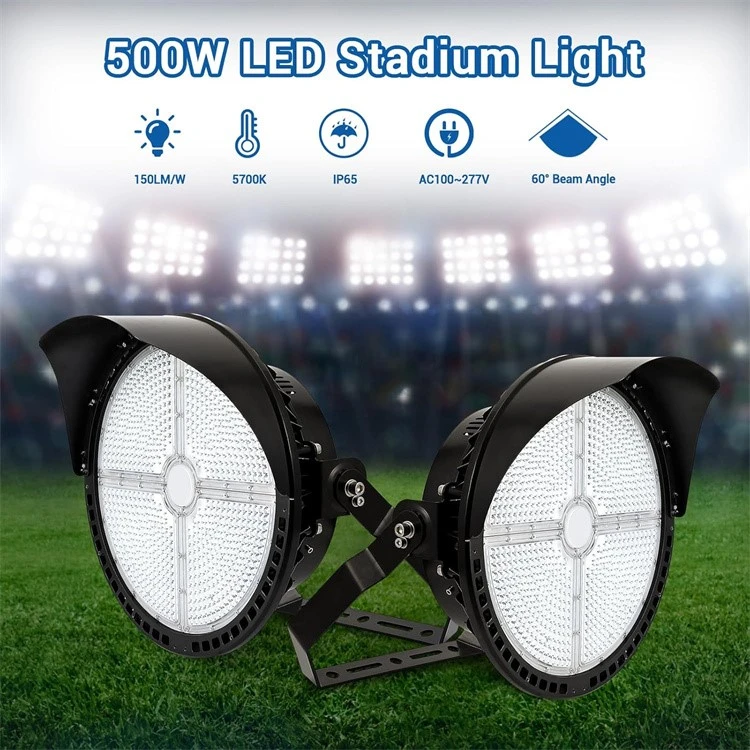
The product is equipped with a high-precision constant-current drive power supply, which outputs stable current and voltage, effectively avoiding light source fatigue and decay acceleration caused by current fluctuation and surge impact. It supports a wide voltage range of AC100-277V, adapting to complex grid voltage environments, and always maintains stable luminous output without strobing or brightness fluctuation. At the same time, with IP65 industrial-grade dustproof and waterproof protection and 10KV lightning surge protection, it isolates external dust, rain, high temperature, lightning surge and other adverse factors, prevents environmental aging damage to internal light sources and circuits, and ensures that the lumen depreciation rate is always in the optimal state even in long-term outdoor harsh environment operation.
Long-Term Value Comparison: Low-Decay Professional Lights vs Ordinary Stadium Lights
Lumen Maintenance Performance Comparison
Ordinary low-quality 500W stadium lights have a lumen decay rate of more than 45% after 30,000 hours of use, basically losing professional lighting value, and need to be replaced in 3–4 years. Medium-quality ordinary LED stadium lights have a decay rate of about 35% after 40,000 hours, with obvious brightness attenuation, unable to meet event standards. This professional low-decay stadium light only has less than 30% lumen depreciation after 50,000 hours of continuous operation, and can maintain more than 70% of the initial high brightness after more than 10 years of daily use. The ultra-low decay performance ensures that the venue always meets professional sports lighting and broadcast standards throughout the product life cycle.
Full-Life-Cycle Economic Benefit Comparison
Although the initial procurement cost of professional low-decay stadium lights is slightly higher than that of ordinary low-end products, the full-life-cycle economic benefit is far superior. Ordinary lamps need to be replaced 3–4 times within 10 years, with high equipment replacement costs, manual maintenance costs, and venue downtime losses. While this product has a ultra-long L70 service life of 50,000 hours, realizing maintenance-free operation for more than 10 years in the early and middle stages of use. Combined with the 150LM/W high luminous efficiency energy-saving advantage, it saves more than 50% of electricity costs every year. The dual advantages of energy saving and low maintenance make the comprehensive operating cost of the venue reduced by more than 40% in ten years, with extremely high return on investment.
Application Scenario Adaptability Comparison
Ordinary high-decay lamps are only suitable for temporary simple lighting and low-standard amateur venues, and cannot support commercial events, professional competitions and high-definition live broadcasts. This low-decay professional stadium light has stable long-term lighting performance, uniform luminous output, no strobing and no color cast, and is fully applicable to professional sports stadiums, commercial event venues, large outdoor plazas, port terminals, and high-bay industrial warehouses. It can meet the high-standard lighting needs of different scenarios and greatly improve the grade and commercial operation capacity of the venue.
Conclusion: Low Lumen Depreciation Is the Core of Stadium Lighting Long-Term Value
Lumen depreciation is the decisive factor for the full-life-cycle value of stadium lighting systems, and also the most critical indicator that distinguishes professional high-end stadium lights from ordinary civilian lighting products. Initial brightness and power only represent instantaneous lighting effects, while low lumen depreciation performance determines the long-term stability, safety, standard compliance and economic benefits of venue lighting. Severe lumen depreciation will lead to substandard venue lighting, increased operating costs, reduced user experience and lost commercial value, bringing many hidden troubles to venue operation.
The 500W high-power professional LED stadium light perfectly solves various pain points of traditional stadium lights with severe light decay. With premium stable light source chips, high-efficiency heat dissipation system, stable drive technology and industrial-grade protection performance, it realizes ultra-low lumen depreciation and 50,000-hour ultra-long service life. It maintains long-term consistent high brightness, high uniformity and high color rendering lighting effects, meets professional sports competition and high-definition broadcast lighting standards, and greatly reduces venue maintenance and energy consumption costs. For all stadium lighting engineering projects that pursue long-term stability, high cost performance and high-standard lighting effects, low-decay professional LED stadium lights are the most reliable and valuable long-term lighting solution.

How To Cooperate With Us?
Since we have our own facilities, we are pleased to have complete control over the production process and the quality of our goods. We are committed to giving our clients the finest prices since we are manufacturers rather than just brokers. We encourage buyers to see our samples first since we are certain that the cost and calibre of our items are transparent. Our dedication to excellence and client happiness motivates us to consistently provide superior products.
Our address
3rd Floor, 5th Building, Hebei Industrial Park, Hualian Community, Longhua District, Shenzhen, China





