

For settings including factories, warehouses, parking lots, tunnels, and food processing facilities, LED Tri-Proof Lights-which are designed to be waterproof, dustproof, and corrosion-resistant-have become indispensable. Even under challenging circumstances, their sturdy design guarantees steady illumination performance. But choosing the incorrect kind of LED Tri-Proof Light might lead to expensive upkeep, poor brightness, a shorter lifetime, or needless power use. Selecting a fixture that meets the unique needs of each installation is crucial for achieving maximum performance and long-term dependability. In order to assist you choose the most effective and long-lasting lighting option for any industrial or commercial location, this article will explain how to choose the best LED Tri-Proof Light based on IP classification, wattage, and kind.
Understand What an LED Tri-Proof Light Is and Its Core Functions
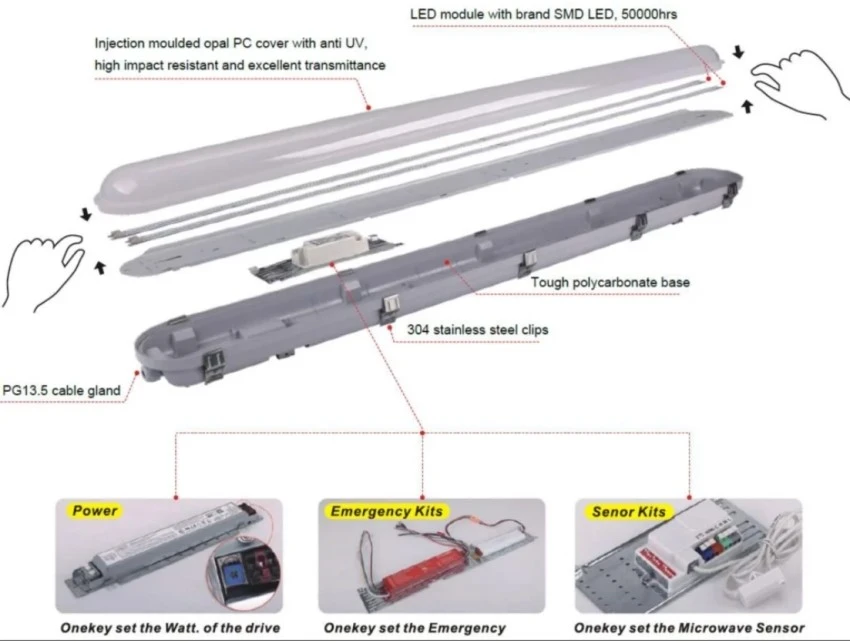
Three crucial protection characteristics-waterproof, dustproof, and corrosion-resistant-are referred to as "Tri-Proof." The purpose of an LED Tri-Proof Light is to protect traditional lighting fixtures against moisture, dust, and chemical vapours. It is perfect for harsh settings like factories, tunnels, or parking lots because of its sealed construction, sturdy housing, and silicone gaskets that stop dust and water buildup.
Beyond safety, an LED Tri-Proof Light's primary purpose is to consistently deliver energy-efficient lighting in regions that are susceptible to corrosion, filth, or humidity. Its extended lifetime and high luminous efficiency guarantee dependable performance and less frequent maintenance, supporting productivity and safety in commercial and industrial settings.
IP Rating: Is It Really Necessary to Be Waterproof and Dustproof?
IP Rating: What Is It?
A lighting fixture's resistance to water and dust entry is gauged by its IP (Ingress Protection) rating. The protection against solids (such as dust) is indicated by the first number, while protection against liquids is shown by the second. Typical LED Tri-Proof Light ratings include IP65, which can withstand dust and low-pressure water jets; IP66, which provides more robust water protection; and IP69K, the highest level, which can withstand high-temperature, high-pressure water cleaning in settings like food processing facilities.
Typical Purchasing Difficulties
Determining whether IP rating is really required is one of the most difficult tasks when choosing an LED Tri-Proof Light. While selecting an excessively high IP level might raise buying prices without really providing value, a rating that is too low can result in product failure, corrosion, or costly maintenance. Cost-effective lighting requires striking a balance between project environment and protection level.
Suggested IP Ratings for Various Uses
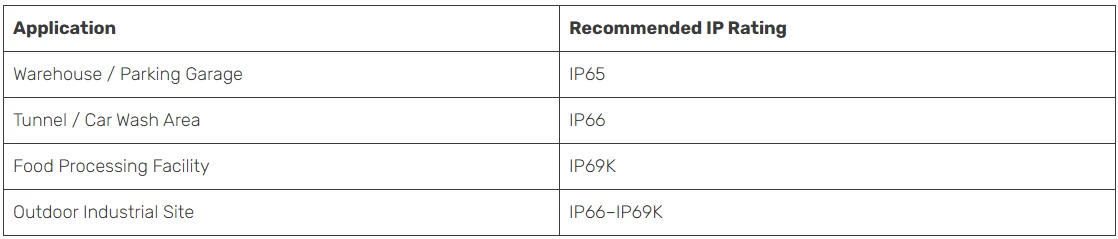
Generally speaking, IP65 protection is sufficient for dry interior spaces, but higher certifications are needed for humid or outdoor settings. Typical applications and appropriate IP levels are summarised in the table below:
Wattage and Luminous Efficiency: Harmonising Performance and Power
Wattage: Selecting the Appropriate Power Output
A lot of consumers don't know how to choose the right wattage for their LED Tri-Proof lights. The installation height, coverage area, and necessary brightness are some of the variables that determine the appropriate power level. For instance, a warehouse with higher ceilings could need 60W or more to ensure consistent lighting, but a 40W bulb might be plenty for a hallway or parking lot. By simulating actual project circumstances, lighting design software like DIALux can guarantee that every area gets the ideal brightness without energy waste or dark areas.
Efficiency: Much Brighter With the Same Power
It is often seen that two LED Tri-Proof Lights of the same wattage might range significantly in brightness. Luminous efficiency, which is expressed in lumens per watt (lm/W), is crucial. Higher luminous efficacy fixtures provide better brightness and energy savings by converting more electricity into light rather than heat. Selecting high-efficiency LED Tri-Proof Lights lowers power costs, requires less maintenance, and improves long-term performance in commercial and industrial settings.
Type: Shaped, Split, or Integrated
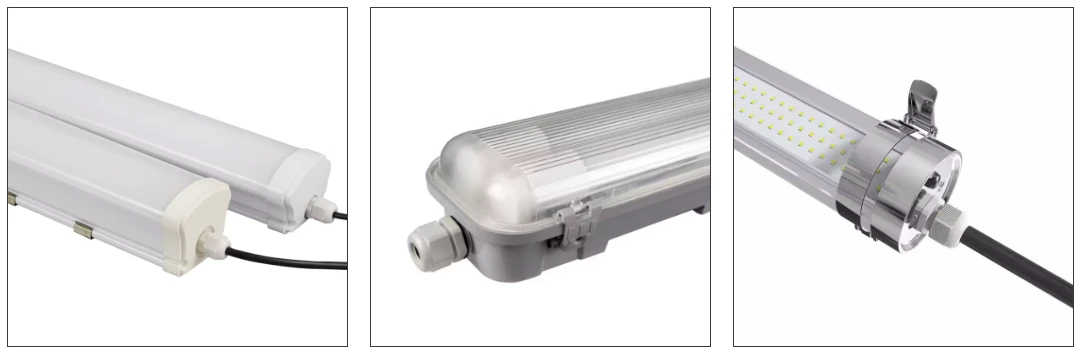
There are many varieties of LED Tri-Proof Lights available on the market, each of which is designed to satisfy distinct financial and environmental needs. Although their primary purposes-waterproofing, dustproofing, and corrosion resistance-are essentially the same, the choice of type may have a significant impact on longevity, ease of installation, and maintenance expenses.
LED Tri-Proof Light Integration
The LED chips, driver, and housing are all incorporated into a single, completely sealed unit in an integrated tri-proof light. This construction ensures dependable functioning in challenging circumstances by offering exceptional protection against moisture and dust. For settings where maximum endurance is required due to continuous exposure to humidity and temperature fluctuations, such vehicle wash stations, cold storage rooms, or tunnels, integrated versions are perfect.
LED Tri-Proof Split Light
The housing and the internal light source, which may be a linear module or changeable LED tube, are separated by a split-type tri-proof light. When a component breaks, this structure makes maintenance simpler and replacements less expensive. For applications like workshops, warehouses, or parking lots, where circumstances are less severe but dependability is still crucial, it provides a more affordable option even if its waterproof level is somewhat lower than the integrated kind.
Round or Shaped LED Tri-Proof Light
Shaped tri-proof lights, such round LED tri-proof lights, are often utilised for projects that need a unique look or a particular light distribution. Their distinctive design works well in environments where both performance and aesthetics are crucial, such as food plants, animal farms, or ornamental industrial spaces. These lights expand the variety of tri-proof applications beyond conventional linear designs by fusing safety with a fashionable appearance.
Additional Crucial Elements: Flexibility, Colour Temperature, Material, and Installation Method
Material: While PC or ABS materials are lighter and less expensive, aluminium housing provides superior heat dissipation and a longer lifetime.
Colour Temperature: While 5000–6500K provides more brightness for industrial or outdoor locations, 4000K neutral white is appropriate for work areas.
Installation Method: Depending on the ceiling height and arrangement, LED Tri-Proof Lights may be surface-mounted, suspended, or linkable.
Installation Flexibility: Quick connections and modular designs make wiring (daisy chain) simpler, which facilitates the installation or replacement of lights in large-scale projects.
In conclusion
IP rating, wattage, size, and type must all be carefully considered when selecting an LED Tri-Proof Light in order to guarantee longevity, energy efficiency, and the best possible illumination. The proper fixture ensures long-term dependability in demanding commercial or industrial settings while also lowering maintenance and energy expenses.





