Professionals working on outdoor lighting projects often ask us: "COB LED strips look so uniform and soft-can they be installed directly outdoors?" The answer is yes, provided you select the correct protection rating and handle installation details properly. If you take a standard indoor model and use it outdoors, issues like water ingress, yellowing, and dead LEDs will soon arise. This article explains the key considerations for outdoor use based on the structural characteristics of COB strips, helping you avoid pitfalls during selection and procurement.
Why COB LED strips are suitable for outdoor settings
COB (Chip on Board) LED strips feature LED chips mounted directly onto a circuit board, with the surface covered by a continuous layer of phosphor-infused encapsulant. This structure offers several advantages for outdoor applications:
No exposed solder joints: Unlike traditional SMD strips, where individual LEDs and solder joints are distinct, COB chips are fully encapsulated, resulting in a lower risk of moisture damage or oxidation.
Uniform light output without "dotting": When used for outlining or wall washing, the light appears seamless even at close range, without visible individual light spots.
High flexibility and contour-hugging: Ideal for installation along architectural edges or curved steps.
It is important to note that these are structural advantages, not inherent waterproofing capabilities. The encapsulant material itself cannot withstand prolonged exposure to rain or UV radiation; additional protective treatment is required.
Essential protection ratings for outdoor use
When selecting outdoor LED strips, prioritize the IP rating over the appearance.
IP20: No waterproofing; suitable only for dry indoor environments; not for outdoor use.
IP54: Dust-resistant and splash-proof; suitable for sheltered semi-outdoor areas, such as under eaves or inside porches.
IP65: Dust-tight and water-jet resistant; suitable for most outdoor scenarios and the most common choice.
IP67: Withstands temporary immersion; suitable for ground-level installations or areas prone to water accumulation.
IP68: Withstands long-term immersion; suitable for special environments like water features or pool perimeters. For standard projects involving courtyards, exterior walls, or terraces, an IP65 rating offers a cost-effective starting point; however, for areas prone to water accumulation, it is advisable to opt for IP67 or higher.
Differences in Waterproofing Structures
Even with the same IP65 rating, different construction methods result in varying lifespans. Common types include:
Epoxy/Silicone Coating: A layer of transparent epoxy or silicone is applied to the surface of the light strip; while low in cost, it is prone to yellowing and hardening after prolonged sun exposure.
Sleeve (Silicone Tubing): The entire light strip is inserted into a silicone sleeve, with both ends sealed. This offers superior protection and easy replacement but slightly affects light output.
PU/Silicone Extrusion: The light strip and casing are molded as a single unit. This provides the best waterproofing and weather resistance but comes at a higher price, making it ideal for long-term projects.
For projects with long lifespans or significant exposure to sun and rain, prioritize sleeve or extruded structures rather than focusing solely on price.
Voltage and Power Supply Selection for Outdoor Use
The power supply method significantly impacts safety and stability.
Low-Voltage DC (12V/24V): The preferred choice for outdoor use; it offers high safety, remaining relatively safe even if localized moisture ingress occurs.
24V is better for long distances: At the same power output, the current is lower and voltage drop is minimized, resulting in more consistent brightness across long cable runs.
Power supplies require separate protection: Even if the light strip is waterproof, an exposed power supply will still cause issues. Choose a waterproof power supply for outdoor use, or house a standard power supply in a waterproof enclosure placed in a sheltered location.
Additionally, COB light strips have limited single-reel lengths; exceeding the recommended length causes noticeable dimming at the far end, necessitating segmented power supply.
Easily Overlooked Installation Details
Many issues with outdoor light strips stem not from product defects, but from improper installation.
Sealing Connection Points: Cut points, connection points, and end caps are the most vulnerable areas for water ingress; these require specialized end caps and sealant for proper sealing. Do not position connectors facing upward: Water can flow along the wiring into the connection point; ensure connectors face downward or incorporate a drip loop.
Select appropriate mounting clips or aluminum channels: Aluminum channels not only facilitate mounting but also aid heat dissipation, extending the product's lifespan. For outdoor use, channels with PC covers are recommended.
Avoid prolonged bending or pulling: Repeated bending can cause micro-cracks in the copper wiring and encapsulation material, allowing moisture to seep in.
Allow space for heat dissipation: Do not seal the light strip in a completely airtight, confined space while operating at high power for extended periods.
Common Outdoor Applications
Common outdoor uses for COB light strips include:
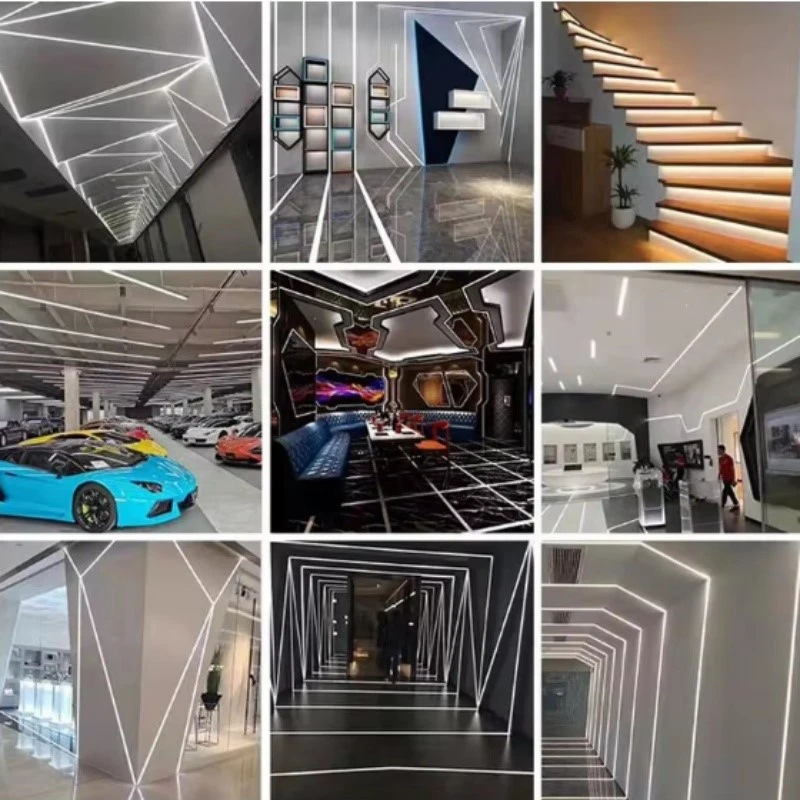
Outlining building facades and architectural cornices
Ambient lighting for garden steps and walkway edges
Soft decorative lighting for patios, gazebos, and pergolas
Illuminated borders for signage and light boxes
Linear lighting for landscape walls and water features
Different scenarios have varying requirements for ingress protection (IP) ratings, color temperatures, and brightness levels; for instance, step lighting favors warm white tones and lower brightness, whereas signage outlines require higher brightness and consistent color uniformity.
Summary
COB LED light strips are perfectly suitable for outdoor use, provided the following conditions are met:
Select an IP65 or higher protection rating; choose IP67/IP68 for areas prone to water accumulation.
Choose a waterproofing structure based on the intended lifespan; for long-term projects, prioritize silicone sleeving or integrated molding.
Use a 12V/24V low-voltage power supply and ensure the power unit is adequately waterproofed.
Properly seal connectors, end caps, and cut points, and install using aluminum channels.
Match color temperature, brightness, and length to the specific application scenario. The key to outdoor lighting is not merely whether it *can* be used, but how *durable* it is. Proper protection and installation at the outset significantly reduce future maintenance costs.
We offer COB LED light strips with various voltage and protection ratings, and can customize specifications, lengths, and waterproofing structures to meet your project requirements. If you are selecting products for outdoor projects, or require samples, quotes, or technical support, please contact us and let us know your application scenario; we will recommend a suitable solution for you.
Our address
No. 5-3 Niujiao Road, Yanchuan Community, Yanluo Subdistrict, Bao'an District, Shenzhen
bwzm18@ledbenweilighting.com