

If you are shopping for LED grow lights, "Full Spectrum" is a term that appears on almost every product page. But what exactly does it mean? Does a "Full Spectrum" label guarantee suitability for plants? To be honest, there is no unified international standard for this term in the industry, and different manufacturers interpret it in vastly different ways. This article clarifies the concept to help you avoid pitfalls when selecting and purchasing lights.
Basic Definition of Full Spectrum
In the field of horticultural lighting, "Full Spectrum" usually refers to light that covers the key wavelengths relevant to plant growth-roughly within the 400–700nm Photosynthetically Active Radiation (PAR) range-with some products extending into the UV (ultraviolet) and IR (far-red) ranges.
The core idea is to mimic the spectral distribution of natural sunlight as closely as possible, ensuring plants receive the light they need at every stage of growth. It is important to note that "Full Spectrum" is a marketing term rather than a strict technical specification; two lights labeled "Full Spectrum" may actually have completely different spectral curves.
How Full Spectrum LEDs Are Achieved
There are currently two main approaches on the market:
White LED-based: A blue LED chip excites a phosphor coating to produce a continuous white light spectrum, which is then supplemented with red LED chips as needed. This method offers a continuous spectrum and good color rendering, making it the most common full-spectrum solution today.
Multi-color LED mixing: Single-color LEDs of various wavelengths-such as blue, green, red, and far-red-are combined in specific ratios to create an effect approximating a full spectrum. While this offers high flexibility, the resulting spectrum may contain certain "gaps."
Neither approach is inherently superior; success depends on the selection of LED chips, their ratios, and the overall design.
Why Plants Need Light of Different Wavelengths
Plant response to light is not as simple as just "red and blue light"; each wavelength plays a specific role:
Blue light (400–500nm): Promotes leaf development, encourages a compact growth habit, and inhibits leggy growth. Green light (500–600 nm): Possesses strong penetrating power, reaching leaves in the lower canopy; previously underestimated, it is now gaining increasing attention.
Red light (600–700 nm): Contributes most significantly to photosynthetic efficiency and influences flowering and fruiting.
Far-red light (700–780 nm): Affects plant morphology and flowering time; effects are more pronounced when used in conjunction with red light.
Ultraviolet (UV) light: Moderate use may influence the content of secondary metabolites in certain plants.
The value of full-spectrum lighting lies in covering these wavebands simultaneously, eliminating the need for manual spectral mixing.
Differences between full-spectrum and red-blue spectrum lighting
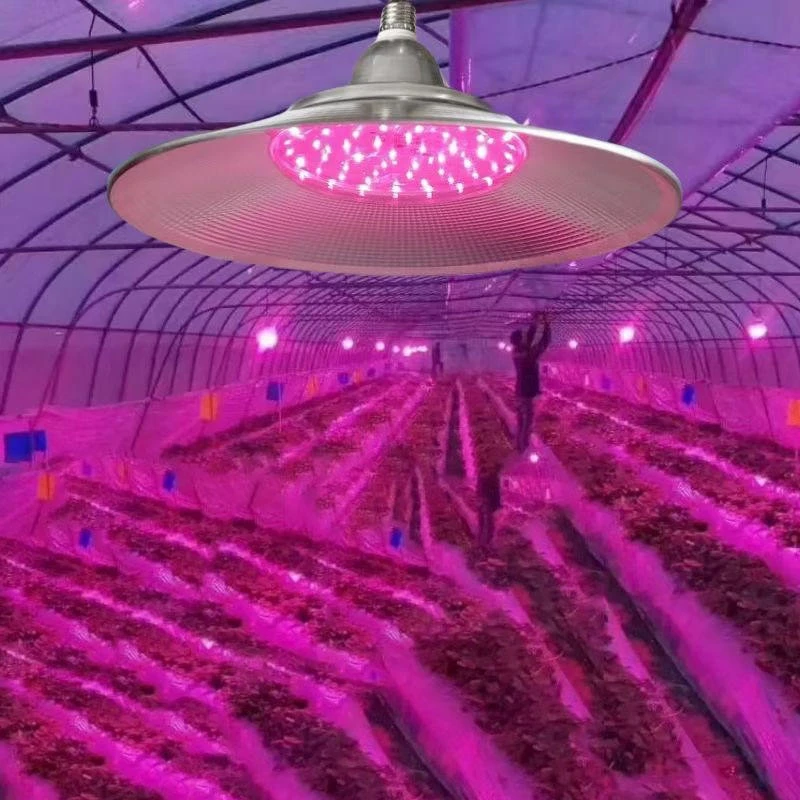
Early LED grow lights mostly utilized a red-blue combination-commonly referred to as "purple-red lights." While efficient and cost-effective, they have distinct drawbacks:
The light appears purplish-red, making it difficult for the human eye to assess plant health or detect issues such as nutrient deficiencies, diseases, or pests.
The spectrum is relatively narrow, lacking wavebands like green and far-red light.
In practice, they are better suited for supplemental lighting for specific crops or specific growth stages.
Full-spectrum lights emit light that appears close to white, offering a more intuitive view of the plants and a more balanced spectrum. The trade-off is that, at the same power level, the luminous efficacy of some full-spectrum designs may be slightly lower than that of red-blue lights optimized for specific purposes.
How to determine if a light is "truly full-spectrum"
Don't just rely on the words "Full Spectrum" in promotional materials; consider the following more reliable indicators:
Check the spectral distribution chart: Reputable manufacturers provide spectral curves; look for continuity in the 400–700 nm range and check for any significant gaps.
Check color temperature and Color Rendering Index (CRI): White light solutions typically specify color temperature (e.g., 3000K, 4000K, 5000K) and CRI.
Check PPE and PPFD data: PPE (Photosynthetic Photon Efficacy, μmol/J) indicates energy efficiency, while PPFD (Photosynthetic Photon Flux Density) indicates the actual amount of light received by the plant canopy. Check the red light ratio: Some "full-spectrum" lights are essentially white light with just a touch of red; the appropriateness of the red light proportion is crucial.
Request third-party test reports: If possible, ask the manufacturer to provide integrating sphere test data.
Spectrum selection for different application scenarios
"Full-spectrum" is not a one-size-fits-all solution; the choice should depend on the specific scenario:
Indoor home gardening and balcony planting: Full-spectrum white light is more suitable; it offers good visual aesthetics and can be used throughout the plant's entire life cycle.
Seedling stage: A spectrum with a slightly higher proportion of blue light helps promote robust seedling growth.
Flowering and fruiting stages: Increase red light and supplement with far-red light if necessary.
Vertical farms and commercial greenhouse supplemental lighting: Spectra are often customized for specific crops rather than relying on off-the-shelf, general-purpose models.
Leafy greens: Requirements for the spectrum are relatively flexible; a full-spectrum solution is usually sufficient.
Summary
"Full-spectrum" refers to lighting that provides relatively complete coverage across the wavelengths relevant to plant growth, aiming to mimic natural light. This can be achieved by combining white and red light or by mixing multi-colored LED beads. Compared to simple red-blue setups, full-spectrum lighting offers better visual clarity and a more balanced spectrum. However, as there is no unified standard for "full-spectrum" lighting, buyers should focus on actual data such as spectral curves, PPE, PPFD, and red light ratios. Ultimately, the right spectral solution should be selected based on the crop type and growth stage.
We offer LED grow lights with various spectral solutions-including full-spectrum white light, red-blue combinations, and crop-specific customization-and can provide spectral curves and test reports. If you are selecting lighting for home gardening, a greenhouse, or a vertical farm, please contact us with details about your crops, growing area, and budget; our engineers will provide tailored recommendations and a quote.
Our address
No. 5-3 Niujiao Road, Yanchuan Community, Yanluo Subdistrict, Bao'an District, Shenzhen
bwzm18@ledbenweilighting.com






