

Introduction: The Hidden Maintenance Cost Crisis of Traditional Factory Lighting
The Necessity of Stable Lighting for Industrial Production
Modern factory production, whether automated assembly line operation, manual workshop processing, warehouse storage and logistics, or outdoor yard loading and unloading, relies on continuous, stable, and high-quality lighting environments. Qualified industrial lighting not only meets basic visual operation needs but also directly affects production safety, product processing accuracy, and employee work efficiency. Dim, flickering, or uneven lighting will increase the error rate of manual operations, reduce the recognition accuracy of automated equipment sensors, and even trigger safety accidents such as falls and collisions. Therefore, maintaining stable lighting operation is a basic guarantee for the sustainable and efficient operation of factory production systems.
High Recurring Costs of Traditional Lighting Solutions
Most traditional factories still use metal halide lamps, high-pressure sodium lamps, and ordinary entry-level LED floodlights as the main lighting equipment. Although these products have low one-time procurement costs, their inherent performance defects lead to extremely high full-cycle maintenance costs. First, traditional industrial lamps have a short service life. The effective service life of metal halide lamps and high-pressure sodium lamps is only 10,000 to 15,000 hours, and they need to be replaced frequently within 2 to 3 years of continuous use. Second, ordinary LED floodlights on the market generally have serious light decay problems. Affected by inferior chip materials and backward heat dissipation designs, their brightness drops sharply after 1 to 2 years of use, resulting in substandard lighting brightness and forced replacement in advance. Third, traditional lamps have poor environmental resistance, which is prone to water ingress, dust accumulation, circuit short circuit and damage in humid, dusty, and high-temperature factory environments, increasing the frequency of emergency maintenance and replacement.
The Core Value of Long-Life Low-Light-Loss LED Floodlights
Different from ordinary lighting products that only pursue low procurement prices, industrial-grade long-life low-light-loss LED floodlights focus on full-cycle cost control and long-term stable performance. With high-quality LED chips, optimized thermal management system, high-standard protection structure, and stable drive design, this type of lamp solves the core pain points of short life and rapid light decay of traditional lighting. It can effectively reduce the frequency of lamp replacement, cut manual maintenance labor costs, reduce spare parts inventory pressure, and avoid production downtime losses caused by lighting failures, becoming a core tool for modern factories to reduce operational costs and optimize asset management.
In-Depth Analysis of Factory Lighting Maintenance Cost Composition
Direct Replacement Cost of Lighting Equipment
Direct equipment replacement cost is the most intuitive part of factory lighting maintenance expenditure. For large and medium-sized factories with hundreds or thousands of lighting fixtures, the annual replacement cost of traditional lamps is extremely huge. Traditional industrial lamps need batch replacement every 2–3 years, while ordinary low-quality LED floodlights will face large-scale brightness attenuation and failure after 1–3 years of use, forcing enterprises to repeatedly purchase new lamps. Continuous repeated procurement not only increases the direct capital investment of lighting equipment but also causes waste of early installation costs, forming a vicious cycle of "low initial cost and high recurring cost".
Manual Maintenance and Labor Cost
Lighting maintenance is a long-term and regular labor expenditure for factories. Traditional lighting equipment has high failure rate and short replacement cycle, requiring special maintenance personnel to conduct regular inspection, fault investigation, disassembly and replacement. For high-altitude installed factory floodlights, each replacement operation requires professional climbing equipment and multi-person cooperative operation, which consumes a lot of working hours. In addition, sudden lighting failures in production workshops and warehouses require emergency maintenance, which will disrupt the daily work arrangement of maintenance teams and increase invalid labor costs. The frequent maintenance work of traditional lighting has become a stable high labor expenditure item for factories.
Indirect Production Downtime and Safety Losses
Many factories ignore the indirect hidden costs caused by lighting failures. In automated production workshops, local lighting dimming or lamp damage will affect the normal operation of precision equipment, leading to production line slowdown or temporary shutdown. In manual processing workshops, insufficient lighting brightness will reduce employee work efficiency and increase product defective rates. At the same time, aging and damaged lamps are prone to short circuit, electric leakage and other faults, which bring potential safety hazards such as electric shock and fire. Once safety accidents or large-scale defective product problems occur due to lighting problems, the economic losses caused are far higher than the maintenance cost of the lamps themselves.
Spare Parts Inventory and Management Cost
To cope with frequent lighting failures, factories need to reserve a large number of spare lamp bodies, drive power supplies, and accessories all year round, occupying enterprise inventory funds and warehouse space. At the same time, the maintenance team needs to spend time sorting out inventory records, counting spare parts, and submitting procurement applications, increasing the daily management cost of the enterprise. Traditional lighting products have inconsistent quality and uneven failure rules, making it impossible to form standardized inventory management, further improving the invisible management cost of factory lighting systems.
Core Technical Advantages of Long-Life Low-Light-Loss LED Floodlights
Ultra-Long Service Life Reduces Replacement Frequency Fundamentally
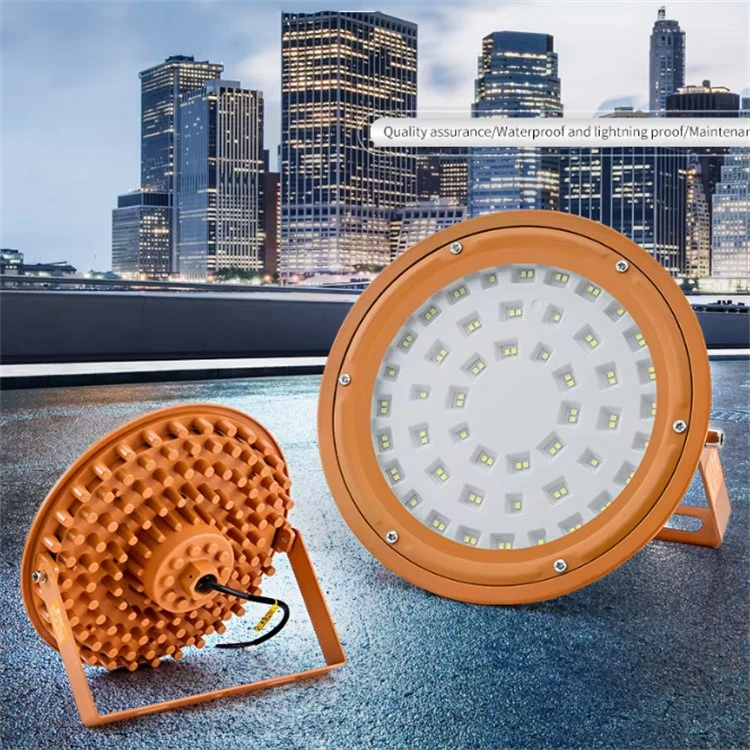
Service life is the core indicator that determines the full-cycle maintenance cost of lighting equipment. This industrial-grade UFO LED floodlight adopts high-quality industrial-grade LED chips and isolated constant-current drive system, with a rated service life of up to 50,000 hours. According to the industrial standard of 12-hour daily factory operation, the continuous service cycle of the lamp can reach 8–10 years, and even in 24-hour uninterrupted working scenarios such as automated workshops and storage yards, it can maintain stable operation for more than 5 years. Compared with traditional metal halide lamps (10,000–15,000 hours) and ordinary low-quality LED lamps (20,000–30,000 hours), its service life is 3–5 times longer. The ultra-long service life fundamentally reduces the annual replacement times of factory lamps, eliminates the repeated procurement cost of equipment, and greatly reduces the inventory pressure of spare parts.
Low Light Decay Technology Maintains Long-Term Stable Brightness
Luminous decay is the key factor leading to premature scrapping of ordinary LED floodlights. Most cheap LED lamps have unoptimized heat dissipation structures and inferior chip packaging processes, resulting in severe light decay. Their brightness will drop by more than 40% after 2 years of use, failing to meet factory lighting standards and requiring forced replacement. This long-life low-light-loss LED floodlight adopts an optimized fin-type full aluminum alloy heat dissipation structure, with a large-area heat dissipation cavity that quickly exports the heat generated by chip operation. It effectively controls the working temperature of the lamp body within a safe range, avoids chip aging and luminous efficiency decline caused by overheating. Professional test data shows that the lamp still maintains a lumen maintenance rate of more than 70% after 50,000 hours of operation, with an annual light decay rate controlled within 3%, far lower than the 15%–20% annual light decay rate of ordinary LED lamps. It can maintain stable and standard lighting brightness for a long time, avoiding premature replacement caused by brightness attenuation.
High-Standard Protection Performance Reduces Fault Maintenance Rate
Factory environments are complex and harsh, with high dust, high humidity, and frequent temperature changes, which put forward high requirements for the environmental adaptability of lighting equipment. This floodlight adopts an integral fully sealed structural design, with industrial-grade waterproof and dustproof protection performance. The thickened tempered glass panel and high-density rubber sealing ring effectively block rainwater, dust, and moisture from invading the lamp body, preventing circuit short circuit and chip damage caused by environmental factors. The whole lamp body is made of anti-corrosion die-cast aluminum alloy, with surface anti-rust and anti-oxidation coating, which can resist humid air, weak chemical corrosion and weathering in factory workshops. It can operate stably in the temperature range of -20℃ to +60℃, adapting to various harsh industrial scenarios. The excellent environmental resistance greatly reduces the failure rate of lamps, eliminates frequent fault investigation and emergency maintenance work, and saves a lot of manual maintenance costs.
Stable Structural Design Improves Operational Reliability
Different from the fragile structure of ordinary consumer-grade floodlights, this industrial-grade lamp adopts a reinforced heavy-duty structure. The thickened lamp body shell has strong compression resistance and impact resistance, which can resist accidental collision and vibration in factory production and handling processes, avoiding lamp body deformation and lens cracking. Equipped with a 180° adjustable stainless steel U-shaped bracket, the installation structure is stable and firm, not easy to loose and fall off after long-term high-altitude operation, reducing hidden dangers of equipment failure caused by structural problems. In addition, the isolated drive system has over-current, over-voltage, and over-temperature protection functions, which can automatically cut off the power in case of abnormal circuit conditions to protect the chip and circuit structure, further improving the long-term operational reliability of the lamp and reducing maintenance frequency.
Quantitative Analysis of Maintenance Cost Reduction Benefits
Equipment Replacement Cost Saving Analysis
Take a medium-sized factory with 200 industrial lighting fixtures as an example. If ordinary low-quality LED floodlights are used, the average replacement cycle is 2–3 years, and the average annual replacement quantity is about 80 units. Calculated according to the average unit price of ordinary industrial lamps, the annual replacement equipment cost is extremely high. In contrast, this long-life low-light-loss LED floodlight has a replacement cycle of more than 8 years, with an average annual replacement quantity of less than 3 units. After batch replacement, the factory can almost eliminate large-scale lamp replacement within 5–6 years, and the direct equipment procurement cost can be saved by more than 90% in the full cycle. Even considering the slightly higher one-time procurement cost of high-quality lamps, the full-cycle equipment cost advantage is extremely prominent.
Labor Maintenance Cost Saving Analysis
Frequent lamp inspection, fault maintenance and replacement consume a lot of human resources. Traditional lighting equipment requires maintenance personnel to conduct monthly inspection and quarterly batch replacement, with a large amount of daily maintenance work. After using long-life low-light-loss LED floodlights, the lamp failure rate is reduced by more than 85%, and the inspection frequency can be reduced from monthly to quarterly or even semi-annually. The number of annual replacement and maintenance operations is reduced by more than 90%, which greatly liberates the labor force of the maintenance team. Maintenance personnel can invest more energy in key equipment maintenance work, improving the overall operational efficiency of the factory while saving a lot of labor costs.
Indirect Economic Benefit Improvement
Stable lighting operation brings huge indirect economic benefits to the factory. First, the long-term stable and uniform lighting environment avoids production line shutdown and efficiency reduction caused by lighting faults, ensuring continuous and stable production capacity. Second, high-quality and consistent lighting reduces product defective rates caused by insufficient brightness and flickering light, improving product yield and economic benefits. Third, the low failure rate of lamps eliminates potential safety hazards caused by aging lighting equipment, reducing safety accident risks and accident compensation costs. In addition, ultra-low light decay ensures that the lighting environment of the factory remains consistent for a long time, avoiding the need for secondary lighting optimization and transformation due to brightness attenuation, saving additional transformation costs.
Inventory Management Cost Optimization
The ultra-long service life and ultra-low failure rate of the lamp enable factories to greatly reduce the reserve quantity of lighting spare parts. Factories no longer need to store a large number of spare lamp bodies and accessories all year round, which saves warehouse space and occupies working capital. At the same time, the standardized and stable performance of industrial-grade lamps makes inventory management more regular and standardized, reducing the time cost of inventory sorting, statistics and procurement application, and optimizing the fine management level of enterprise assets.
Practical Application Strategies to Maximize Cost Reduction Effect
Batch Replacement and Integrated Layout
To maximize the full-cycle cost reduction effect, factories should adopt a one-time batch replacement strategy for old and aging traditional lighting equipment. Replace all high-failure, short-life traditional lamps and ordinary low-quality LED lamps with long-life low-light-loss industrial-grade floodlights, and form a unified and standardized factory lighting system. Integrated layout can avoid the mixed use of old and new equipment, reduce differentiated maintenance work, and facilitate unified daily management and later inspection, further reducing management and maintenance costs.
Scientific Installation and Angle Adjustment
This floodlight is equipped with a 180° adjustable U-shaped bracket, which supports flexible angle adjustment. In the installation process, according to the spatial structure and production layout of the factory workshop, warehouse and outdoor yard, scientifically adjust the lighting angle to eliminate lighting blind spots and ensure uniform lighting coverage. Scientific installation and angle optimization can give full play to the high-efficiency lighting performance of the lamp, avoid local brightness shortage caused by unreasonable layout, and prevent early replacement caused by blind lighting equipment supplementation, realizing energy saving and cost reduction in the whole application link.
Regular Simple Maintenance and Protection
Although the lamp has ultra-low failure rate and long service life, regular simple maintenance can further extend its service life and stabilize performance. It is recommended to carry out semi-annual simple inspection and cleaning work, wipe the dust on the lamp surface and lens, check whether the installation bracket is loose, and confirm the sealing performance of the lamp body. Simple daily maintenance can avoid lamp performance degradation caused by dust accumulation and loose installation, ensure long-term stable operation of the equipment, and maximize the full-cycle service life and cost-saving benefits.
Conclusion
Factory lighting maintenance cost is a long-term hidden expenditure that cannot be ignored in industrial operation. Traditional lighting solutions are restricted by short service life, rapid light decay, poor environmental adaptability and high failure rate, resulting in continuous high costs in equipment replacement, manual maintenance, production loss and inventory management. Long-life low-light-loss LED floodlights, relying on ultra-long service life, ultra-low luminous decay, high-standard protection performance and stable industrial-grade structure, fundamentally solve the core pain points of traditional factory lighting. It not only directly reduces the frequency of lamp replacement and manual maintenance labor costs, but also optimizes inventory management, avoids production downtime and safety losses, and creates huge full-cycle economic benefits for enterprises. For modern factories pursuing refined operation and cost reduction and efficiency improvement, replacing traditional lighting equipment with high-quality long-life low-light-loss LED floodlights is a low-investment, high-return, long-term effective optimization measure. It can help enterprises realize standardized, low-consumption and low-maintenance factory lighting management, effectively reduce overall operational costs, and enhance the core competitiveness of enterprise operation.

How To Cooperate With Us?
We are happy to have total control over the manufacturing process and the calibre of our products since we have our own facilities. Since we are producers rather than just brokers, we are dedicated to providing our customers with the best pricing. Since we are certain that the price and quality of our products are clear, we invite customers to see our samples first. Our commitment to quality and customer satisfaction drives us to continuously provide top-notch goods.
Our address
3rd Floor, 5th Building, Hebei Industrial Park, Hualian Community, Longhua District, Shenzhen, China





