

Introduction
Current Situation of Stadium Lighting Operation and Maintenance
With the continuous development of global sports industry and urban public infrastructure construction, the number of large and medium-sized professional stadiums, outdoor sports courts, and comprehensive sports parks is increasing year by year. Lighting system, as the basic supporting facility to ensure the normal operation of stadiums, needs to meet the high-standard lighting requirements of professional competitions, daily training, and public opening. Large stadium lighting systems usually consist of dozens or even hundreds of high-power floodlights, which are installed on high masts of 10 meters to 50 meters, facing complex and harsh outdoor operating environments such as wind, rain, high temperature, low temperature, and salt spray erosion all year round.
In the actual operation process, most stadium operators are faced with prominent maintenance pain points. Traditional lighting equipment has a short effective service life, frequent lamp damage and light attenuation failure, requiring regular manual inspection, fault troubleshooting, and equipment replacement. Moreover, the high-altitude installation mode of stadium lamps leads to high difficulty and high risk of maintenance operation, resulting in high labor costs and equipment loss costs. For large stadium groups and multi-functional sports venues, the annual maintenance expenditure of lighting systems has become an important part of the venue's operating costs, seriously restricting the long-term profitable operation of the venues.
Core Causes of High Maintenance Costs in Traditional Lighting Projects
The high maintenance cost of traditional stadium lighting projects is not caused by a single factor, but is the result of the superposition of product technical defects, structural design limitations, and environmental adaptability deficiencies. First of all, traditional light sources such as metal halide lamps have inherent shortcomings such as short service life, slow startup, and severe light decay. The average service life is only 8,000 to 15,000 hours, and a large number of lamps will experience insufficient brightness, stroboscopic failure, and bulb burnout within 1 to 3 years of use, requiring large-scale replacement.
Secondly, the integrated design of traditional stadium floodlights leads to extremely high maintenance costs. Once a single light source or driving component fails, the entire lamp needs to be removed and replaced, which not only increases the cost of equipment replacement, but also consumes a lot of manual working hours. In addition, traditional lamps have low protection grades, poor heat dissipation performance, and weak corrosion resistance. Under long-term outdoor harsh conditions, the failure rate of waterproof and dustproof failure, circuit aging, and shell damage is extremely high, further increasing the frequency of maintenance and the overall cost of project operation.
Research Significance and Core Objectives
Under the background of global energy conservation, emission reduction and refined venue operation management, reducing the maintenance cost of stadium lighting projects has become an important demand for venue operation optimization. Replacing traditional high-maintenance lighting equipment with high-performance, long-life, and easy-maintenance modular LED stadium lights is the most effective way to solve the pain point of high maintenance costs of stadium lighting. This paper aims to analyze the composition of stadium lighting maintenance costs in detail, clarify the advantages of modular LED stadium lights in reducing failure rate, simplifying maintenance operations, and extending service life, and summarize systematic maintenance cost reduction strategies, so as to help stadium operators reduce long-term operating expenditures, improve the stability and service life of lighting systems, and realize low-cost and high-efficiency operation of large stadium lighting projects.
Composition and Classification of Maintenance Costs for Large Stadium Lighting Projects
Equipment Replacement Cost
Equipment replacement cost is the most direct and largest proportion of maintenance expenditure in stadium lighting projects. This cost includes the purchase cost of new lamps, light sources, drivers, and accessory parts, as well as the scrap loss cost of failed equipment. For traditional stadium lighting systems, due to the short service life of light sources and vulnerable internal components, large-scale equipment replacement is required every 2 to 3 years. For a standard professional football stadium or track and field stadium equipped with 80 to 120 high-power floodlights, the one-time replacement cost of all equipment is extremely high. In addition, the inconsistent failure time of single lamps leads to frequent sporadic replacement, which increases the repeated procurement cost and inventory management cost of equipment accessories in the long run.
Different from traditional integrated lamps, the modular design of new LED stadium lights realizes the separation of light source modules, driving modules and structural components. The independent operation of each module avoids the overall scrap of the lamp caused by the failure of a single component, which can greatly reduce the equipment replacement cost in the whole life cycle of the lighting system.
Manual Operation and Maintenance Cost
The manual maintenance cost of stadium lighting mainly includes daily inspection, fault troubleshooting, high-altitude operation replacement, and later debugging and calibration costs. Stadium lighting lamps are mostly installed on high masts and roof high positions, and all maintenance operations belong to high-altitude dangerous operations, requiring professional maintenance personnel and special lifting equipment. The daily regular inspection of the lighting system needs to consume a lot of human resources to check the brightness, circuit, and appearance of the lamps one by one. When a fault occurs, it is necessary to arrange personnel to carry out high-altitude operation troubleshooting and replacement, with long operation cycle and high labor cost.
Traditional integrated lamps have complex disassembly and assembly processes. The replacement of a single faulty lamp requires the whole process of hoisting, disassembly, wiring, installation and debugging, which takes a long time. While modular LED stadium lights adopt a quick-disassembly structure design, which simplifies the maintenance process, shortens the single operation time of maintenance personnel, and effectively reduces the labor cost of long-term maintenance.
Failure Loss and Derivative Cost
The derivative maintenance cost caused by lamp failure is easily ignored in project cost accounting, but it has a great impact on the operating income of stadiums. The abnormal failure of stadium lighting will lead to the inability to carry out night training, public fitness opening, commercial events and other activities, resulting in venue operation income loss. In addition, the local lighting failure of the stadium will lead to uneven illumination, which cannot meet the professional competition standards, resulting in the cancellation or delay of events, bringing greater economic losses and reputation losses to the venue.
At the same time, the frequent failure of traditional lamps will also lead to increased power consumption and heat loss of the system. The aging circuit and attenuated light source will cause the lamp to consume more electric energy to meet the basic brightness demand, resulting in additional energy consumption costs, which further increases the comprehensive operating cost of the lighting project.
Subsequent Debugging and Maintenance Cost
After each equipment replacement and fault maintenance of stadium lighting, professional illuminance calibration and angle debugging are required to ensure that the overall illumination uniformity, brightness standard and light distribution effect of the stadium meet the design requirements. Traditional lamps have poor stability after replacement, and the light attenuation speed is fast, which requires frequent secondary debugging and parameter adjustment, increasing the subsequent technical maintenance cost. While high-performance modular LED stadium lights have stable luminous performance and consistent light distribution parameters, the subsequent debugging frequency is extremely low, which can effectively save long-term technical maintenance costs.
Defects of Traditional Stadium Lighting Systems in Maintenance Management
Short Service Life and Frequent Fault Attenuation
The core defect of traditional stadium lighting equipment is the short service life and uncontrollable light attenuation. Metal halide lamps and high-pressure sodium lamps, the mainstream traditional light sources, have a rated service life of only 10,000 hours on average, and the actual service life in outdoor high-temperature and humid environments is even shorter. After 6 to 12 months of use, the light attenuation rate of the lamp will exceed 30%, resulting in insufficient stadium brightness and failure to meet the use standard. A large number of lamps will be completely damaged and unable to light after 2 years of use, requiring comprehensive replacement.
Frequent light attenuation and equipment failure not only increase the frequency of equipment replacement, but also make the lighting system in an unstable state for a long time, requiring continuous manual inspection and maintenance, which is the primary cause of high maintenance costs of traditional stadium lighting projects.
Integrated Structure Leads to High Maintenance Difficulty
Almost all traditional high-power stadium floodlights adopt an integrated closed structure. The light source, driving power supply, circuit board and heat dissipation structure are integrated into a whole, without independent modular partition. Once any small component inside the lamp fails, such as light source burnout, driver damage or circuit aging, the entire lamp cannot work normally, and the whole equipment can only be replaced instead of partial maintenance.
This integrated design makes the maintenance cost of single equipment extremely high. Even if only a low-cost driving component fails, the operator needs to bear the replacement cost of the whole high-power lamp. At the same time, the integrated lamp has complex internal wiring and disassembly difficulties. Maintenance personnel need professional technical operation during replacement, which increases the difficulty and time cost of high-altitude maintenance.
Low Protection Grade and Poor Environmental Adaptability
Most traditional stadium lamps only have IP54 or low IP65 protection grade, with poor waterproof, dustproof and corrosion resistance. Stadiums are mostly built in open outdoor areas, which are exposed to rainwater immersion, dust accumulation, ultraviolet radiation, and coastal salt spray erosion all year round. Low-protection lamps are prone to water inflow, dust blockage, internal circuit damp and rust in harsh environments, resulting in short circuit, no light, and flickering failure.
In rainy and humid seasons, the failure rate of traditional lamps will increase exponentially. The damaged lamps need frequent maintenance and replacement, and the shell is easy to age and deform after long-term outdoor use, which cannot resist wind and rain impact, further shortening the service life of the equipment and forming a vicious cycle of "short service life - frequent failure - high maintenance cost".
Backward Heat Dissipation Technology Accelerates Component Aging
Heat dissipation performance is the key factor determining the service life and stability of lighting equipment. Traditional stadium lamps adopt simple heat dissipation structures such as thin iron shell and ordinary aluminum plate heat dissipation, with low heat dissipation efficiency and poor heat conduction performance. High-power lamps will generate a lot of heat during long-time continuous operation. The heat cannot be dissipated in time, resulting in long-term high-temperature operation of internal light source and driving components, accelerating the aging and damage of electronic components.
Long-term high-temperature operation will not only aggravate light attenuation, but also lead to frequent failure of driving power supply, greatly reducing the stability of the lighting system. The backward heat dissipation technology makes the failure rate of traditional lamps far higher than that of new LED lamps, which directly increases the long-term maintenance pressure of the project.
Core Advantages of Modular LED Stadium Lights in Reducing Maintenance Costs
Modular Split Structure: Realize Partial Maintenance and Reduce Replacement Cost
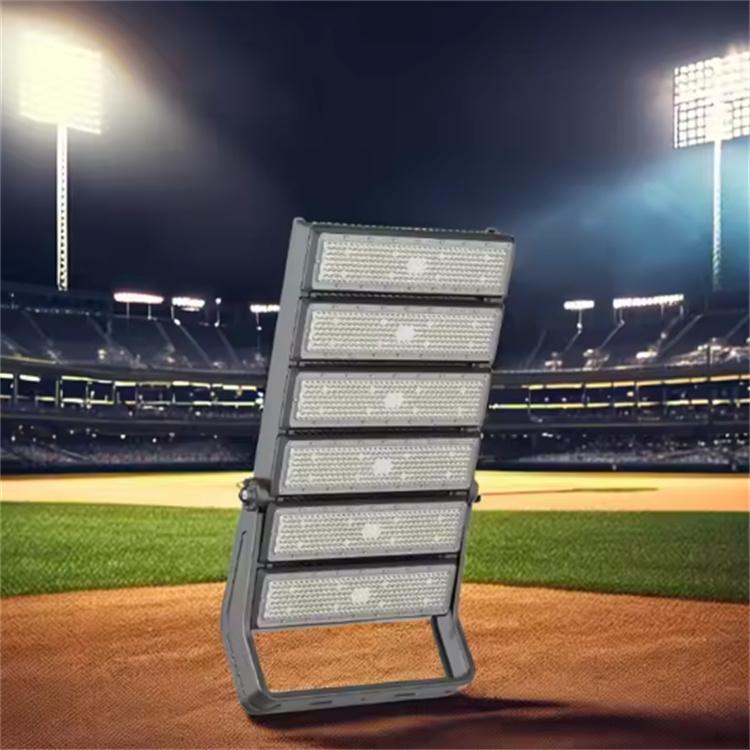
The biggest technical advantage of modular LED stadium floodlights in maintenance cost control is the independent modular split design. The lamp is composed of multiple independent light source modules, independent driving modules and integral structural components. Each module operates independently without mutual interference. When a single module fails and is damaged, it will not affect the normal operation of other modules and the whole lamp. Operators only need to replace the faulty single module instead of the whole lamp, which greatly reduces the single equipment replacement cost.
This modular maintenance mode completely changes the maintenance logic of traditional integrated lamps. For large stadiums with hundreds of lamps, the long-term cumulative cost saved by partial module replacement is extremely huge. At the same time, the modular structure adopts a quick plug-in installation design, without complex wiring and disassembly steps. Maintenance personnel can complete module replacement in a short time during high-altitude operation, which greatly shortens the maintenance operation time and reduces labor costs and high-altitude operation risks. In addition, the modular design supports free power combination of 250W to 1000W, which can flexibly adapt to different venue lighting needs, and the unified module specification also reduces the difficulty of equipment inventory management and accessory procurement costs.
Ultra-Long Service Life and Low Light Attenuation: Reduce Maintenance Frequency Fundamentally
Modular LED stadium lights adopt high-quality original high-lumen LED chips, matched with scientific constant current driving technology and optimized heat dissipation system, which fundamentally solves the problems of short service life and severe light attenuation of traditional light sources. The rated service life of the product is as high as 50,000 hours, which is 3 to 5 times that of traditional metal halide lamps. According to the daily operation standard of 8 to 10 hours for stadiums, the service life of the lamp can reach more than 10 years, realizing long-term stable operation without large-scale equipment replacement.
In terms of light attenuation control, the product adopts intelligent temperature control and uniform light distribution technology. The professional die-cast aluminum heat dissipation structure can quickly export the heat generated by the chip, keep the chip working at a constant safe temperature, effectively inhibit light decay, and control the annual light attenuation rate within 3%. Compared with traditional lamps with 30% light attenuation in one year, modular LED lamps maintain stable brightness for a long time, avoiding frequent maintenance and replacement caused by insufficient brightness attenuation, and fundamentally reducing the overall maintenance frequency of the lighting project.
IP66 High Protection Grade: Adapt to Harsh Environments and Reduce Fault Rate
All modular LED stadium floodlights adopt full-sealed integrated cavity structure, reaching the industry-leading IP66 waterproof and dustproof protection grade. Compared with traditional low-protection lamps, this product can fully resist the intrusion of outdoor rainwater, fog, dust, sand and moisture. The internal light cavity is completely isolated from the external environment, which can effectively avoid circuit short circuit, damp damage and dust blockage caused by environmental factors.
In terms of anti-corrosion and anti-aging performance, the lamp shell adopts thickened die-cast aluminum alloy material, with electrostatic anti-corrosion spraying treatment on the surface, which can resist acid-base erosion, coastal salt spray corrosion and long-term ultraviolet radiation. The lamp shell will not rust, peel or deform after long-term outdoor use. The excellent environmental adaptability makes the product maintain ultra-low failure rate in rainy, snowy, high-temperature, low-temperature and dusty harsh environments, greatly reducing the number of fault maintenance and emergency maintenance, and saving a lot of derivative maintenance costs caused by equipment failure.
Efficient Heat Dissipation System: Stabilize Equipment Performance and Extend Maintenance Cycle
The product is equipped with a professional fin-type air convection heat dissipation system. The thickened aluminum alloy heat sink forms a three-dimensional heat dissipation structure, which enlarges the heat dissipation area and accelerates the air circulation inside and outside the lamp body. The rapid heat conduction and convection heat dissipation mode can instantly export the heat generated by the LED chip and driving power supply, keep the internal working temperature of the lamp in a stable and safe range, and avoid component aging and performance degradation caused by high temperature.
The efficient heat dissipation system solves the core problem of high-temperature aging of traditional lamps, ensures the long-term stable operation of internal electronic components, greatly extends the regular maintenance cycle of the lighting system, reduces the frequency of daily inspection and debugging, and further reduces the human and material resources investment of maintenance work.
Stable Operating Performance: Reduce Derivative Failure Loss
Modular LED stadium lights adopt high-efficiency constant current driving power supply, with wide voltage adaptation range, strong voltage fluctuation resistance, no stroboscopic, no flash failure during long-term operation. The product has uniform light distribution and stable luminous performance, which can always meet the professional illuminance standards of stadium competitions and daily use, avoiding venue operation stop and income loss caused by lighting failure.
At the same time, the product has ultra-high energy-saving performance, which saves more than 60% of electric energy compared with traditional HID lamps. While reducing energy consumption costs, it avoids the problem of increased power consumption caused by aging and attenuation of traditional lamps, realizing double cost reduction of energy consumption and maintenance. The stable and reliable operating performance greatly reduces the derivative economic losses caused by lighting equipment failure, and optimizes the comprehensive cost control level of stadium lighting projects.
Systematic Strategies to Reduce Maintenance Costs of Stadium Lighting Projects
Replace Traditional Equipment with Modular LED Lights in Full Coverage
The most fundamental strategy to reduce the maintenance cost of large stadium lighting projects is to complete the upgrading and replacement of traditional lighting equipment. For all kinds of old stadiums still using metal halide lamps and high-pressure sodium lamps, full replacement with high-performance modular LED stadium lights can completely eliminate the inherent maintenance pain points of traditional equipment. In the equipment selection process, according to the actual lighting area and power demand of the stadium, flexibly match 250W-1000W modular LED lamps to ensure that the lighting effect meets the standard while maximizing the use of equipment performance and avoiding excess energy consumption and maintenance pressure caused by excessive power.
For newly built stadium lighting projects, modular LED stadium lights should be taken as the preferred scheme in the design stage. The modular structure and standardized module specifications can lay a foundation for later maintenance and management, reduce the difficulty of later equipment upgrading and accessory matching, and realize the whole life cycle low-cost operation of the lighting system.
Establish Modular Simplified Maintenance Management Mechanism
Combined with the quick maintenance advantages of modular LED lamps, stadium operators can establish a simplified and efficient lighting maintenance management mechanism. Different from the traditional full-inspection and full-replacement maintenance mode, the modular maintenance mode adopts "single module fault targeted replacement" to realize precise maintenance. The maintenance personnel only need to regularly check the working state of each module of the lamp, and replace the faulty module in time, without overall disassembly and overall replacement, which greatly simplifies the maintenance process.
At the same time, due to the unified specification of modular components, operators only need to reserve a small number of general module accessories in inventory, which reduces the inventory occupation cost and accessory procurement cycle. The simplified maintenance mechanism can greatly improve the maintenance efficiency of the lighting system and reduce the long-term manual maintenance cost.
Regular Standardized Inspection and Maintenance to Extend Equipment Life
Although modular LED stadium lights have ultra-low failure rate and long service life, standardized regular inspection and maintenance can further extend the equipment service life and reduce the probability of sudden failure. The stadium can formulate a quarterly and annual inspection system: conduct regular dust cleaning and appearance inspection of the lamp shell and heat dissipation structure every quarter to avoid dust accumulation affecting heat dissipation effect; conduct a comprehensive inspection of module operation status and line stability every year, and calibrate the lighting angle and illuminance parameters to ensure the best operating state of the equipment.
Standardized daily maintenance can avoid minor problems evolving into major faults, reduce the frequency of large-scale maintenance and replacement, and maximize the whole life cycle value of modular LED lighting equipment, so as to continuously reduce the comprehensive maintenance cost of the project.
Match Intelligent Control System to Optimize Operation and Maintenance
On the basis of modular LED stadium lights, matching intelligent lighting control system can further optimize operation and maintenance management and reduce unnecessary loss and maintenance. The intelligent system can realize single-lamp independent control, timing switch, brightness adjustment and real-time fault monitoring of stadium lamps. The system can automatically feed back the fault information of a single module to the management terminal, helping maintenance personnel quickly locate the fault point, avoiding large-scale manual troubleshooting, and greatly improving maintenance efficiency.
At the same time, the intelligent timing switch and brightness adjustment function can avoid long-term no-load operation and excessive brightness loss of lamps, reduce the working load of equipment, slow down component aging and light attenuation speed, further extend the service life of lamps, and reduce long-term maintenance and replacement costs.
Cost Benefit Verification of Modular LED Lighting Maintenance Optimization
Short-Term Maintenance Cost Comparison
Taking a standard professional football stadium equipped with 100 high-power floodlights as the verification object, the short-term maintenance cost data of traditional lighting and modular LED lighting are compared. Within three years of operation, traditional metal halide lamps need 2-3 large-scale replacements and multiple sporadic maintenance, with an average annual maintenance cost of about 15,000-20,000 US dollars, including equipment replacement cost, labor maintenance cost and fault derivative loss. While modular LED stadium lights have almost no large-scale replacement demand within three years, with only a small amount of routine inspection and maintenance costs, and the average annual maintenance cost is less than 3,000 US dollars, which saves more than 80% of short-term maintenance costs compared with traditional schemes.
Long-Term Whole Life Cycle Cost Advantage
From the perspective of 10-year whole life cycle of stadium lighting equipment, the cost advantage of modular LED lights is more prominent. The service life of traditional lamps is only 2-3 years, and 3-4 times of full equipment replacement are required in 10 years, with superposed maintenance and energy consumption costs. While modular LED lamps can operate stably for more than 10 years with one-time installation, without full replacement, and only a small number of individual module replacements are required in the later stage. After comprehensive calculation, the whole life cycle comprehensive cost of modular LED stadium lighting system is saved by more than 70% compared with the traditional lighting system, which has extremely significant cost reduction benefits.
Comprehensive Benefit Improvement of Venue Operation
While reducing maintenance costs, modular LED stadium lights also bring comprehensive operational benefits to stadiums. The stable and high-standard lighting effect meets various professional competition and commercial event needs, improving the venue's service capacity and operating income. The ultra-low failure rate ensures the continuous and stable operation of the venue, avoiding income loss and reputation damage caused by lighting failure. The energy-saving and environmental protection performance also meets the global green building and energy-saving emission reduction standards, helping the venue realize standardized and high-quality operation.
Conclusion
The high maintenance cost of traditional stadium lighting projects is caused by the superposition of short equipment service life, high failure rate, unreasonable structural design and poor environmental adaptability, which has always been a major pain point restricting the refined operation of large stadiums. The emerging modular LED stadium floodlights completely break through the technical limitations of traditional lighting equipment. Through the core advantages of independent modular split structure, ultra-long service life, low light attenuation, IP66 high protection grade and efficient heat dissipation system, it effectively solves various maintenance problems of stadium lighting.
Full replacement of traditional equipment with modular LED stadium lights, combined with simplified modular maintenance management mechanism and intelligent control system, can fundamentally reduce the equipment replacement frequency, manual maintenance cost and fault derivative loss of large stadium lighting projects, and realize long-term low-cost and high-efficiency operation of lighting systems. A large number of practical cases and cost verification show that modular LED lighting scheme is the optimal solution for large stadium lighting projects to reduce maintenance costs and improve operational benefits, which is worthy of widespread promotion and application in global stadium infrastructure construction and renovation projects.

How To Cooperate With Us?
We are happy that we have total control over the manufacturing process and the quality of our products since we have our own facilities. Since we are producers rather than just brokers, we are dedicated to providing our customers with the best pricing. Since we are certain that the price and quality of our products are transparent, we advise customers to examine our samples first. Our commitment to quality and customer satisfaction drives us to continuously provide top-notch goods.
Our address
3rd Floor, 5th Building, Hebei Industrial Park, Hualian Community, Longhua District, Shenzhen, China





