Today, COB LED light strips have become a popular choice for creating ambiance in homes, decorating commercial spaces, and providing industrial lighting, thanks to their seamless and uniform light emission and flexible installation capabilities. However, many users are often confused about how to properly install and adjust them to achieve optimal performance after receiving the product-after all, unlike traditional LED light strips, COB's high-density chip packaging design requires attention to detail in its use. This guide will teach you step-by-step how to correctly use COB LED light strips, from initial preparation to post-installation maintenance, avoiding common mistakes and ensuring that every beam of light accurately illuminates your space.
Pre-use Preparation: Gather Tools and Inspect the Product
Preparing before installation and use can prevent confusion and effectively protect the product, extending its lifespan. This step is often overlooked, but it is crucial.
Essential Tools Preparation
The key items to prepare are: sharp scissors or a precision knife (for cutting the LED strip), a measuring tape (for measuring the installation length), a screwdriver or electric drill (if needed to secure the aluminum profile), and alcohol wipes (for cleaning the installation surface). If splicing LED strips is required, a soldering kit or quick connectors will also be necessary. For dimming functionality, a compatible dimmer and controller will be required.
Product Inspection Points
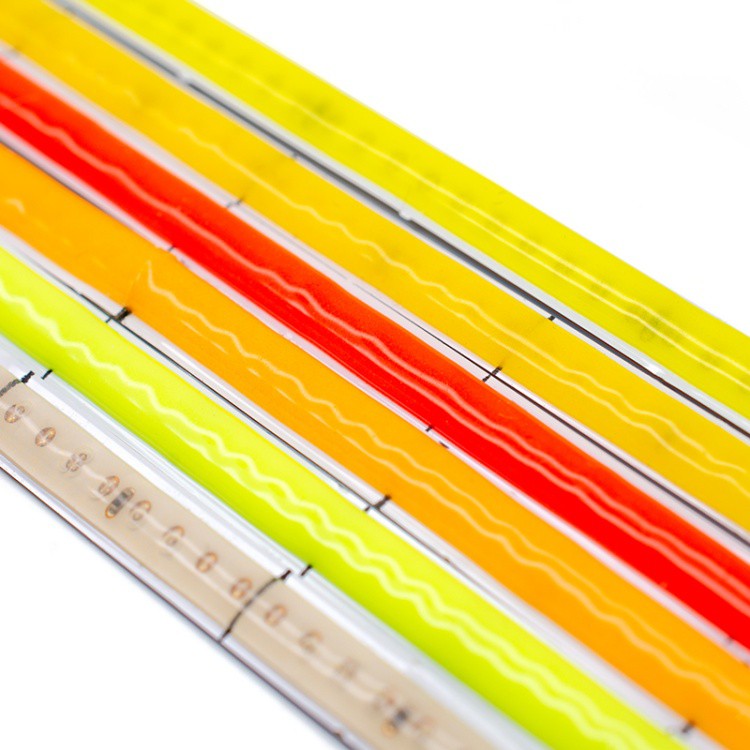
First, inspect the COB LED strip itself: Check for surface damage, chip detachment, and the integrity of the adhesive layer on the back (if the adhesive is insufficient, additional double-sided tape will be needed). Second, verify the accessories: Confirm that the voltage and power of the LED driver (transformer) match the strip (commonly 12V or 24V; the total power of the strip should not exceed 80% of the power supply's power) to avoid voltage mismatch burning out the strip. Finally, check the cutting points: Confirm the cutting marks on the strip surface (usually one every 25mm, 50mm, or 50.8mm). Subsequent cutting must strictly follow these marks; do not cut arbitrarily.
COB LED Strip Usage Process
This part is crucial. Follow the steps carefully; even beginners can easily get started. Pay attention to details at each step to avoid affecting the performance due to improper operation.
Measurement and Cutting: Precisely Fitting the Installation Space
The first step is to determine the installation location. Use a measuring tape to measure the required length of the LED strip. Then, referring to the cutting marks on the surface of the LED strip, use scissors or a precision knife to cut perpendicularly along the marks. Apply even pressure when cutting to ensure a clean cut and avoid damaging the internal circuitry. Note: Cutting must be done along the designated cutting points; otherwise, the LED strip may short-circuit and fail to light up. Any excess material after cutting should not be arbitrarily spliced; it must be used with a dedicated connector.
Surface Cleaning and Fixing: Ensuring a Secure Installation
First, wipe the installation surface with an alcohol swab to remove dust, oil, and moisture, ensuring the surface is dry and flat-this step directly affects the adhesion of the LED strip; if the surface is not clean, the LED strip may easily detach. After cleaning and drying, there are two fixing methods available: ① Direct pasting: Peel off the protective film on the back of the light strip, align it with the installation position, and press evenly from one end to the other, ensuring the light strip is completely adhered to the surface and avoiding air bubbles; ② Aluminum profile fixing: If the installation environment requires heat dissipation (such as prolonged lighting), you can first fix the aluminum profile to the installation position, then place the light strip inside the profile and cover it with a diffuser. This facilitates heat dissipation and makes the light softer and more uniform.
Wiring and debugging: Safe power-on test.
Always turn off the power before wiring to avoid the risk of electric shock. Pay attention to the polarity when wiring: connect the "+" terminal of the light strip to the "+" terminal of the power supply, and the "-" terminal to the "-" terminal. Do not reverse the connections, otherwise the light strip will not light up, and in severe cases, it may burn out the chip. If multiple light strip segments need to be spliced, use quick connectors or soldering. When soldering, the solder joints must be firm and clean to avoid poor contact due to loose connections. After wiring, do not fix the LED strip. Turn on the power and test to check if the LED strip emits light evenly, without any dark areas or flickering. If there are any problems, adjust the wiring or replace the LED strip segment immediately.
Dimming and Mode Settings
If a dimmer or RGB controller is used, after a normal power-on test, you can set the brightness and lighting effect mode according to your needs. Single-color temperature LED strips can have their brightness adjusted via a dimmer to achieve a smooth transition from dark to bright; dual-color temperature or RGB LED strips can have their color temperature switched (2700K-6500K), and their color and dynamic modes (such as breathing, gradient) adjusted via a controller to suit different scene atmospheres. Note: The dimmer and controller must be compatible with the LED strip model; otherwise, they will not work properly.
Usage Precautions: Avoiding Damage and Safety Hazards
Although COB LED LED strips are durable, proper use is essential to extend their lifespan and avoid safety issues. These details must be remembered; many users' LED strips are damaged because these points are overlooked.
Voltage Safety: 12V/24V low-voltage LED strips must not be directly connected to a 220V household power supply. A dedicated driver power supply is required; otherwise, the strip will burn out instantly. The power supply wattage must match the total wattage of the LED strip; it is recommended to allow 10%-20% of the wattage as a margin to extend the power supply's lifespan.
Installation Specifications: Avoid folding or twisting the LED strip during installation. The bending radius must be at least 50mm. Do not bend it to a 90-degree angle or at the solder pads to prevent damage to the circuitry. Avoid pressing on the chip surface when handling the LED strip, and do not scratch the surface with sharp objects.
Environmental Requirements: Indoor standard LED strips (IP20) are not suitable for humid or outdoor environments. For outdoor or humid areas (such as bathrooms or balconies), choose an IP65 or higher waterproof model. The operating temperature should be controlled between -20℃ and 50℃. Avoid proximity to high-temperature, flammable, or explosive materials to prevent overheating damage.
Electrostatic Discharge Protection: COB chips are sensitive to electrostatic discharge. It is recommended to wear an anti-static wrist strap or gloves during operation to prevent electrostatic discharge from damaging the chip and affecting the lighting effect.
Daily Use: Avoid frequent power-on and power-off cycles, as these will accelerate chip aging. When not in use for extended periods, turn off the power to reduce energy consumption and protect the LED strip. When cleaning the LED strip, turn off the power and gently wipe it with a dry cloth; do not rinse with water or use corrosive cleaning agents.
Common Troubleshooting: Quickly Resolve Usage Problems
If you encounter problems during use, do not rush to replace the LED strip. First, troubleshoot using the following methods. Most minor faults can be quickly resolved, saving time and costs.
Fault 1: LED strip does not light up – Check if the power supply is on and if the positive and negative terminals are reversed; ensure the cutting follows the specified marks. If the cutting is incorrect, replace the LED strip; check for loose connections at the wiring points and resolder or reinforce the connectors.
Fault 2: Uneven LED strip illumination or dark areas – Check if the LED strip is completely flush with the mounting surface and is not loose; check if the wiring connections are good; if some chips are damaged, cut off the damaged parts and reassemble.
Fault 3: Flickering and unstable brightness of the LED strip – Check if the power supply is insufficient; replace with a higher wattage power supply. Check for poor contact at the wiring points. If a dimmer is used, check if the dimmer is compatible and malfunctioning.
Fault 4: Adhesive detachment from the LED strip – Clean the installation surface and re-attach. If the adhesive layer is aged, replace the double-sided tape or use aluminum profiles for fixing to enhance stability.
Usage Summary
Using COB LED strips is actually not complicated. The key is "proper preparation, correct steps, and attention to detail." From initial tool preparation and product inspection, to mid-stage cutting, fixing, and wiring adjustments, and then to later daily maintenance and troubleshooting, as long as you follow the guide, you can fully utilize its advantages of seamless light emission, high brightness, and high flexibility. It can easily adapt to various applications, including home ambiance creation, commercial space decoration, and industrial lighting.
Compared to traditional SMD LED strips, COB LED strips offer advantages such as a grain-free appearance, superior heat dissipation, long lifespan (50,000-80,000 hours), and high color rendering index (CRI≥90), making them the preferred choice for high-end lighting. However, proper use is crucial to avoid unnecessary damage, extend their lifespan, and maximize their value.
If you encounter any problems during use, or if you need customized COB LED strip solutions for specific scenarios (such as home lighting without main lights, commercial shop decoration, or outdoor lighting), please contact our professional team. We not only provide high-quality COB LED strip products but also offer one-on-one usage guidance and customized solutions to help you easily unlock perfect lighting effects. Contact us now and start your lighting upgrade journey!
www.benweilighting.com/professional-lighting/led-strip-lights/ip20-cob-led-strip-light.html
Our address
No. 5-3 Niujiao Road, Yanchuan Community, Yanluo Subdistrict, Bao'an District, Shenzhen
bwzm18@ledbenweilighting.com