

Introduction: The Two Extremes of Commercial Lighting
Despite their differences, both environments share a common vulnerability: a total dependence on reliable, high-quality illumination. A flickering or dim subway station is a security risk and a logistical nightmare to maintain. A poorly lit supermarket is a graveyard for perishable goods and a deterrent to consumer spending. Traditional lighting solutions, such as fluorescent tubes or low-grade residential LED panels, simply cannot withstand the relentless 24/7 operational tempo of these spaces. The industry standard has therefore shifted decisively toward commercial-grade backlit panels. These fixtures are not merely light sources; they are highly engineered optical instruments designed to deliver uncompromising reliability, visual comfort, and aesthetic precision.
Section One: The Subway Environment-Reliability, Safety, and Visual Comfort
First and foremost, the issue of flicker must be addressed. In a transient environment like a subway station, commuters are constantly in motion, reading signage, checking mobile devices, or navigating crowded platforms. Flicker-free technology is not a luxury; it is a public health necessity. Flickering lights can induce eye strain, migraines, and even neurological discomfort in photosensitive individuals. The premium backlit panel is engineered to provide absolute flicker-free operation, ensuring a stable visual environment that reduces cognitive load on travelers and staff alike.
Furthermore, the Unified Glare Rating (UGR) is of paramount importance. Subway platforms often use highly reflective materials like polished stone, stainless steel, and glass. If lighting fixtures produce excessive glare (high UGR), these surfaces become visually blinding. An advanced commercial-grade panel features a UGR<19 rating. This low glare rating is achieved through the meticulous design of the diffusion board and refractive membrane, which softens the light and scatters it evenly. As a result, commuters experience a soft, comfortable illumination that enhances visibility without causing discomfort or compromising safety.
Perhaps the most critical factor in subway lighting is thermal management and durability. Replacing a light fixture 30 feet above a subway platform requires specialized equipment, nighttime closures, and significant labor costs. The aluminum cooling frame utilized in premium backlit panels is essential for maximizing the lifespan of the LEDs. Unlike plastic housings, aluminum efficiently conducts heat away from the critical LED junctions, preventing overheating. This superior thermal management minimizes lumen depreciation-the gradual dimming of the light over time-and drastically extends the fixture's operational life. When paired with a robust metal back cover and a sealed multi-layered architecture, these panels are built to survive the harsh realities of transit infrastructure for years, making them the only financially viable choice for transit authorities.
Section Two: The Supermarket Arena-Driving Retail Sales Through Optical Precision
As demonstrated in comparative visual analyses, low-Ra lighting is a commercial death sentence. Under a low-Ra (Ra<80) light source, the vibrant reds of ripe tomatoes appear muddy and brownish. The lush greens of fresh lettuce look sickly and pale. Oranges lose their vitality. When consumers perceive produce as discolored, they subconsciously interpret it as spoiled or of poor quality. The psychological impact is immediate: they refuse to purchase the product, leading to massive food waste and lost revenue. Conversely, a commercial-grade backlit panel featuring an Ra>80 rating restores the true, vibrant colors of the merchandise. The reds pop, the greens are lush, and the oranges glow with vitality. Ra>80 lighting acts as an invisible salesperson, making products look irresistible and maximizing inventory turnover.
Beyond color rendering, the physical distribution of light is critical. Supermarkets utilize long aisles of vertical shelving. Inferior lighting often creates "hot spots" and "dark spots"-zones directly beneath the fixture are brightly lit, while the spaces between fixtures or deep inside shelves remain shadowed. This forces customers to strain to read labels or inspect products. The premium backlit panel solves this through advanced circular lens technology. As highlighted in the product specifications, these circular lenses ensure high light uniformity and a precise 180-degree beam angle. This guarantees that absolutely no dark spots appear on the diffuser, providing an even, consistent wash of light across entire aisles.
Moreover, the sheer size of a supermarket demands massive energy efficiency. With the luminous efficacy of 120lm/W, these panels deliver brilliant illumination while significantly reducing energy consumption. For a facility operating hundreds of fixtures for 15 to 18 hours a day, this efficiency translates into tens of thousands of dollars in annual savings. Finally, the flexibility of adjustable Color Temperature (CCT) allows store managers to tailor the atmosphere to specific departments. A warm 3000K light can be used in the bakery section to create a cozy, inviting atmosphere, while a cool 5000K light can be utilized in the meat and seafood section to convey cleanliness, freshness, and clinical precision. A simple dip switch adjusts the entire mood of the store, offering adaptability that standard fixed-temperature fixtures cannot match.
Section Three: The Anatomy of an Industry Standard-Engineering Excellence
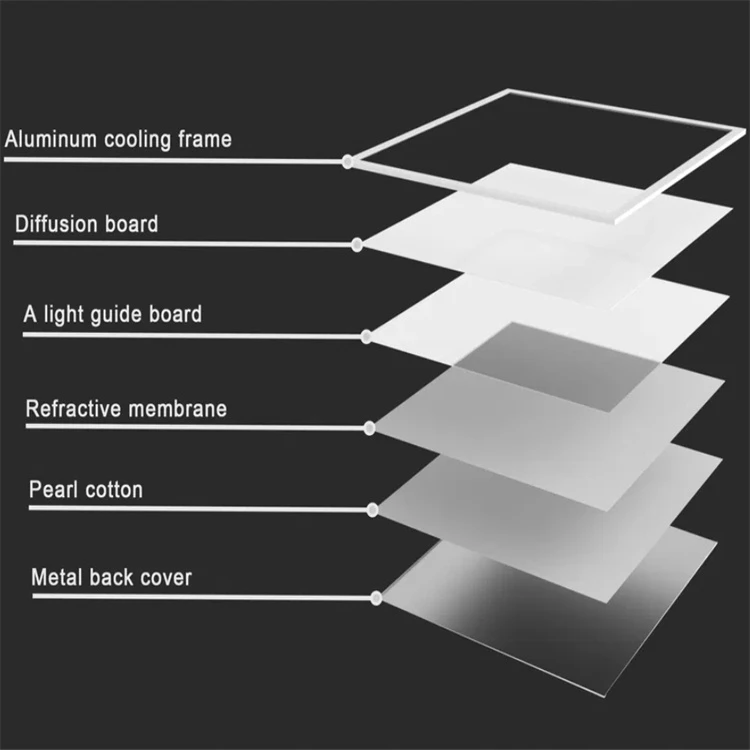
At the foundational level, the fixture is protected by a robust Metal Back Cover. This back cover provides structural rigidity, preventing the panel from warping or flexing over time. Behind this metal cover lies a layer of Pearl Cotton. This material serves a dual purpose: it acts as a shock absorber during transportation and installation, and more importantly, it acts as a secondary thermal insulator and light reflector, preventing light leakage and ensuring maximum luminous efficacy.
The core of the optical engine consists of the Refractive Membrane and the Light Guide Board. The refractive membrane is a highly specialized optical film designed to break up the concentrated light emitted by the LED chips. It redirects the light laterally into the light guide board. The light guide board then utilizes total internal reflection to distribute the light evenly across the entire surface of the panel. Without these two layers, a backlit LED panel would simply look like a series of bright dots, rather than a uniform, continuous sheet of light.
Above the light guide board sits the Diffusion Board. This layer is responsible for softening the light, eliminating any remaining hotspots, and delivering a gentle, glare-free illumination to the room. Finally, the entire sandwich of optical layers is encased in an Aluminum Cooling Frame. This frame is the unsung hero of the fixture. By acting as a massive heatsink, it draws thermal energy away from the LEDs. Because LEDs are highly sensitive to heat, this thermal management ensures that the light output remains stable (minimizing lumen depreciation) and the color rendering remains accurate (maintaining Ra>80) throughout the fixture's long lifetime. The combination of these layers-metal back cover, pearl cotton, refractive membrane, light guide board, diffusion board, and aluminum frame-constitutes the DNA of a true commercial-grade fixture. It is a system where every component supports the others to deliver flawless performance.
Section Four: Operational Efficiency and Total Cost of Ownership
Commercial-grade backlit panels dramatically lower TCO across all these vectors. While the upfront cost might be slightly higher than inferior alternatives, the operational savings quickly offset this difference. The 120lm/W efficiency ensures a direct reduction in utility bills. The long lifetime-driven by the aluminum cooling frame and minimized lumen depreciation-means that maintenance crews spend less time replacing fixtures. In a subway system, avoiding a single platform closure for lighting maintenance can save thousands of dollars in labor and operational disruption. In a supermarket, reducing energy consumption directly improves the bottom line, allowing the business to invest in inventory or marketing.
Furthermore, the environmental impact cannot be overlooked. As global regulations tighten around carbon emissions and energy efficiency, businesses are under increasing pressure to adopt sustainable practices. High-efficiency, long-lasting LED panels are a direct contributor to a reduced carbon footprint. They contain no hazardous materials like mercury (unlike fluorescent tubes), making their eventual disposal safer and more environmentally friendly. By standardizing on commercial-grade backlit panels, enterprises demonstrate a commitment to both fiscal responsibility and environmental stewardship.
Conclusion: The Inevitable Choice for High-Stakes Environments
The phrase "industry standard" is often overused, but in this context, it is entirely justified. The multi-layered architecture-featuring aluminum cooling frames, light guide boards, refractive membranes, and precision circular lenses-represents the pinnacle of modern lighting design. It is a standard defined by a refusal to compromise on longevity, optical integrity, and energy efficiency.
For decision-makers in commercial infrastructure and retail, the choice is clear. Inferior lighting is a liability that costs money, damages brand perception, and compromises safety. Upgrading to commercial-grade backlit panels is an investment in operational excellence. It is a commitment to providing a superior environment for commuters, a more compelling shopping experience for consumers, and a healthier bottom line for the business. As our cities and commercial centers continue to evolve, the illumination that powers them must evolve alongside them. The commercial-grade backlit panel is not just a light fixture; it is the gold standard for illuminating the spaces where modern life happens.

How To Cooperate With Us?
We are happy to have total control over the manufacturing process and the calibre of our products since we have our own facilities. Since we are producers rather than just brokers, we are dedicated to providing our customers with the best pricing. Since we are certain that the price and quality of our products are clear, we invite customers to see our samples first. Our commitment to quality and customer satisfaction drives us to continuously provide top-notch goods.
Our address
3rd Floor, 5th Building, Hebei Industrial Park, Hualian Community, Longhua District, Shenzhen, China





